CJP protesters hold talks with government after march to Parliament stalled
CJP protesters hold talks with government after march to Parliament stalled.
- Core Development: CJP protesters hold talks with government after march to Parliament stalled.
- Beat Context: Categorized under News with independent corroboration.
- Reporting Depth: 5 minute analytical read synthesized from verified newsroom sources.
the CJP has taken a step towards taking the matter to the centre ... The party has halted its march to the Parliament after it was . The Cockroach Janta Party (CJP) demanded an independent probe into “the paper leak of NEET‑UG on 10 July 2026”. The outlet said it was “disappointed with the Environment Ministry’s stance”.
In earlier updates, both the Union Education Minister and CJP met in talks in Delhi. Both parties were reported to have agreed on the demand for an independent panel to investigate the alleged papers. The political party also announced the proposed “Chalo Sansad” march. The protestors were not permitted to march and the authorities said they would intervene if they proceed.
Media additions
In ongoing developments, the crowd has gathered massively at the Jantar Mantar on Monday, 20 July 2026 but the protest march has yet to commence. The upon the “Chalo Sansad” march is raising increased concerns among authorities. The Indian govt have restrained the crowd from marching towards the Parliament. However, the CJP has affirmed no lapse on their part in the “Putting #Unscalable”.
Nothing has stopped the march, through the crowd “It’s 11:52 AM. Ashutosh Ranka and I, on behalf of the Cockroach Janta Party, are on our way to meet J.P. Nadda. The government had reached out for talks in the morning. Our demands are clear. The youth has gathered in huge numbers. We shall win!”. Saurav Das said in an interview on X.. The police, had already taken a few party members to the Deputy commissioner office and while the ‘talks’ were ongoing. The party didn’t get permission from Delhi Police for the march in the first place. “All subject to approval of the Security Agencies”, the CJP said.
“Both the parties have yet to discuss on any terms for accusations from the apart”. This has left the crowd l to be relocated “in the report. The crowd was asked to remain at the site in spite of heavy rain in the city but was allowed for Pictures. The CJP’s newly acquired opposition has yet to finalised the media.
In the midst of the standoff, Sonam Wangchuk, a well‑known climate activist from Ladakh, continued his indefinite hunger strike at Safdarjung Hospital. Three student activists—Neha, Manish and Aameen—ended their 23‑day fast after a parliamentary appeal. Wangchuk’s wife, Dr Gitanjali Angmo, filed an appeal in the Delhi High Court against a single judge’s order that denied her request to transfer her husband to a private hospital.
The Cockroach Janta Party emerged in mid‑May after a comment by the Chief Justice of India that some unemployed young people were likening themselves to “cockroaches”. The movement started as a satirical online campaign but quickly grew into a street protest demanding accountability over the NEET‑UG paper leak. Its founder, Abhijeet Dipke, a graduate student at Boston University, said the idea was born after seeing the comment and that the group had no intention of becoming a political party.
The protest site at Jantar Mantar has been occupied for over a month. The area is surrounded by yellow metal barricades erected by Delhi police. The crowd includes students, young professionals and activists. The site has a memorial wall with photographs of students who have died after the NEET‑UG exam was cancelled. Police said around 8,000 protesters were present.
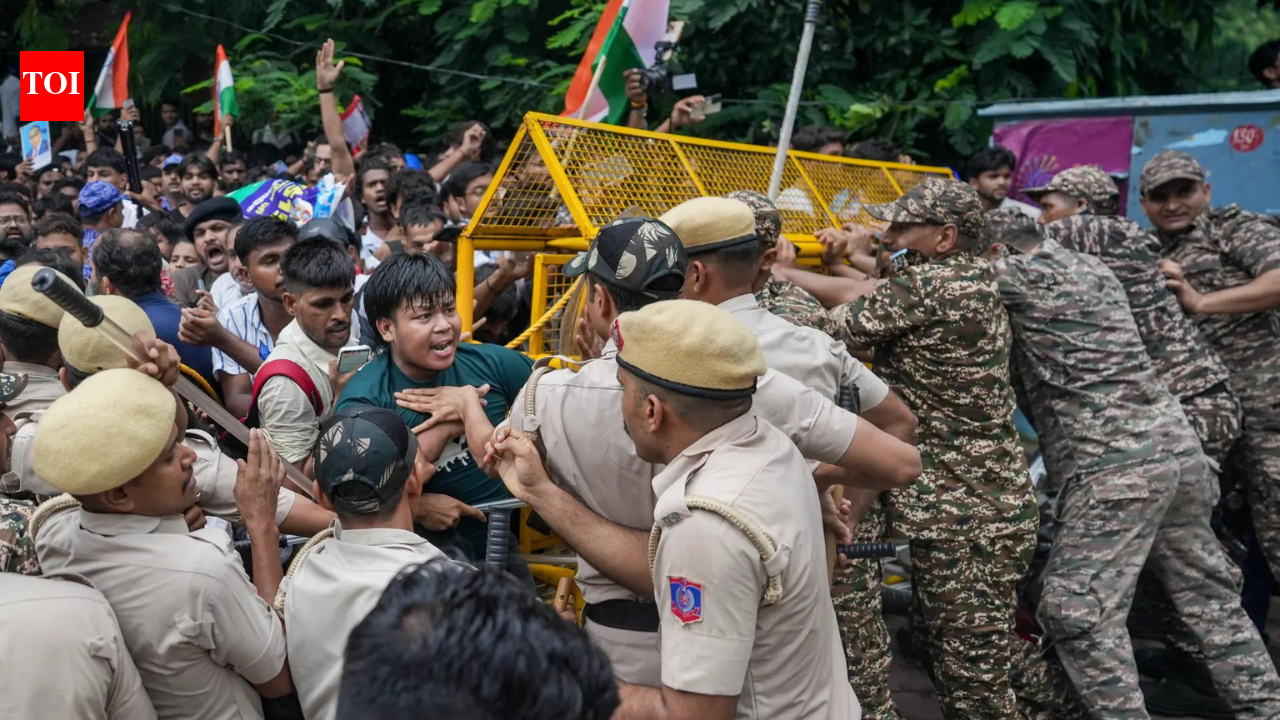
Delhi police denied the CJP a permit for a march to Parliament and deployed a riot‑control vehicle early on Monday. Police also used a mild lathi charge to disperse protesters attempting to move from Mandi House toward the Parliament building. Water cannons were kept on standby and barricades were erected on Tolstoy Marg, one of the main entry points to the protest site. The police said no permission had been sought or granted for the march.
The Delhi Metro Rail Corporation temporarily closed several stations in central Delhi to prevent crowds from reaching the protest site. Janpath, Rajiv Chowk, Patel Chowk and Seva Teerth were shut. The DMRC later reopened the interchange facilities and gates at Rajiv Chowk and Central Secretariat, while Janpath and the other stations remained closed until further notice.
Sonam Wangchuk, a climate activist from Ladakh, began an indefinite hunger strike at Safdarjung Hospital. He said he would end the fast if the government accepted responsibility for the NEET paper leak or if the CJP leadership were allowed to meet MPs at Parliament and be assured that the issue would be raised in the Monsoon Session. Three student activists ended their 23‑day fast after a parliamentary appeal.
Wangchuk’s wife, Dr Gitanjali Angmo, filed an appeal in the Delhi High Court against a single‑judge order that refused to transfer her husband to a private hospital. The appeal claims the order deprives Wangchuk of the right to choose his medical treatment and violates his rights to informed consent and bodily autonomy under Article 21. The court was asked to schedule an urgent hearing.
The protest has attracted support from a range of public figures. Actors Prakash Raj and Shabana Azmi, MP Mahua Moitra and AAP leaders Atishi, Sanjay Singh and Manish Sisodia joined the march. AAP leader Gopal Rai said the movement represented the concerns of youth across the country. The protest also drew national attention from the media and social networks.
CJP spokesperson Saurav Das confirmed that talks with the government were underway after the police had taken him to the deputy commissioner’s office. The party has not yet received a clear response from the administration. The Delhi Police reiterated that prohibitory orders under Section 163 of the BNSS remain in force and that no permission had been granted for the march.
Observers will watch for the outcome of the High Court appeal, the response of the Ministry of Education, and the stance of Parliament during the Monsoon Session that begins on Monday. The future of the protest depends on whether the government can offer assurances that the NEET‑UG paper leak will be investigated and whether the CJP can secure a meeting with MPs to discuss education reforms.
How significant is this development?
Contribute your assessment to the aggregated reader sentiment ledger.
Frequently Asked Questions
Key questions answered in this reportWhat is the key development in: CJP protesters hold talks with government after march to Parliament stalled?
CJP protesters hold talks with government after march to Parliament stalled.
Why is this News development significant for the UK?
This report covers critical events in our News beat. Independent reporting monitors related UK statements, regulatory shifts, and public responses as further verified details emerge.
How was this reporting corroborated and verified?
Newsarchy UK compiles and cross-references reporting from primary reporting from hindustantimes.com and cross-checked wire reports. All coverage adheres to published editorial standards.
When was this report published?
This briefing was published on July 20, 2026 and is permanently cataloged in the Newsarchy UK News archives.