Physician appointment wait times hit 31 days as shortages deepen
The average wait for a new-patient appointment has risen to 31 days, a 19% increase since 2022. The report highlights how workforce constraints and insurance acceptance impact patient access to care.
- Core Development: The average wait for a new-patient appointment has risen to 31 days, a 19% increase since 2022. The report highlights how workforce constraints and insurance acceptance impact patient access to care.
- Beat Context: Categorized under NHS with independent corroboration.
- Reporting Depth: 3 minute analytical read synthesized from verified newsroom sources.
Why the 31‑day figure matters now
The AMN Healthcare survey of 1,391 medical offices in 15 major metropolitan areas shows the average wait for a new‑patient appointment has risen to 31 days. That represents a 19 % increase since the survey was last run in 2022 and a 48 % increase since the first wave in 2004.
Leah Grant, president of AMN Healthcare’s Physician Solutions division, called the trend “a sobering sign for the rest of the country when even patients in large cities must wait weeks to see a physician.”
Media additions
How the numbers stack up across specialties and cities
The report broke the average down by six specialties—cardiology, dermatology, obstetrics‑gynecology, orthopedic surgery, family medicine and gastroenterology. Overall, the average across all specialties is 31 days, but the spread is wide.
- In Portland, a dermatology appointment could be anywhere from one to 291 days.
- In Boston, an obstetrics‑gynecology slot ranged from one to 231 days.
- Boston posted the longest average wait across all specialties at 65 days.
- Atlanta had the shortest at 12 days.
All 15 metros were chosen because they have “some of the highest physician‑to‑population ratios in the country,” according to the Advisory Board report, suggesting that even well‑staffed markets are feeling the squeeze.
Insurance acceptance adds another layer of complexity
AMN also tracked payer mix. Overall, 82 % of surveyed offices accepted Medicare, but only 53 % took Medicaid. Acceptance varied sharply by city: Boston led with 94 % Medicare acceptance while Atlanta lagged at 68 %. On the Medicaid side, Detroit topped the list at 85 % and New York fell to 28 %.
“An additional barrier [to accessing care] may be the type of insurance physicians accept,” AMN wrote. “If a physician does not accept a patient's form of insurance, the patient will have to find a physician who does, or seek care at a community health center or hospital emergency department, or forego care altogether.”
What practice leaders are saying
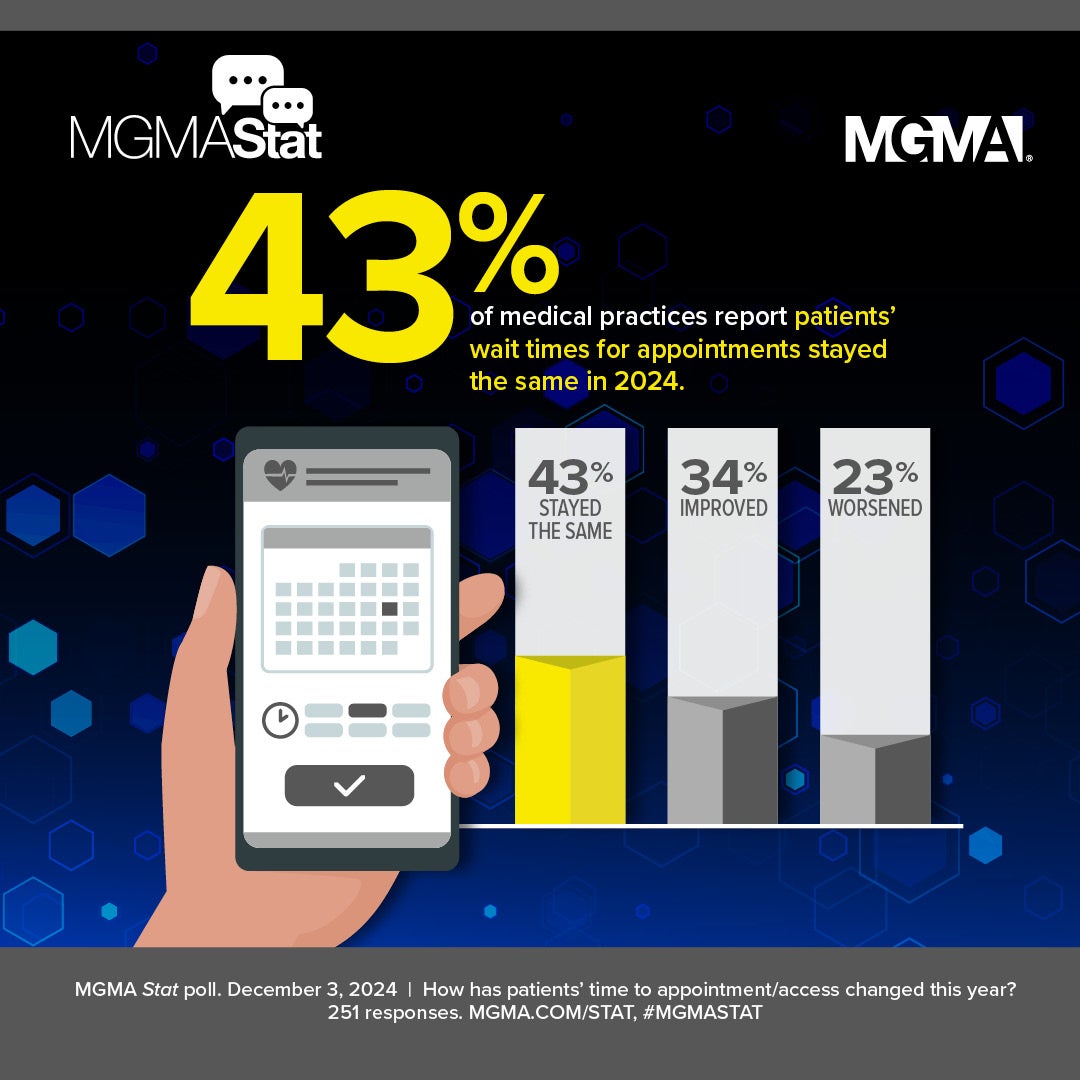
The Mgma Stat poll of December 3, 2024, at 251 respondents, found that 77 % of practice leaders reported their organization’s wait times either improved (34 %) or stayed the same (43 %). The remaining 23 % said wait times worsened.
Leaders who noted improvement pointed to better clinician hiring and upgraded scheduling systems. Those holding wait times steady cited satellite clinics and expanded clinician hours. The group reporting deterioration blamed clinician resignations, retirements, difficulty recruiting replacements and higher patient demand. Late arrivals and no‑shows were also mentioned as contributors to open slots that could not be filled.
Comparing the 2024 poll with the November 2023 poll shows a shift: in 2023, less than one in four groups reported improvement, while 38 % said access worsened or stayed the same. The 2024 results suggest a modest rebound, but the underlying shortage narrative remains.
Expert commentary on the broader shortage
Laurie Norman, senior director at Optum Advisory, described the climb in wait times as “physician appointment wait times continue to rise due to growing demand and workforce constraints, highlighting the urgent need for systemwide innovation in access and scheduling.” She added that “enabling physicians and advanced practice clinicians to work at the top of their license is a critical strategy to expand capacity, reduce delays, and ensure timely, high‑quality care.”
Mahaya Walker, a research consultant at Advisory Board, warned that “AMN’s 2025 Survey of Physician Appointment Wait times highlights that despite patient access being a top priority for provider organizations across the country, we have not been able to move the dial on appointment wait times.” She noted that without expanding the definition of access, “we will continue to see minimal, or even reverse, progress on appointment wait times.”
Context from national physician‑supply projections
Both the Association of American Medical Colleges and the Health Resources and Services Administration have issued projections that line up with the wait‑time data. The AAMC’s 2024 report estimated a potential shortage of up to 86,000 physicians by 2036. The HRSA projected a shortfall of 57,259 full‑time‑equivalent physicians for the current year and 81,180 by 2035.
Drivers cited include population growth, an aging patient base, an aging physician workforce, limited training capacity, burnout and geographic maldistribution. The AMN data, which captures real‑world appointment access, serves as a tangible symptom of those broader trends.
How significant is this development?
Contribute your assessment to the aggregated reader sentiment ledger.
Frequently Asked Questions
Key questions answered in this reportWhat is the key development in: Physician appointment wait times hit 31 days as shortages deepen?
The average wait for a new-patient appointment has risen to 31 days, a 19% increase since 2022. The report highlights how workforce constraints and insurance acceptance impact patient access to care.
Why is this NHS development significant for the UK?
This report covers critical events in our NHS beat. Independent reporting monitors related UK statements, regulatory shifts, and public responses as further verified details emerge.
How was this reporting corroborated and verified?
Newsarchy UK compiles and cross-references reporting from primary reporting from finance.yahoo.com and cross-checked wire reports. All coverage adheres to published editorial standards.
When was this report published?
This briefing was published on July 2, 2026 and is permanently cataloged in the Newsarchy UK NHS archives.