Indonesia earthquake leaves 53 dead and forces thousands to evacuate
A powerful shallow earthquake struck eastern Indonesia's Flores island, killing at least 53 people, injuring over 130, and forcing thousands into evacuation camps amid severe infrastructural damage.
- Core Development: A powerful shallow earthquake struck eastern Indonesia's Flores island, killing at least 53 people, injuring over 130, and forcing thousands into evacuation camps amid severe infrastructural damage.
- Beat Context: Categorized under World with independent corroboration.
- Reporting Depth: 4 minute analytical read synthesized from verified newsroom sources.
A powerful shallow earthquake struck eastern Indonesia on Sunday, 16 August 2026, leaving at least 53 people dead and forcing thousands to flee their homes as blocked roads and landslides hampered emergency response efforts. The magnitude-7.7 tremor hit just off the north coast of Flores island, triggering panic and reviving painful memories of a historic disaster in the region more than three decades ago.
Authorities reported that more than 130 individuals sustained injuries, with many suffering from broken bones. In the Sikka region alone, over 3,300 residents either self-evacuated or sought refuge in designated sports arenas, according to the national disaster mitigation agency BNPB. Across the wider affected zone, roughly 5,000 people were displaced, crowding into temporary shelters, hillside camps, and sports stadiums.
Survivors described harrowing escapes as the initial tremor struck. Residents reported that the sea retreated immediately following the quake, prompting widespread fear of an incoming tsunami and sending panicked crowds running for higher ground. While authorities later lifted the tsunami warning, waves of up to 1.6 metres were recorded in certain coastal areas by Indonesia's BMKG geological agency.
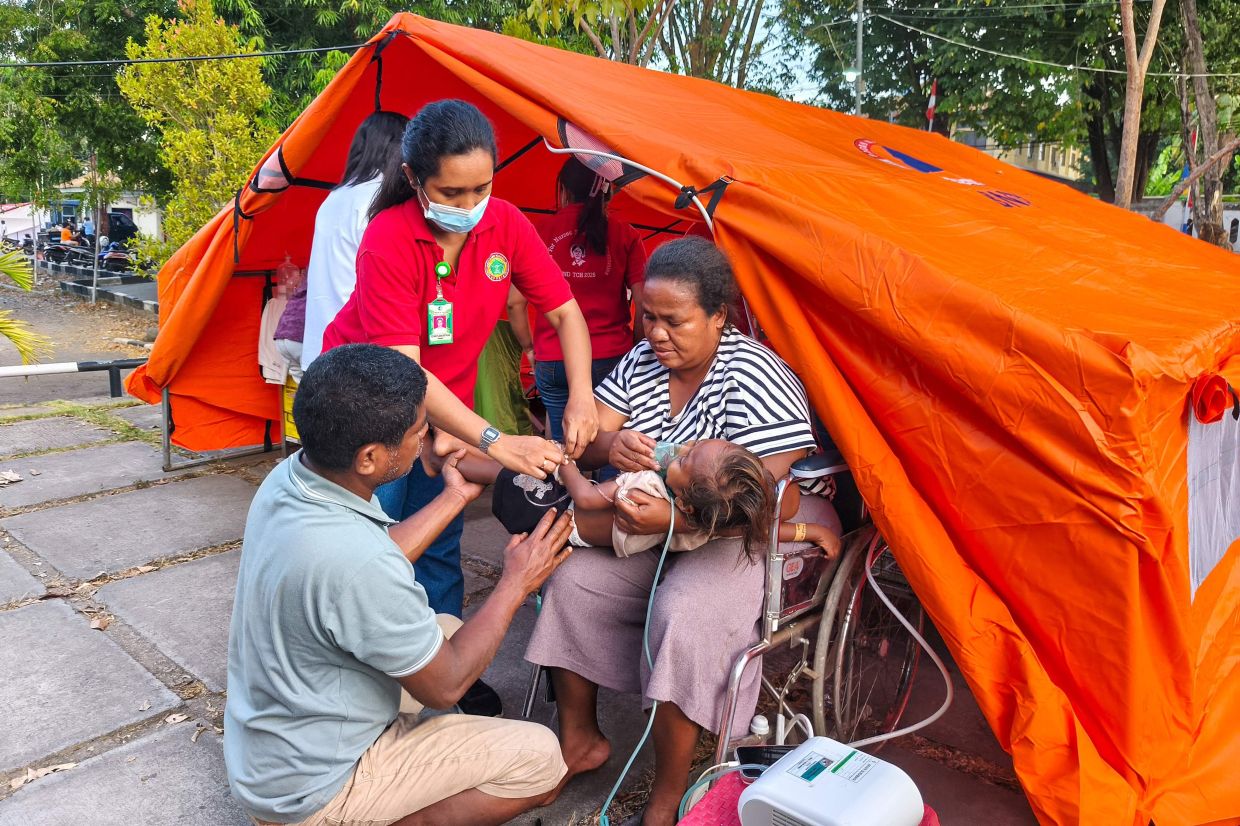
Families huddled in makeshift conditions while waiting for assistance. Some Sikka residents found themselves stranded outside collapsed homes under a makeshift tent made out of tarp, while others received treatment in a tent outside a hospital in the port town of Maumere. Abdul Mutas, aged 63, recounted his escape after he and his family slept on a tarp surrounded by trees in the town of Sikka, stating that he only brought his body and ran because the tides were rising. Local officials observed similar scenes across the territory. Simon Subandi, deputy regent of Sikka, described the widespread reluctance to remain indoors to news channel KompasTV, noting that almost all of Sikka's residents did not dare stay indoors, so they slept on a porch or a tent outside.
The disaster left communities grappling with severe infrastructural damage. According to regional officials, hundreds of houses were severely damaged alongside dozens of public facilities, including educational institutions, health clinics, and government offices. Parts of the affected territory lost electricity and telecommunications connections, leaving critical emergency routes blocked. State utility firm Perusahaan Listrik Negara noted that while the power supply was nearly fully restored, workers continued fixing distribution lines.
Relief operations faced steep logistical hurdles. Search teams deployed heavy equipment to clear rubble and mudslides in hard-hit areas such as Manggarai, East Manggarai, and Nagekeo. Officials stated that rescue personnel were concentrating fully on combing through debris for anyone potentially trapped, though local search and rescue official Fathur Rahman confirmed that no official missing person reports had been logged.
The central government responded by dispatching massive aid shipments, while regional authorities in East Nusa Tenggara moved to establish a 14-day emergency response status to expedite resource mobilization. Cabinet Secretary Teddy Indra Wijaya stated that more than 3,500 military and police officers had been deployed to the region. International assistance also began to mobilize, with the International Federation of Red Cross and Red Crescent Societies preparing shelter supplies and European Union leadership offering satellite observation support, prompting European chief Ursula von der Leyen to state that Europe stood ready to deploy Copernicus satellites to support search and rescue operations.
Geological experts pointed to the region's precarious tectonic setting. The tremor originated along the Flores back-arc thrust fault, a major system of west-east thrust faults, as noted by geology expert Dwikorita Karnawati. Indonesia as a whole sits atop the Pacific Ring of Fire, a hyper-active seismic arc prone to frequent earthquakes and volcanic activity.
For many survivors, the catastrophe stirred deep psychological scars. Residents openly drew comparisons to the devastating 1992 earthquake and tsunami that struck Flores and claimed thousands of lives. Margaretha Movaldes Da Maga Bapa, head of the region's disaster mitigation agency, noted that despite Indonesia's frequent seismic events, the sheer intensity of the latest tremor forcefully resurrected trauma from decades past. Evacuees like Nurhidayati echoed those sentiments from hilltop camps, expressing ongoing terror and trauma stemming from the historical disaster.
Authorities have urged all displaced residents to remain outside damaged structures, warning that relentless aftershocks—numbering nearly 1,000—continue to threaten weakened buildings.
What to watch next
- Local authorities are processing formal emergency response decrees to maintain mobilized funding and resources across the disaster zone.
- Search and rescue teams continue clearing blocked access roads and combing through rubble in isolated districts.
- Distribution logistics for emergency tents, clean water, medicines, and food remain the immediate priority for incoming aid packages.
How significant is this development?
Contribute your assessment to the aggregated reader sentiment ledger.
Frequently Asked Questions
Key questions answered in this reportWhat is the key development in: Indonesia earthquake leaves 53 dead and forces thousands to evacuate?
A powerful shallow earthquake struck eastern Indonesia's Flores island, killing at least 53 people, injuring over 130, and forcing thousands into evacuation camps amid severe infrastructural damage.
Why is this World development significant for the UK?
This report covers critical events in our World beat. Independent reporting monitors related UK statements, regulatory shifts, and public responses as further verified details emerge.
How was this reporting corroborated and verified?
Newsarchy UK compiles and cross-references reporting from primary reporting from thestar.com.my and cross-checked wire reports. All coverage adheres to published editorial standards.
When was this report published?
This briefing was published on August 16, 2026 and is permanently cataloged in the Newsarchy UK World archives.