Japan quake death toll climbs to 13 as rescuers hunt for trapped
A magnitude-7.1 earthquake struck Kumamoto prefecture in Japan, causing significant damage, collapses, and a massive rescue effort for the missing.

- Core Development: A magnitude-7.1 earthquake struck Kumamoto prefecture in Japan, causing significant damage, collapses, and a massive rescue effort for the missing.
- Beat Context: Categorized under World with independent corroboration.
- Reporting Depth: 4 minute analytical read synthesized from verified newsroom sources.
On Tuesday, a magnitude-7.1 earthquake struck Kumamoto prefecture on Japan’s southern main island of Kyushu. The tremor hit at a shallow depth of six miles, with its epicentre situated about twelve miles south of Kumamoto city, which has roughly 700,000 residents. The violent shaking registered at Shindo level 7—the highest possible intensity on Japan’s domestic scale. A brief tsunami warning followed the tremor, though it was lifted within minutes, but the resulting structural failures have left widespread devastation across the region.
The most visible collapse occurred at the Aeon Mall in Kashima town, where dashboard camera footage captured the side of the building exploding outward. Prime Minister Sanae Takaichi confirmed that three people died in the mall collapse, including two women in their twenties. Kumamoto Prefecture Public Relations official Akino Sonoda stated that eight people were pulled from the rubble, five of whom sustained injuries that were not life-threatening. Between 20 and 30 mall workers were initially unaccounted for, and mall operators are investigating whether a gas leak triggered the blast. A senior government official reported that the main gas valve had been shut off as police, firefighters, and Self-Defense Forces conducted coordinated searches.
Media additions
Severe casualties also occurred at the Nippon Paper Industries plant in Yatsushiro, where the tip of a chimney collapsed. According to national broadcaster NHK, two additional individuals were found in a state of "cardiac arrest"—a term in Japan that indicates no signs of life remain, though deaths have not yet been officially confirmed. Local authorities reported that eleven people were trapped at the plant, with nine remaining missing. At least 18 houses collapsed in the town of Hikawa, where residents were reportedly trapped in two of the destroyed homes.
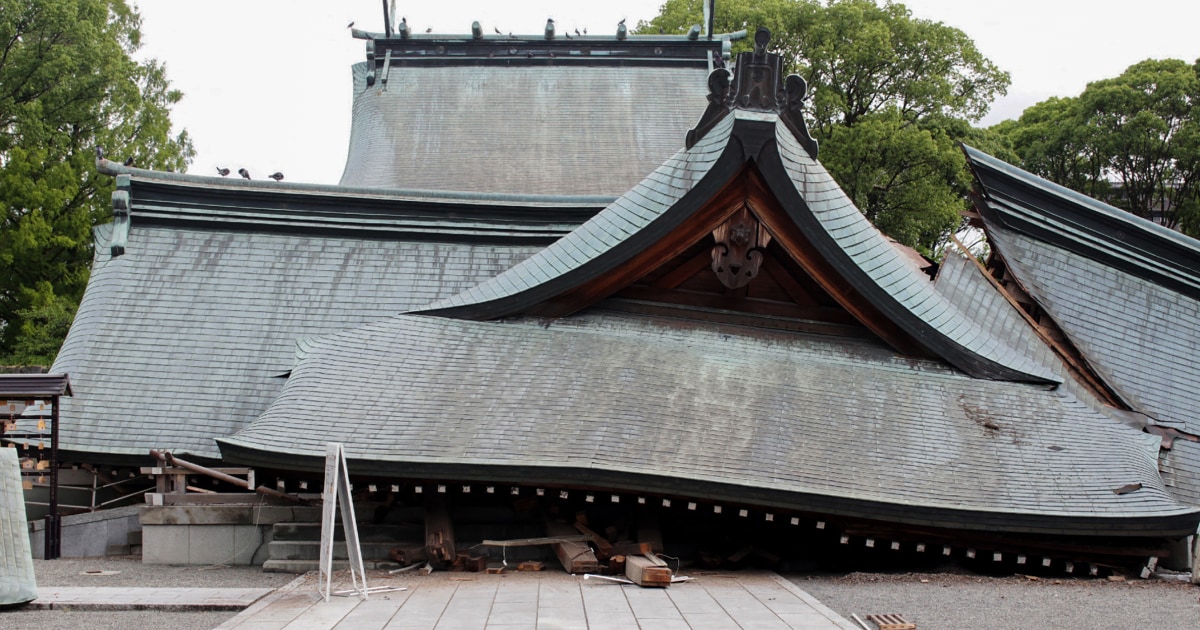
Historic landmarks sustained heavy damage. Parts of the exterior walls of the 400-year-old Kumamoto Castle crumbled, and stone walls at the Yatsushiro Shrine were toppled. Transport networks suffered immediate disruption: a freight train derailed and overturned at Yatsushiro station, the Kyushu Expressway was partly ripped up near the Yatsushiro Interchange, and all Shinkansen bullet train services and local rail operations across Kyushu were suspended for safety checks. Aso Kumamoto Airport closed its runway with no prospect of immediate resumption, while the Defense Ministry deployed aircraft to assess the damage.
Power infrastructure was severely hit. Kyushu Electric Power reported that 35,000 households remained without electricity, while overall figures cited 36,700 residences in the dark. The government maintained approximately 450 evacuation centres, supplying food, water, air-conditioning, and generators. Government spokesman Minoru Kihara stated that 9,186 people had sought refuge in 506 evacuation centres across five prefectures, while Kumamoto prefecture alone recorded 9,872 evacuees.
Rescue operations mobilized a substantial force, with 4,600 personnel deployed, including roughly 2,000 police officers and about 1,000 firefighters, alongside military forces and specialist units such as the Tokyo Metropolitan Police Department's Special Rescue Team and Aviation Unit. Hospitals faced immense strain, with two facilities taking in at least 50 injured patients each. Saiseikai Kumamoto Hospital, a 400-bed facility, reached full capacity and suspended pre-scheduled hospitalizations due to an influx of burns and fractures, compounded by water leaks and electrical system failures inside the building. Education and public life ground to a halt as more than 175 schools and community centres closed, with several repurposed alongside sports venues and public parks as evacuation sites.
Temperatures in Kumamoto reached 35C, prompting health warnings over heatstroke as emergency crews worked through sweltering conditions alongside constant aftershocks. Prime Minister Takaichi, speaking in Tokyo, emphasized the gravity of the ongoing mission.
she told reporters, adding that the death toll stood at 13. Akio Yoshida, the president of Aeon, was scheduled to address the situation at a press conference at 16:30 Japan Standard Time."Even now, there are people waiting to be rescued, and this is a race against time. We will marshal all available resources on the ground to save and rescue as many people as possible,"
Prime Minister Sanae Takaichi, via NBC News
Looking ahead, Japan's meteorological agency warned residents to remain vigilant against potential aftershocks reaching a maximum seismic intensity of 7 over the following week, particularly across the next two to three days. Meanwhile, the International Atomic Energy Agency confirmed that the Sendai nuclear power plant sustained no damage and that nuclear authorities would continue monitoring the site. As rescue teams sift through debris, recovery efforts hinge on weather conditions, power restoration, and the ongoing search for dozens of missing individuals.
How significant is this development?
Contribute your assessment to the aggregated reader sentiment ledger.
Frequently Asked Questions
Key questions answered in this reportWhat is the key development in: Japan quake death toll climbs to 13 as rescuers hunt for trapped?
A magnitude-7.1 earthquake struck Kumamoto prefecture in Japan, causing significant damage, collapses, and a massive rescue effort for the missing.
Why is this World development significant for the UK?
This report covers critical events in our World beat. Independent reporting monitors related UK statements, regulatory shifts, and public responses as further verified details emerge.
How was this reporting corroborated and verified?
Newsarchy UK compiles and cross-references reporting from primary reporting from nbcnews.com and cross-checked wire reports. All coverage adheres to published editorial standards.
When was this report published?
This briefing was published on July 29, 2026 and is permanently cataloged in the Newsarchy UK World archives.