Trump’s Helicopter Was Briefly Too Close To Commercial Jet On Tuesday, FAA Says
Federal aviation officials opened a safety review following a momentary loss of separation between Marine One and a commercial jet near Reagan National Airport.
- Core Development: Federal aviation officials opened a safety review following a momentary loss of separation between Marine One and a commercial jet near Reagan National Airport.
- Beat Context: Categorized under World with independent corroboration.
- Reporting Depth: 3 minute analytical read synthesized from verified newsroom sources.
Federal aviation officials opened a safety review following a momentary loss of separation that placed President Donald Trump’s Marine One close to a passenger jet departing Ronald Reagan Washington National Airport. The incident revives intense scrutiny of the tightly regulated airspace around the nation’s capital, a zone still haunted by a mid-air collision in January 2025 between an Army Black Hawk helicopter and an American Airlines regional jet that claimed 67 lives. That tragedy remains the deadliest U.S. Air disaster since November 2001 and was preceded by several near misses and safety incidents near the airport.
The Federal Aviation Administration confirmed that air-traffic controllers were in contact with both aircraft when the breach occurred on Tuesday afternoon, but stressed that the president was never in danger. The agency’s preliminary findings could prompt a formal probe, according to National Transportation Safety Board Chair Jennifer Homendy, who stated that the agency is considering opening an investigation while specialists collect and review additional information.
Media additions
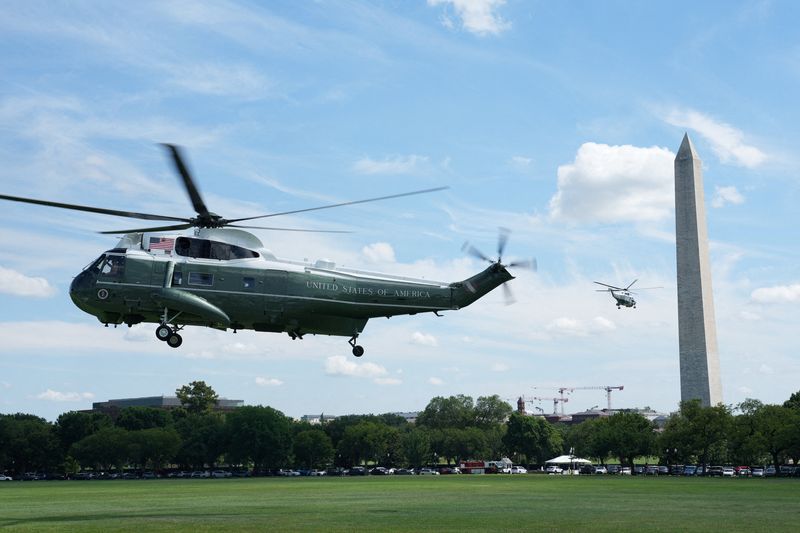
What happened, step by step
- 2:33 p.m. EDT (1833 GMT) on Tuesday – Marine One lifts off from the Ellipse near the White House on his way to Joint Base Andrews for a trip to Los Angeles, according to a pool report.
- 2:34 p.m. – Envoy Air 3742, a regional E170 jet bound for Pensacola, Florida, departed and was involved in the incident with Marine One, according to a source told Reuters. Envoy is a wholly owned subsidiary of American Airlines, which did not immediately comment on the incident.
- FAA rules require aircraft to remain separated by at least 1.5 miles horizontally and 500 feet vertically around airports.
- The air traffic controller was in communication with both the commercial pilot and the Marine One pilot during the loss of separation.
- A second regional flight, Republic 4700, was 3 miles (5 km) from Reagan during the incident and was rerouted out of caution, according to the other source. That Republic Embraer 175 operating on behalf of American had departed from Raleigh-Durham and looped around the airport before landing at 2:52 p.m., according to FlightAware.
The FAA’s statement, first reported by the Wall Street Journal, notes that the loss of separation was brief and that the aircraft continued to move away from one another.
"Based on our preliminary safety review, there was momentary loss of separation after which the aircraft continued to move away from one another,"
FAA, via Reuters
The incident unfolded under a set of rules sharpened after the January 2025 Potomac River crash. That disaster prompted the FAA to bar mixed helicopter and jet traffic around the airport and enact permanent restrictions on helicopter operations. In March, the FAA also barred the use of visual separation to handle helicopter traffic near major airports. Furthermore, standard procedures dictate that air traffic control is usually given at least three minutes of advance notice before Marine One departs from near the White House to ensure a halt in traffic around Reagan. However, two sources told Reuters that air-traffic controllers had not halted commercial flights at Reagan National as required under the policy set last year following the collision.
Expert and official reactions
Jennifer Homendy, chair of the National Transportation Safety Board, told Reuters on Wednesday that the agency is considering opening an investigation. Air traffic control specialists are reviewing existing and incoming data to determine whether to investigate, according to Homendy. Two sources told Reuters that the FAA is planning to convene a safety review team into the incident.
What to watch next
- Potential formal NTSB investigation, dependent on findings from the FAA’s ongoing data collection and safety review team.
- Further evaluations by aviation authorities regarding adherence to post-2025 traffic halting procedures for presidential helicopter departures.
The incident underscores that even brief moments of reduced separation in heavily monitored airspace can trigger a cascade of regulatory scrutiny and revive concerns over regional aviation safety.
How significant is this development?
Contribute your assessment to the aggregated reader sentiment ledger.
Frequently Asked Questions
Key questions answered in this reportWhat is the key development in: Trump’s Helicopter Was Briefly Too Close To Commercial Jet On Tuesday, FAA Says?
Federal aviation officials opened a safety review following a momentary loss of separation between Marine One and a commercial jet near Reagan National Airport.
Why is this World development significant for the UK?
This report covers critical events in our World beat. Independent reporting monitors related UK statements, regulatory shifts, and public responses as further verified details emerge.
How was this reporting corroborated and verified?
Newsarchy UK compiles and cross-references reporting from primary reporting from aol.com and cross-checked wire reports. All coverage adheres to published editorial standards.
When was this report published?
This briefing was published on August 6, 2026 and is permanently cataloged in the Newsarchy UK World archives.