MIA flight disruptions continue following fatal Amazon cargo plane crash
Flight operations at Miami International Airport remain severely disrupted following a fatal Amazon cargo jet accident that killed five people and injured five others.

- Core Development: Flight operations at Miami International Airport remain severely disrupted following a fatal Amazon cargo jet accident that killed five people and injured five others.
- Beat Context: Categorized under Business with independent corroboration.
- Reporting Depth: 4 minute analytical read synthesized from verified newsroom sources.
Flight operations at Miami International Airport remain severely disrupted following a fatal accident involving an Amazon cargo jet that careened off a runway and plowed into nearby vehicles, killing five people and injuring five others.
The disaster unfolded when a Boeing 767 cargo aircraft operating as Prime Air Flight 7598 arrived from Luis Muñoz Marín International Airport in San Juan, Puerto Rico. According to the Federal Aviation Administration, the plane overran the tarmac and plowed across a roadway utilized by warehouse workers and surrounding businesses. The impact triggered a complex engine compartment fire and a substantial fuel leak, requiring around two hundred emergency personnel and sixty response units from Miami-Dade Fire Rescue to tackle the blaze and secure the area.
Media additions


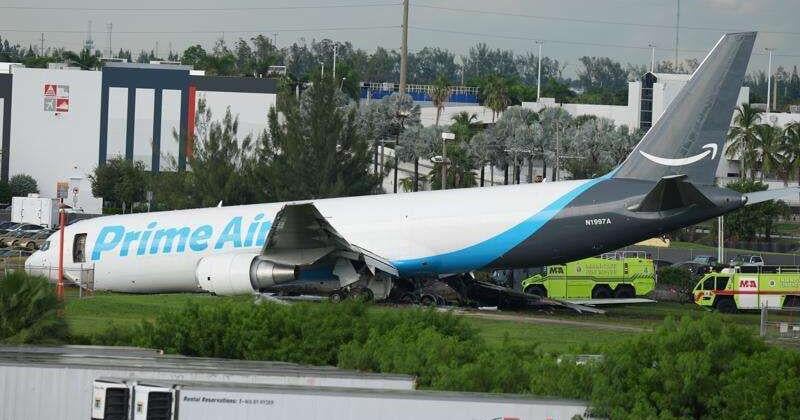
Emergency responders arrived to find heavy flames and thick black smoke billowing into the sky. Miami-Dade Fire Rescue Chief Ray Jadallah reported that firefighters had to extricate the pilot and copilot from the cockpit, rescue trapped occupants from damaged cars, and free a person pinned underneath a vehicle. Miami-Dade Sheriff Rosie Cordero-Stutz confirmed the five fatalities during a press conference, while authorities noted that three of the five injured individuals were listed in critical condition.
The operational fallout across the travel hub was immediate. The FAA issued a ground stop shortly after the accident, shutting down all runways for hours. Although airport officials gradually restored operations by reopening two of the four available runways, the lingering effects hobbled schedules. According to FlightAware tracking data cited across multiple reports, hundreds of flights faced heavy delays or outright cancellations, while other incoming aircraft were diverted over two hundred miles north to Orlando.
As transportation officials grapple with the immediate aftermath, broader questions regarding aviation infrastructure have come to the fore. Aviation safety analysts and legal experts have pointed out that Miami International Airport lacks an Engineered Materials Arresting System, commonly known as EMAS. These beds of crushable, lightweight concrete are designed to safely decelerate aircraft that overshoot runways. While the FAA maintains that such systems have been installed at more than one hundred and twenty airports nationwide and credited with saving hundreds of lives, MIA relies instead on standard runway safety areas.
Investigators are also scrutinizing the precise mechanics of the landing itself. Airline Captain Francisco Diaz observed from available footage that the aircraft appeared to execute an unstable approach, pitching down before floating far down the tarmac and bouncing twice before touching down on its main gear. Diaz suggested that standard training protocol under such circumstances mandates aborting the landing and going around. Aviation safety expert Steve Arroyo similarly questioned whether the plane touched down within the standard touchdown zone—typically defined as the first three thousand feet or nine hundred and fourteen meters of a runway—and why the crew did not execute a go-around maneuver if they overshot that zone.
| Reporting Metric / Factor | Reported Figure or Status | Source Attribution |
|---|---|---|
| Fatalities | 5 dead | Miami-Dade Sheriff Rosie Cordero-Stutz via Local10 |
| Injuries | 5 injured (3 critical, 2 hospitalized) | Miami-Dade Fire Rescue Chief Ray Jadallah via KPTV |
| Aircraft Age and Type | 32-year-old Boeing 767 cargo conversion | Flightradar24 via The Boston Globe |
| Flight Disruption Figures | Over 160 cancellations and nearly 325 delays | FlightAware data via Yahoo News |
| Emergency Response Scale | Around 200 personnel and 60 MDFR units | Miami-Dade Fire Rescue via The Tribune |
Additional scrutiny is centering on environmental conditions and the aircraft's background. Mary Schiavo, a pilot and former Inspector General of the Transportation Department, noted that online video footage showed the plane floating above the runway for an extended period without proper nose-up flaring. Schiavo pointed out that dark storm clouds loomed nearby and strong winds were present, raising the possibility that a tailwind pushed the aircraft further along the tarmac. Furthermore, Schiavo highlighted that federal investigators will dig into the maintenance records and foreign ownership history of the thirty-two-year-old aircraft, which was originally built for passenger transport before being converted to cargo operations.
Amazon released a statement expressing deep sorrow over the loss of life and pledging full cooperation with all inspecting bodies. The operating carrier, 21 Air, echoed those sentiments, confirming that its primary focus remains assisting authorities and supporting affected families.
What happens next depends heavily on federal oversight bodies. The National Transportation Safety Board is scheduled to lead the ongoing inquiry alongside the Federal Aviation Administration. Chairwoman Jennifer Homendy is expected to provide further briefings detailing the investigative roadmap, examining flight data recorders, examining mechanical components, and reviewing air traffic control communications as the airport continues to work through lingering flight schedule adjustments.
How significant is this development?
Contribute your assessment to the aggregated reader sentiment ledger.
Frequently Asked Questions
Key questions answered in this reportWhat is the key development in: MIA flight disruptions continue following fatal Amazon cargo plane crash?
Flight operations at Miami International Airport remain severely disrupted following a fatal Amazon cargo jet accident that killed five people and injured five others.
Why is this Business development significant for the UK?
This report covers critical events in our Business beat. Independent reporting monitors related UK statements, regulatory shifts, and public responses as further verified details emerge.
How was this reporting corroborated and verified?
Newsarchy UK compiles and cross-references reporting from primary reporting from The Tribune and cross-checked wire reports. All coverage adheres to published editorial standards.
When was this report published?
This briefing was published on September 7, 2026 and is permanently cataloged in the Newsarchy UK Business archives.