Miami International Airport faces flight delays following deadly cargo plane crash
Miami International Airport experiences widespread flight disruptions following a fatal Prime Air cargo plane accident that killed five people.

- Core Development: Miami International Airport experiences widespread flight disruptions following a fatal Prime Air cargo plane accident that killed five people.
- Beat Context: Categorized under Business with independent corroboration.
- Reporting Depth: 4 minute analytical read synthesized from verified newsroom sources.
Flight schedules faced severe disruptions across Miami International Airport following a fatal cargo plane accident that left five people dead and multiple others injured. The incident occurred when a Prime Air Boeing 767 overran a runway, smashing through a perimeter road and striking vehicles in a parking area. The disaster prompted a complete temporary shutdown of airport operations, triggering widespread cancellations and forcing the diversion of inbound aircraft to alternate hubs.
According to Federal Aviation Administration reports, the aircraft was operating Prime Air Flight 7598 after originating from Luis Muñoz Marín International Airport in San Juan, Puerto Rico. Upon reaching the aviation hub, the freighter overran the northwest end of the facility's diagonal runway. Miami-Dade Fire Rescue Chief Ray Jadallah stated that the impact and subsequent engine compartment fire sent thick black smoke billowing into the sky, trapping the flight crew in the cockpit as well as occupants inside nearby automobiles. Emergency responders also had to extract a person trapped underneath a vehicle.
Media additions

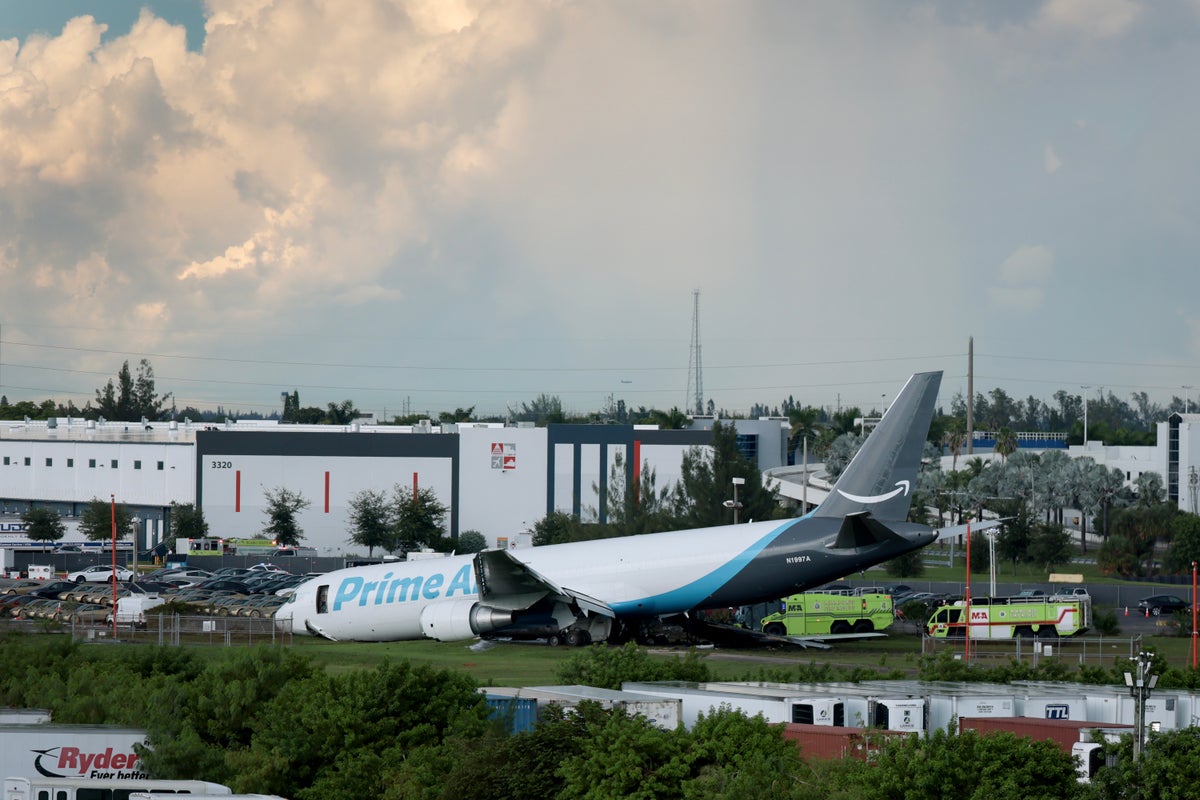

The aircraft came to rest on its belly beside a road near two semitrucks, remaining largely intact despite heavy flames. Approximately 200 emergency personnel
deployed to the scene, utilizing specialized airport firefighting units and foam to suppress the complex blaze, while crews contended with an active fuel leak for hours afterward. Amazon released a statement expressing deep sorrow over the tragedy and pledged full cooperation with investigating agencies. We're heartbroken to learn that five people lost their lives in today's incident at Miami International Airport,
the company said, extending sympathies to affected families and loved ones.
Federal investigators with the National Transportation Safety Board, led by Chairwoman Jennifer Homendy, arrived on the ground to spearhead the inquiry. Aviation analysts and safety experts noted that video footage of Sunday’s landing indicates the jet remained airborne well down the tarmac before touching down. Standard landing protocols require commercial aircraft to touch down within the initial 3,000 feet, or 914 meters, of a runway. Aviation safety expert Steve Arroyo explained that if an aircraft exceeds that threshold, the flight crew should abort the landing and circle back for another attempt. Former Transportation Department Inspector General Mary Schiavo observed that recordings appear to show the jet floating for an extended period without pitching its nose upward to force the main landing gear onto the ground. Schiavo added that strong winds and potential tailwinds in the area could have contributed to the aircraft floating further down the airstrip.
Furthermore, airline Captain Francisco Diaz described the approach captured on video as unstable, noting that the aircraft was pitching down and made two small bounces before touching down on its main gear. Diaz also identified the specific aircraft registration as N19977A, noting it was the original Prime Air plane introduced a decade ago. Data from Flightradar24 indicates the 32-year-old Boeing 767 spent more than two decades carrying passengers for various carriers before undergoing a freighter conversion. Schiavo noted that investigators will scrutinize the jet's maintenance logs due to its history of international ownership, including a past period under a Russian firm.
Questions have also been raised regarding airport infrastructure. According to federal data, Miami International Airport does not feature an Engineered Materials Arresting System, which the FAA says has been installed at more than 120 airports nationwide to safely halt overrunning aircraft using beds of crushable material. While the airport complies with regulations by maintaining a 1,000-foot runway safety area instead, Diaz and other aviation experts suggested that an arresting bed could have prevented the cargo plane from breaching the perimeter road.
The disaster caused immediate logistical strain across the aviation network. By late Sunday, tracking data showed hundreds of disruptions affecting travelers and freight operations alike.
| Tracking Source / Outlet | Reported Flight Cancellations | Reported Flight Delays |
|---|---|---|
| WPLG Local 10 (Monday figures) | 65 domestic flights | 129 domestic flights |
| India Today / Newswav / The Globe and Mail (Sunday totals) | More than 160 flights | Nearly 325 flights |
In response to the runway closures and accident investigations, airport officials confirmed that inbound flights were diverted to alternative locations, including Orlando International Airport, situated more than 200 miles, or 320 kilometers, north of Miami. Airport authorities confirmed that two of the facility's four runways have since reopened, with one resuming operations around 4:15 p.m. Sunday and a second following roughly 30 minutes later, though residual delays and cancellations persisted into Monday morning.
The tragedy echoes previous major aviation accidents involving cargo carriers, including a crash last year where a UPS plane lost an engine during takeoff acceleration at Muhammad Ali International Airport in Louisville, resulting in the deaths of three flight crew members and 12 people on the ground, alongside 23 injuries.
As the investigation progresses, federal authorities are expected to release further findings regarding the aircraft's mechanical integrity, speed, braking performance, and meteorological factors. Passengers flying through the region are advised to consult their carriers regarding flight statuses before traveling to Miami International Airport, with additional updates anticipated from the NTSB briefings.
How significant is this development?
Contribute your assessment to the aggregated reader sentiment ledger.
Frequently Asked Questions
Key questions answered in this reportWhat is the key development in: Miami International Airport faces flight delays following deadly cargo plane crash?
Miami International Airport experiences widespread flight disruptions following a fatal Prime Air cargo plane accident that killed five people.
Why is this Business development significant for the UK?
This report covers critical events in our Business beat. Independent reporting monitors related UK statements, regulatory shifts, and public responses as further verified details emerge.
How was this reporting corroborated and verified?
Newsarchy UK compiles and cross-references reporting from primary reporting from Newswav and cross-checked wire reports. All coverage adheres to published editorial standards.
When was this report published?
This briefing was published on September 7, 2026 and is permanently cataloged in the Newsarchy UK Business archives.