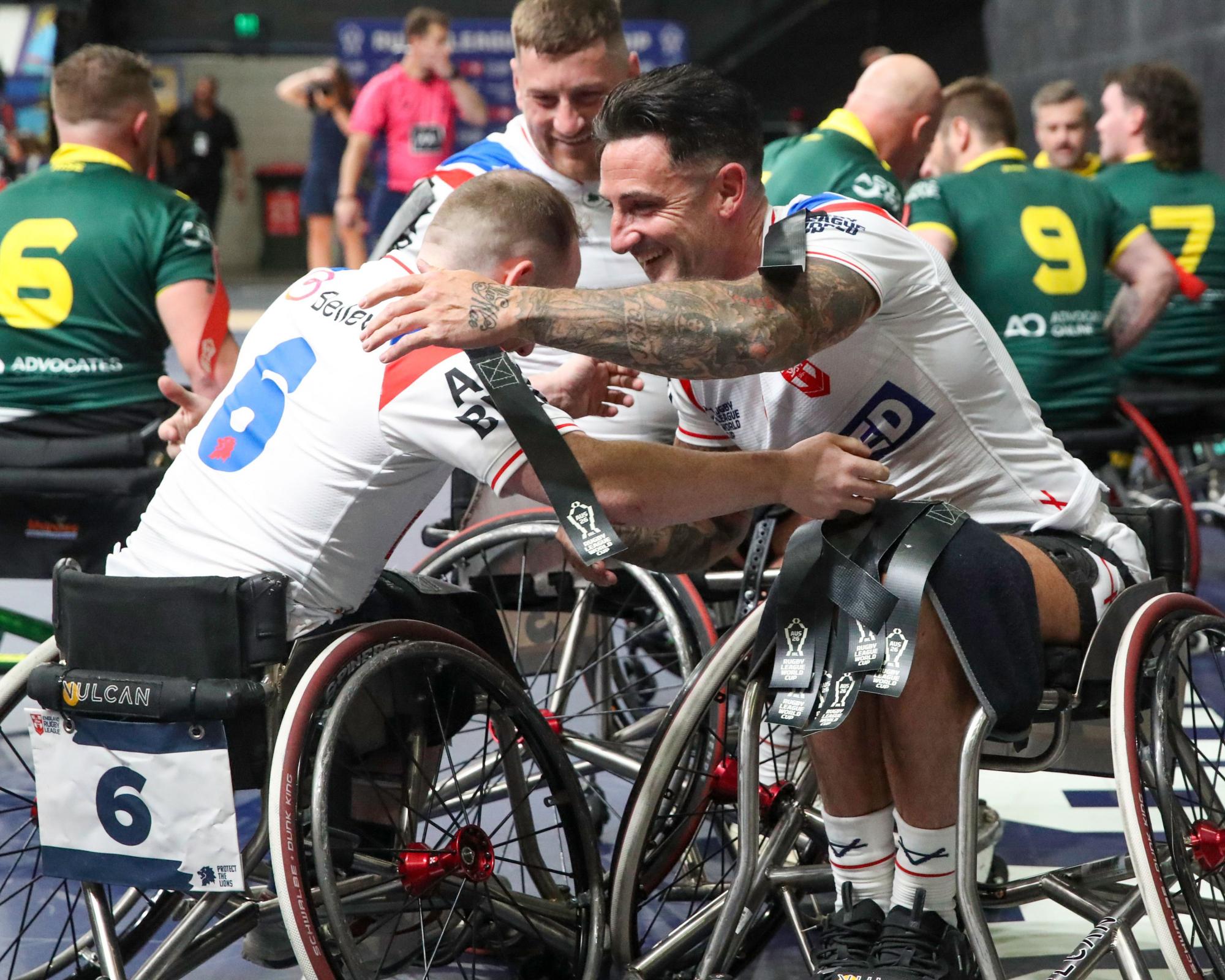
As England prepares to face France in the wheelchair rugby league final, the sport is experiencing notable participation growth and expanding club backing.
| Metric | 2022 (pre‑World Cup) | Current |
|---|
| Formal league teams in England | 19 | 42 |
| Participation growth since 2022 | — | 110% |
England’s route to the final has been emphatic. After a 98‑18 opening win over Wales, Tom Coyd’s side posted a 104‑12 victory against Spain and then a 121‑0 rout of Ireland in their final Group A match, with Joe Coyd and James Simpson each crossing for four tries and Jack Brown and Nathan Collins adding hat‑tricks.
The squad blends elite athletes with stories that have become central to the sport’s appeal. Captain Lewis King was partially paralysed by a spinal blood clot in 2009 at age 24 and found wheelchair rugby league during rehabilitation at Stoke Mandeville. “It started as a bit of fun and you’d only ever have a couple of family members watching; maybe a dog too if you were lucky,” King said. “But I fell in love very easily.” Star Rob Hawkins, who claimed a third consecutive Golden Boot this week, lived with chronic fatigue syndrome and was bedridden for 18 months before returning to elite competition. Luis Domingos switched from professional wheelchair basketball for Portugal to rugby league for England. Finlay O’Neill, forced out of running rugby league by hyper‑mobility in his knees, watched England lift the 2022 trophy and is now scoring tries in the 2026 final. “We speak about that regularly,” King said. “Finlay was watching us at the last World Cup and now he’s scoring tries and playing in a final himself. There is a pathway for anyone and we want to show people trauma in life doesn’t mean you can’t play and enjoy sport.”
That pathway is expanding. Super League clubs Leeds Rhinos, Wigan Warriors and newly crowned men’s champions Wakefield Trinity all field wheelchair sides alongside girls’ and junior teams. Jack Brown, who spent five and a half years coaching and welding in Queensland, will become Wakefield’s wheelchair head coach next season. The International Rugby League noted 72 sanctioned internationals in 2024 — the most in any non‑World Cup year, and highlighted wheelchair rugby league as “growing at an unbelievable pace,” with New Zealand hosting Australia for the sport’s first internationals in both nations last year.
Broadcast exposure remains a lever. The 2022 final drew nearly 2 million TV viewers and 5,000 fans in Manchester. This year’s tournament sits behind a paywall in the UK, but the BBC will televise the final, offering a mainstream platform. England captain Tom Halliwell, reflecting on record crowds at London’s Copper Box during the 2021 World Cup, said: “We’re just living the dream, playing at a World Cup on home soil with record‑breaking crowds and you sometimes have to pinch yourself… we wanted to recreate something similar. I feel like we’ve done that with record‑breaking crowds but we have to move on.”
France arrive with a squad that pushed England to a thriller in Saint‑Lo in 2024 after England’s comfortable win in Wigan, keeping the rivalry tight at the top of the IRL rankings. Ireland, ranked third, opened with a 110‑10 demolition of the USA but were outclassed by England. Australia, hosting every match in Wollongong, field their strongest ever line‑up led by non‑disabled captain Bayley McKenna, who has faced online abuse questioning his place in a wheelchair sport. “There is such a stigma around able‑bodied athletes playing in wheelchairs. It is ridiculous,” McKenna told ABC. England’s Brown is also non‑disabled, having entered the game alongside his disabled brother.
The final kicks off Friday morning UK time. A win would make England the first nation to retain the wheelchair World Cup, but the players frame the trophy as only half the measure. “We had some young players present our shirts before we came to Australia,” King said. “That’s the win for us: seeing the next generation want to do it because of us.”