Japan economic growth could double through business reforms and tech prowess
Japan's per capita economic growth could double through optimized business reforms and its technological capabilities, though structural rigidities suppress productivity.
- Core Development: Japan's per capita economic growth could double through optimized business reforms and its technological capabilities, though structural rigidities suppress productivity.
- Beat Context: Categorized under Business with independent corroboration.
- Reporting Depth: 3 minute analytical read synthesized from verified newsroom sources.
Japan’s per capita economic growth could double if the country successfully implemented vital business reforms and leveraged its world-leading technological capabilities, according to independent economic analysis. While the nation sits at the forefront of global technological complexity, structural rigidities in its financial and labor markets continue to suppress productivity and stifle the widespread adoption of modern innovations.
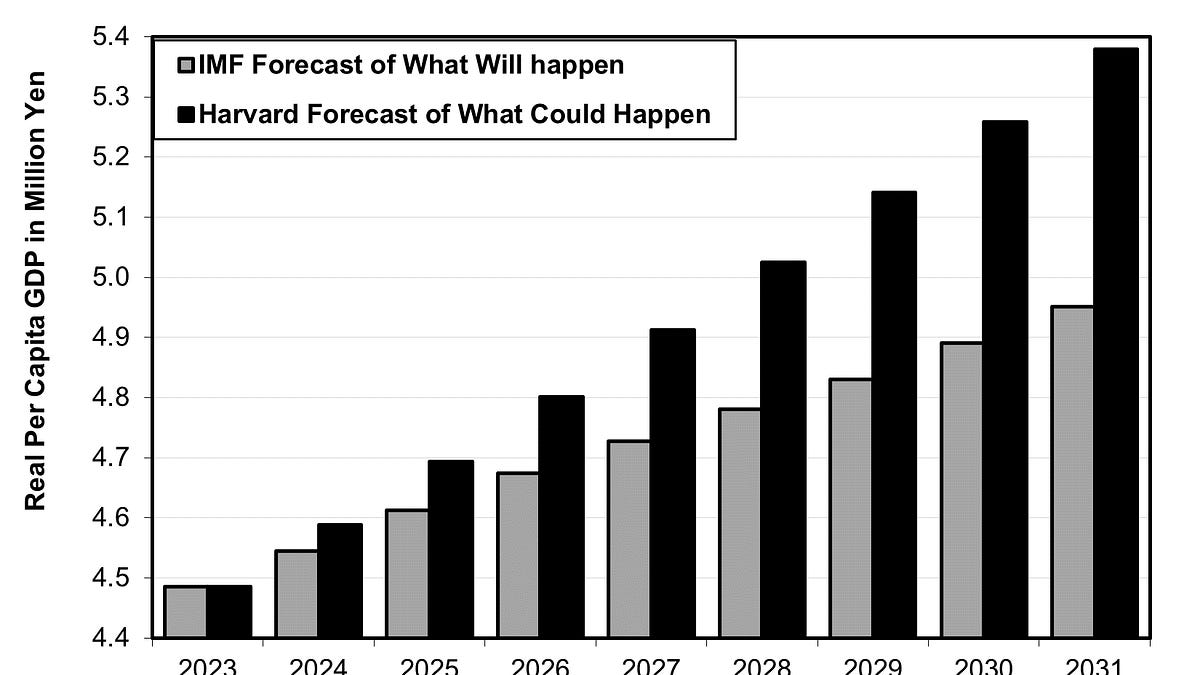
The stark disconnect between Japan's technical potential and its actual economic performance highlights a persistent structural dilemma. According to research from the Harvard Growth Lab, Japan’s real GDP could expand by 1.8 percent annually between 2023 and 2031, translating into a robust 2.3 percent per capita growth rate when factoring in ongoing population declines. Yet under current policy settings, the International Monetary Fund projects total GDP will crawl at just 0.7 percent per year through 2029, with per capita growth limping at 1.2 percent annually.
Media additions



The root cause of this underperformance lies in how corporate systems translate inventions into economic value. Although Japanese scientists and engineers generate advanced patents, the nation's financial and labor systems remain too rigid to ensure sufficient capital and talent flow toward innovative enterprises. Comparative data shows that when a company’s patent stock increases by 10 percent, the corresponding increase in its labor force reaches 2.2 percent in the United States and 1.5 percent in the United Kingdom, but drops to a meager 0.5 percent in Japan. Similar frictions plague capital allocation, leaving emerging firms starved of the funding and experienced staff required to scale.
| Metric | Japan | United Kingdom | United States |
|---|---|---|---|
| Labor response to 10% patent increase | 0.5% | 1.5% | 2.2% |
| Financing response to 10% patent increase | 1.5% | 2–3% | 3.5% |
| Projected per capita GDP growth (optimized) | 2.3% | — | — |
| IMF projected total GDP growth (through 2029) | 0.7% | , | , |
Discrepancies also exist in how international observers measure technological strength. While Harvard’s Economic Complexity Index places Japan first out of 133 countries, the World Intellectual Property Organization’s Global Innovation Index ranks the nation 13th out of 132 economies when evaluating more than 100 separate dimensions. Analysts point out that Japan's high economic complexity score has been sustained partly by a concentration on highly intricate export niches, even as overall export growth has flattened and comparative advantages in dozens of traditional industries have eroded.
Further analysis reveals that Japan's export growth slowed significantly, shifting from an annualized rate of 10.9 percent between 1962 and 2010 down to 0.26 percent from 2010 to 2021, according to economist Dany Bahar and his co-writers. Exports per worker even shrank at an annualized rate of -0.32 percent during that latter period. By 2021, Japan had reportedly lost its comparative advantage in nearly half of the 394 industries where it previously held advantages. Iconic Japanese brands have also faced major commercial shifts when consumer markets changed, such as when cameras turned digital and integrated into cell phones, leading to steep revenue drops for firms like Nikon and Canon.
At the same time, Japan struggles with corporate digital agility. In 2023, the nation ranked 64th out of 64 economies in measures evaluating improvements in sales, profits, and productivity resulting from digital investments. Furthermore, while Japan boasts hundreds of products with dominant global market shares above 50 percent, the median global sales volume among these items remains low, limiting their overall impact on national GDP growth and living standards.
Future developments will depend heavily on whether policymakers and corporate leaders tackle these entrenched labor and financial frictions. Observers and researchers continue to monitor upcoming economic metrics, R&D productivity outputs, and potential regulatory shifts to see if Japan will finally unlock growth commensurate with its technological assets.
How significant is this development?
Contribute your assessment to the aggregated reader sentiment ledger.
Frequently Asked Questions
Key questions answered in this reportWhat is the key development in: Japan economic growth could double through business reforms and tech prowess?
Japan's per capita economic growth could double through optimized business reforms and its technological capabilities, though structural rigidities suppress productivity.
Why is this Business development significant for the UK?
This report covers critical events in our Business beat. Independent reporting monitors related UK statements, regulatory shifts, and public responses as further verified details emerge.
How was this reporting corroborated and verified?
Newsarchy UK compiles and cross-references reporting from primary reporting from SolarQuotes and cross-checked wire reports. All coverage adheres to published editorial standards.
When was this report published?
This briefing was published on October 9, 2026 and is permanently cataloged in the Newsarchy UK Business archives.


