Carney holds first UK PM meeting after Toronto investment summit
Following a major Toronto investment summit targeting $1 trillion, Prime Minister Mark Carney has traveled to Liverpool for his first meeting with UK leader Andy Burnham.

Prime Minister Mark Carney’s first in‑person meeting with the United Kingdom’s new leader, Andy Burnham, has opened a fresh chapter in Ottawa’s quest to lure billions of dollars of capital away from a trade‑warred neighbour and into a diversified portfolio of Canadian assets. The meeting in Liverpool follows a two‑day investment summit in Toronto that sought to convince more than 100 of the world’s wealthiest investors to stake their money in Canada’s energy, critical‑mineral, defence and AI sectors.
The BBC described the Toronto event as “Carney gambles on the world’s biggest investors betting on Canada.” Carney, who has steered the country through the 2008 financial crisis and the Brexit negotiations, is now using his personal network to pitch Canada as a stable, resource‑rich alternative to the United States, whose tariffs are squeezing Canadian exporters.
Media additions


"Canada has what the world wants," said Carney ahead of this "first of its kind" investment summit.
Carney, via BBC
Organised by the Canada Pension Plan Investment Board and the Public Sector Pension Investment Board, the summit drew more than 100 global investors, including sovereign wealth funds from the United Arab Emirates and Norway, and chief executives from BlackRock, Blackstone and other major finance firms. The agenda, laid out in a 66‑page prospectus, highlighted 160 projects across conventional energy, clean energy, mining, marine and port infrastructure, digital technology and advanced manufacturing.
| Metric | Value |
|---|---|
| Target investment over five years | $1 trillion |
| Private‑sector capital target | $500 billion |
| Assets overseen by invited investors | Nearly $120 trillion |
| Number of investors and CEOs invited | More than 100 |
The Yahoo! Finance Canada report added that Carney had appointed former McKinsey partner Dominic Barton to chair Invest in Canada, the agency tasked with turning the $1 trillion goal into real projects. Barton’s appointment follows the August 31 announcement of a new leadership team for Invest in Canada, including Gurinder Grewal as chief executive officer.
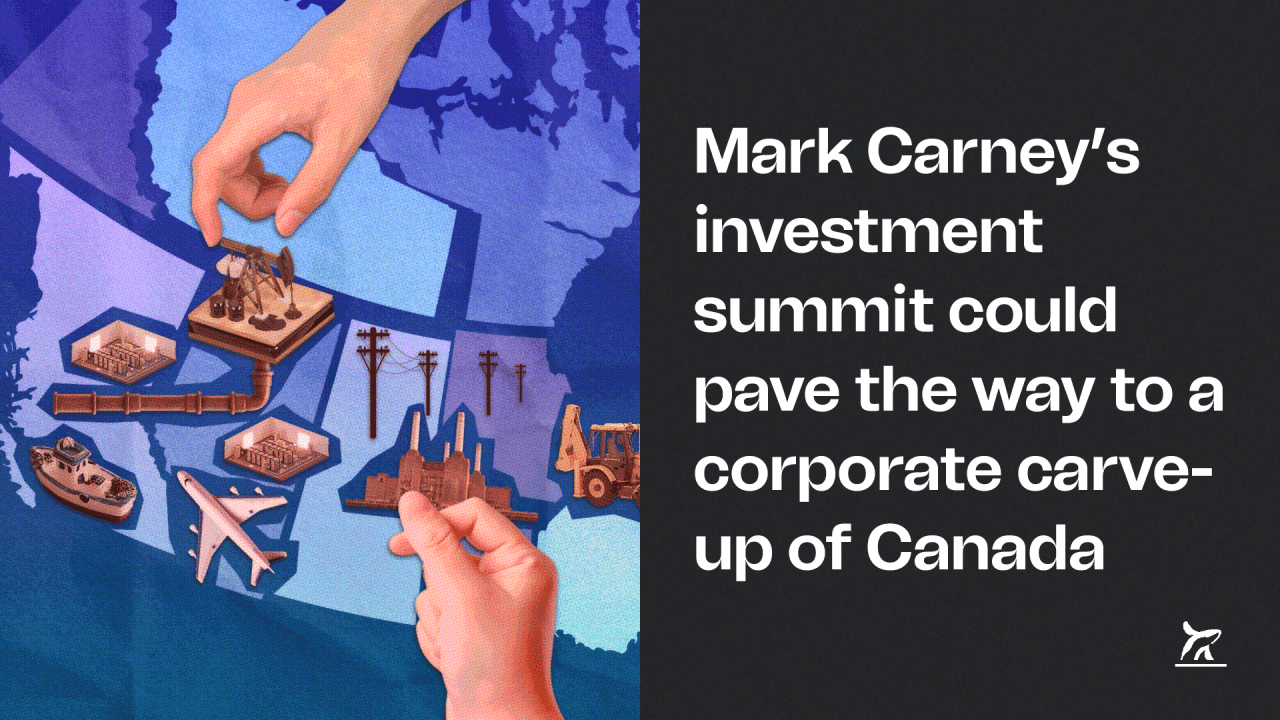
The Breach warned that the summit could pave the way to a corporate carve‑up of Canada, with private investors buying public infrastructure such as airports, ports and pipelines. The article argued that proceeds from such sales might subsidise “oil and gas pipelines, LNG terminals, and critical mineral projects” that would place the cost on taxpayers.
Critics, including Conservative Leader Pierre Poilievre, have highlighted Dominic Barton’s past ties to the opioid crisis and the potential conflict of interest in steering public assets towards private firms.
Against this backdrop, Carney’s first meeting with the UK’s Prime Minister is a strategic move to broaden Canada’s investor base beyond North America. According to the Briefs report, Carney will be in Europe from 15 to 17 September, stopping in Strasbourg, France, and Liverpool, England. In Liverpool, he will meet with Andy Burnham, who took office in July. The agenda, as outlined by his office, will cover defence and security, energy policy, artificial intelligence and the supply of critical minerals.
The meeting comes at a time when the UK is striving for warmer ties with Brussels. Carney’s visit to Strasbourg, where he will attend Ursula von der Leyen’s state‑of‑the‑union address and speak to EU lawmakers, signals a desire to integrate Canada into a broader European‑centric investment framework. The UK government, as noted by the Briefs article, is under pressure to strengthen relations with the EU while balancing its own domestic economic priorities.
Carney’s strategy reflects a broader shift in Ottawa’s economic policy. The government’s most recent federal budget pledged to “spur more than $1 trillion in total investment from public, private and institutional partners over five years.” With the United States imposing tariffs and the global economy facing uncertainty, Canada’s leadership is positioning itself as a “stable alternative” for investors seeking diversification.
Yet the ambitious $1 trillion target raises questions about feasibility. The Yahoo! Finance Canada article cautions that “the test for Barton and Grewal isn’t the size of the investment funds Ottawa attached to their mandate — it’s whether that number turns into shovels in the ground and sustained economic momentum in Canadian communities.” The article also notes that the $500 billion of private capital must be secured from the global investors present at the summit.
As Carney moves to the UK, the focus will likely shift from purely financial persuasion to building political and economic alliances. The meeting with Burnham will provide a platform to discuss joint defence initiatives, AI collaboration, and critical‑mineral supply chains that could benefit both nations. It will also offer an opportunity for Carney to underscore Canada’s “rock‑solid fiscal strength,” a point repeatedly highlighted by Finance Minister François‑Philippe Champagne during the summit.
Looking ahead, observers will watch for several outcomes:
- Whether Carney secures concrete investment commitments from the summit’s attendees, especially in clean‑energy and AI.
- How the government addresses concerns over a potential privatisation agenda, particularly regarding public infrastructure.
- Whether the UK‑PM meeting leads to tangible policy alignments, such as joint defence procurement or shared critical‑mineral sourcing.
- How public opinion evolves in response to the government’s aggressive investment outreach and the accompanying criticisms.
In a world where geopolitical tensions and climate uncertainty shape investor sentiment, Carney’s dual agenda — first to win capital in Toronto, then to forge a partnership with the UK, could either cement Canada’s position as a diversified investment hub or expose the limits of a strategy that relies heavily on private capital and infrastructure sales. The next few weeks will determine whether the $1 trillion promise translates into real jobs, infrastructure and a more resilient economy, or whether it becomes another ambitious but unfulfilled pledge.