SpaceX targets first double catch of Starship in ambitious test flight
SpaceX is launching Starship on an orbital test to achieve the first-ever double catch of both rocket stages, advancing toward full rocket reusability.

SpaceX is launching Starship on a multi-day orbital test to achieve the first-ever double catch of both rocket stages, a crucial step toward accelerating lunar and Martian exploration.
According to reporting from the Sun Sentinel, the mission represents the boldest test yet for Elon Musk's aerospace company. The vehicle is scheduled to lift off from the Starbase facility in South Texas. The Federal Aviation Administration provided final approval shortly before the planned late-afternoon liftoff, addressing regulatory uncertainty reported earlier by outlets such as The News and UNN.
Media additions

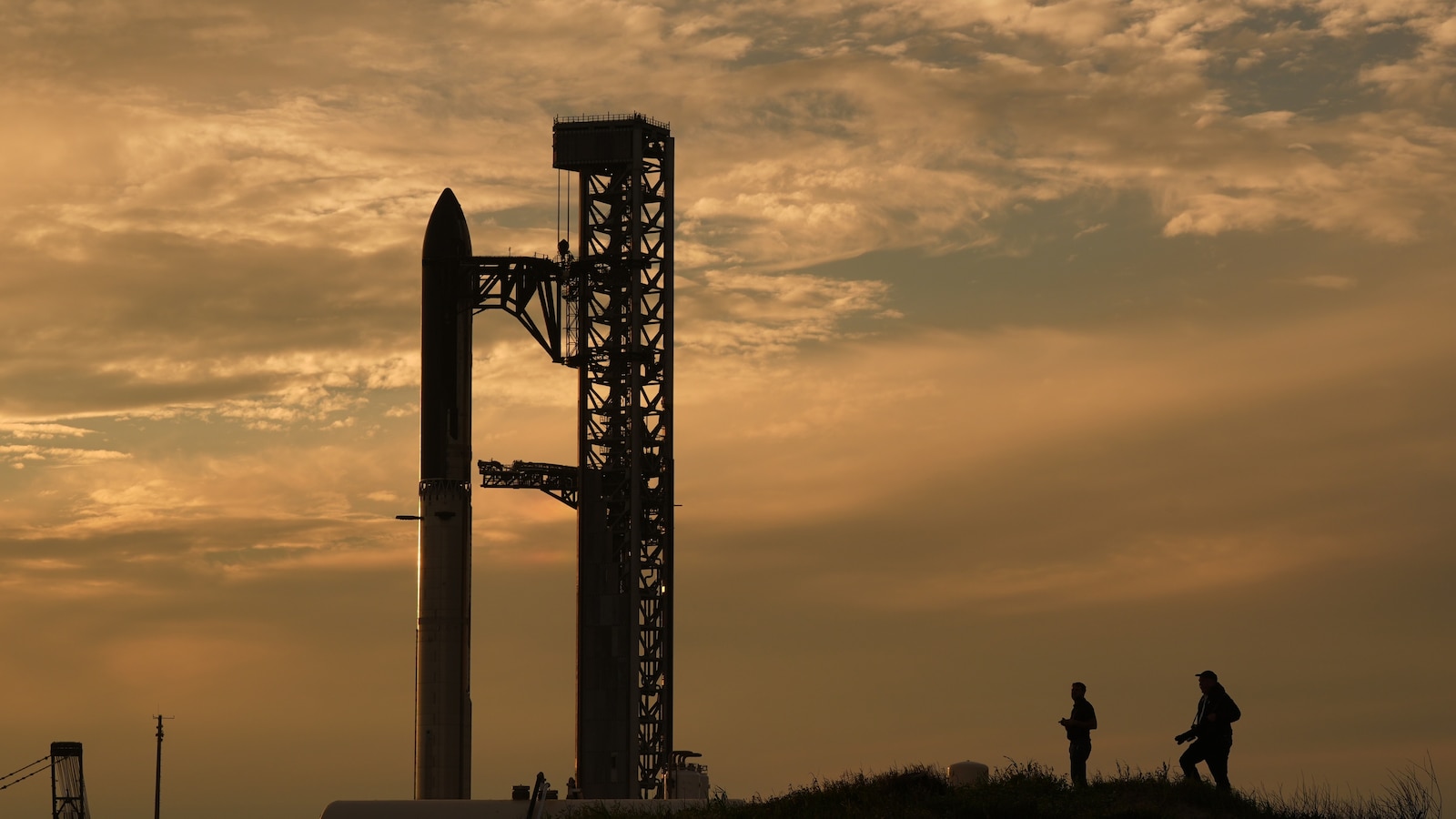

The monumental vehicle stands tall on the pad. Together, the upgraded Super Heavy booster and the bullet-shaped Starship spacecraft form the world's largest and most powerful rocket.
If successful, the flight will mark the first time every single piece of an orbital rocket is retrieved for recycling. Clayton Swope, an aerospace expert at the Center for Strategic and International Studies, described a fully reusable spacecraft as the "Holy Grail" of the space industry, noting that no one has managed it previously, according to Free Malaysia Today.
Mission Timeline and Operational Phases
The mission combines commercial payload delivery with high-stakes engineering tests. Once in orbit, Starship will deploy 26 advanced Starlink V3 internet satellites. The upper stage is slated to complete multiple laps around the globe at an altitude of approximately 170 miles before initiating its return trajectory.
| Mission Phase | Target Time / Duration | Expected Action |
|---|---|---|
| Launch Window | 75-minute duration | Liftoff from Starbase, South Texas |
| Booster Recovery | Minutes after liftoff | Super Heavy returns to pad for a mid-air tower catch |
| Orbital Operations | Over 22 hours | Spacecraft deploys 26 Starlink V3 satellites across multiple orbits |
| Spacecraft Recovery | Following 14 orbits | Ship upper stage returns for a land-based tower catch in Texas |
While SpaceX has previously executed three successful booster catches using mechanical "chopsticks" attached to the launch tower, catching the upper stage presents a significantly greater hurdle. As detailed by Geo and ABC News, the spacecraft travels considerably faster than the booster and must survive intense atmospheric re-entry before executing a landing flip.
SpaceX emphasizes that safety and system checks govern the maneuver. As reported by Space.com, the flight control team must ensure that vehicle systems are entirely healthy before attempting reentry and the final landing burn. If anomalies arise, pre-planned ocean splashdown zones in the Pacific or the Gulf of Mexico remain available.
Broader Infrastructure and Lunar Ambitions
Successful reusability underpins Musk's long-term vision. Kiko Dontchev, SpaceX vice president of launch, explained that scaled infrastructure and full recovery are necessary to scale launch cadences exponentially, pointing toward future operations in Florida and Louisiana as noted by the Sun Sentinel. Musk expects to achieve weekly Starship launches by the first half of 2027.
Beyond satellite deployment and commercial connectivity—including future plans for data-processing AI swarms known as Starmind, highlighted by UNN and Kyabram Free Press—the megarocket is a cornerstone of NASA's Artemis program. NASA has provided billions in development funding, selecting Starship as a lunar lander alongside Jeff Bezos's Blue Origin, which is developing the Blue Moon lander.
Industry analysts and engineers cited by UNN caution that several complex technical milestones remain. These include proving in-space fuel transfers between tanker and main spacecraft variants, a mandatory prerequisite for missions venturing beyond low Earth orbit toward the Moon.
What to Watch Next
- Monitor flight control updates during the initial hours of orbit to verify Starlink V3 satellite deployment.
- Watch for the booster return burn and tower catch shortly after liftoff.
- Track telemetry for the re-entry burn and final landing approach of the Starship upper stage in Texas.
- Follow further developments regarding NASA's upcoming docking tests and the timeline for crewed lunar landings.
For related analysis on corporate developments, read more in our Business coverage.