US military deploys third aircraft carrier to Middle East amid Iran conflict
The US military has deployed a third aircraft carrier, the USS Theodore Roosevelt, to the Middle East amid intensifying naval buildups and stalled talks.

The USS Theodore Roosevelt arrived in the Middle East, bringing thousands of additional troops and intensifying a naval buildup near Iran even as political leaders signal divergent paths for the nearly nine-month-old conflict. Unnamed U.S. Officials told outlets including PBS and Newsweek that the Roosevelt entered the region.
The arrival of the Roosevelt marks the third American aircraft carrier currently deployed to the region, joining the USS George H.W. Bush and the USS George Washington. According to Navy figures cited in reporting, the expanded flotilla also includes 13 destroyers, two cruisers, and a littoral combat ship, alongside two additional destroyers stationed in the Red Sea. The Roosevelt deployed alongside the USS Makin Island amphibious readiness group, which includes the USS John P. Murtha and USS Anchorage amphibious landing ships and around 2,000 Marines, though those accompanying landing ships had not yet reached the area.
Media additions
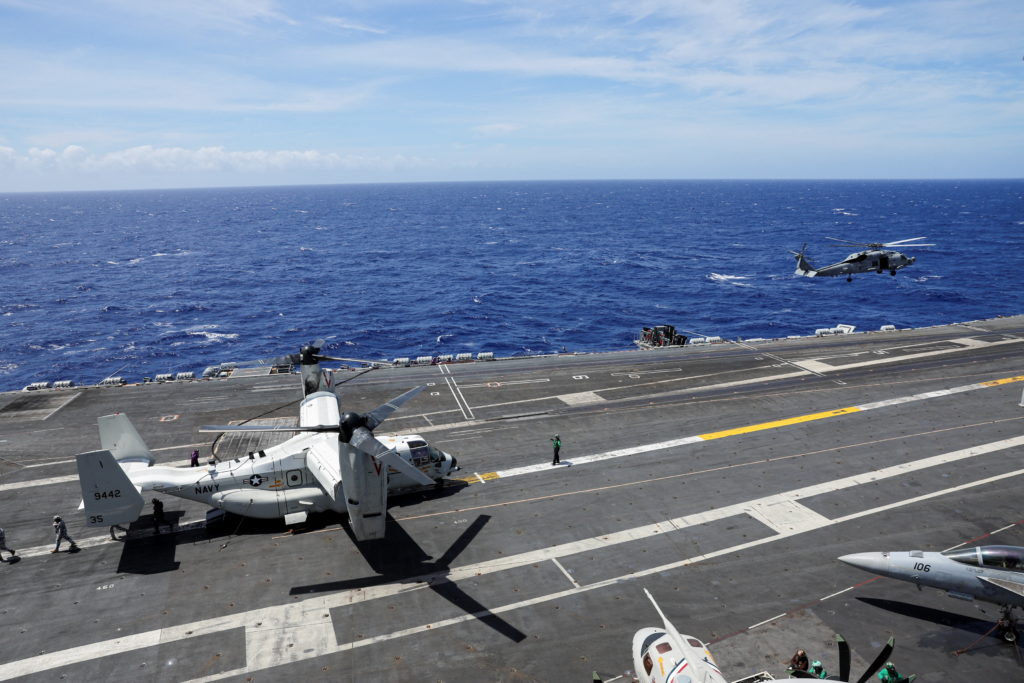

The Roosevelt is part of Strike Group 9, which includes the Ticonderoga-class guided-missile cruiser USS Chosin and Carrier Air Wing 11. The carrier left its home port in San Diego in late September, arriving in the western Pacific for the Keen Sword 27 exercise before moving through the Malacca Strait and out into the Indian Ocean. Meanwhile, the H.W. Bush arrived in the region in April and the George Washington arrived in August to relieve the USS Abraham Lincoln. U.S. Navy leaders reportedly told family members of sailors on the Bush that the carrier's deployment had been extended through the holidays and could last as long as a year.
The military reinforcement coincides with mounting maritime dangers in the Strait of Hormuz. Iranian state television, quoting the naval arm of the Revolutionary Guard and the army, warned shipping companies that the U.S.-supported southern route through the waterway is hazardous due to mines. Brigadier General Mohammad Akrami-Nia, a spokesperson for the Iranian Army, stated that the Strait of Hormuz would not reopen until the enemy accepts Iran's conditions. The Revolutionary Guard's navy reported that multiple oil tankers had struck mines and caught fire, while regional statements varied regarding the exact tally of damaged vessels. Separately, the United Kingdom Maritime Trade Operations Centre reported that a tanker was struck by an unknown projectile, sparking an engine room fire with no casualties reported. CNBC reported that international benchmark Brent crude futures dropped 0.7% to $91.8 a barrel, while U.S. West Texas Intermediate futures fell 0.7% to $85.1 a barrel in Asian trading.
| Vessel / Asset Group | Deployment Status / Location | Key Details |
|---|---|---|
| USS Theodore Roosevelt (Strike Group 9) | Arrived in Middle East on Sunday | Accompanied by USS Chosin and Carrier Air Wing 11; left San Diego in September |
| USS George H.W. Bush | Extended in region | Arrived in April; deployment extended through the holidays and potentially up to a year |
| USS George Washington | Operating in region | Arrived in August to relieve the USS Abraham Lincoln |
| Destroyers & Cruisers | Deployed across Middle East | 13 destroyers and a cruiser protect carriers and launch offensive strikes |
Diplomatic efforts remain deadlocked. Indirect negotiations mediated through Qatar have stalled over nuclear program provisions and Washington's refusal to lift economic sanctions and the naval blockade on Iranian ports. President Donald Trump has offered mixed signals, stating after a meeting with Qatar's prime minister that the war is militarily effectively over and could end fairly soon, while simultaneously warning that the U.S. Military remains locked and loaded to monitor facilities like Pickaxe Mountain. Secretary of State Marco Rubio asserted that active military strikes are unnecessary while economic sanctions and the naval blockade maintain pressure on Tehran.
Domestic political fallout from the prolonged hostilities has already materialized. Voters delivered major losses to the Republican Party in midterm elections, a result publicly attributed to the war by Vice President JD Vance, who posted on social media that the reason the party lost is the war. Intelligence reports cited by CNBC indicate Iran has explored plans targeting senior administration officials, prompting heightened security measures in Washington and the relocation of Treasury Secretary Scott Bessent to military housing. Meanwhile, Ian Bremmer, president and founder of Eurasia Group, told CNBC that Tehran is likely to intensify attacks on commercial shipping to pressure Washington, though he cautioned that expecting economic strain alone to force concessions misjudges Iranian leadership capacity.
Operations in the region continue under the purview of U.S. Central Command as markets and international observers monitor whether the expanded carrier presence deters further maritime strikes or precipitates a wider escalation.