Seven dead and more than 100 injured after trains collide in Egypt
A devastating train collision in Egypt's Giza province left seven people dead and over 112 injured, prompting an immediate government inquiry into safety.

The disaster unfolded in the al-Ayyat district of Giza province, approximately 32 miles south of Cairo. According to the Transportation Ministry, a regional service travelling from Giza toward the southwestern province of Fayoum slammed into the rear of another passenger train that was stationary on the tracks. The stationary service was operating on the Cairo-to-Aswan route. The impact caused multiple carriages to derail, with several cars overturning and plunging down an embankment. One of the mangled cars appeared split in two.
Local residents rushed to the wreckage before professional rescue teams arrived. Ayman Gamal, a resident of Kafr Girza, described pulling survivors from the wreckage and seeing dozens of casualties loaded into ambulances. Survivors interviewed outside Al-Wasta Central Hospital in Beni Suef province recounted moments of panic, noting that thick dust choked the air inside the mangled cars and made breathing difficult before villagers pulled them free. Farha Gamal, a passenger on the Fayoum train, told reporters that she saw fellow travellers struggling to find their way out of crushed carriages.
Media additions
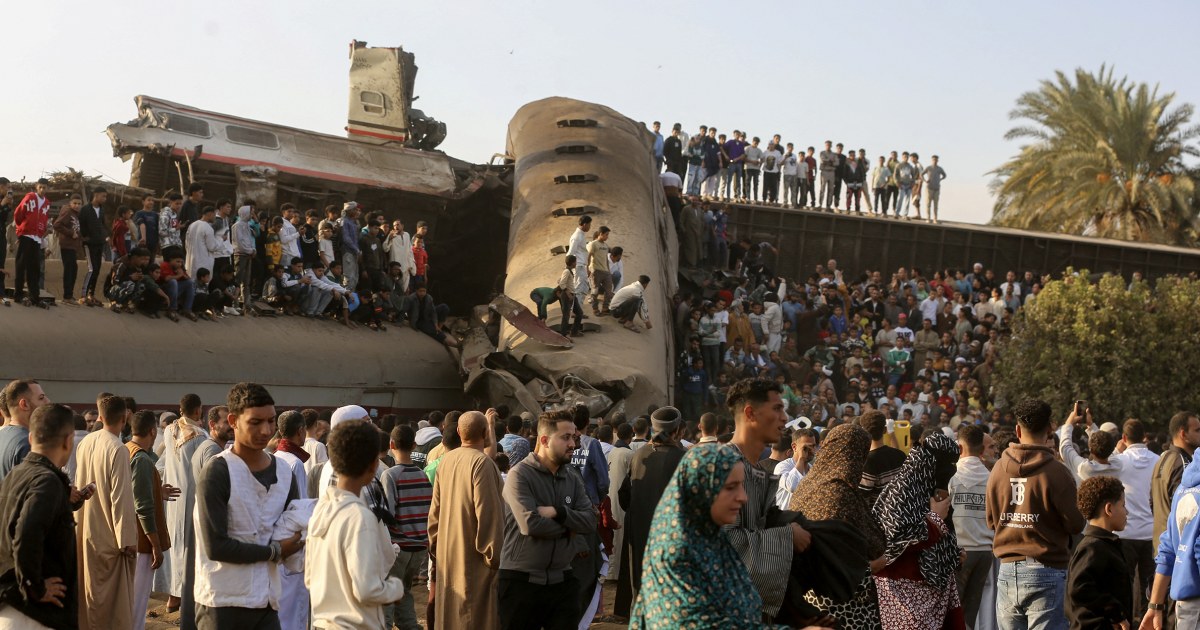

Casualty figures fluctuated as emergency services combed the site. Initial tallies from the Egyptian Health Ministry and Newscord reported four dead and 88 injured. That figure climbed as search operations continued. The ministry later confirmed that the death toll reached seven, while the count of wounded individuals rose past 112, with some private estimates pushing the injured total beyond 140. Health Minister Dr Khaled Abdel Ghaffar reported that patients suffered broken bones, bruises, lacerations, and head injuries. At least 45 people were discharged after receiving initial treatment.
| Reporting Entity | Confirmed Deaths | Recorded Injuries |
|---|---|---|
| Initial Health Ministry Tally | 4 | 88 |
| Updated Official Toll | 7 | 112+ |
| Private Estimates | 7 | 140+ |
The tragedy claimed the life of a train driver and the train's conductor according to the chief prosecutor's office. A massive emergency response deployed 72 ambulances to ferry the wounded to medical facilities in Giza, Beni Suef, and surrounding areas. Hospitals across the region were placed on heightened alert. The Egyptian Red Crescent dispatched teams to offer psychological support and aid to traumatized families at the scene, while the Ministry of Transport provided temporary passenger buses to maintain transit links while tracks remained blocked.
President Abdul Fattah al-Sisi took to social media to express concern over the disaster, stating that he directed state agencies to provide comprehensive medical care. He ordered an immediate inquiry to determine the exact sequence of events and hold accountable anyone found to have been negligent
(CBS News). Prime Minister Mustapha Madbouly coordinated patient transfers alongside the Ministers of Health and Social Solidarity.
Investigators from the public prosecutor's office arrived at the site late Sunday to examine signaling equipment and operating logs. Al-Mansah reported that officials within the National Railways Authority floated two primary theories: either a technical failure in the signaling system that cleared the moving train to proceed improperly, or a human error by the driver who failed to heed operational stop instructions. Transport Minister Kamel al-Wazir authorized a specialized technical committee to inspect the wreckage and review operating protocols.
The crash occurred between Kafr Ammar and Al-Raqqa stations in Al-Ayyat—a stretch of track with a grim history. This location sits near the site of Egypt's deadliest rail disaster in February 2002, when a fire ripped through an overnight passenger train travelling from Cairo to Luxor, killing more than 370 people. Other fatal incidents marred the region in subsequent decades, including a 2017 crash near Alexandria that killed more than 40 people, and a freight train collision in the same al-Ayyat district last September that injured a driver and his assistant.
Public frustration over the recurring disasters sparked immediate fallout. Citizens and commentators voiced anger on Sunday, with some calling for the resignation of the transport minister. Analysts noted that the crash places renewed pressure on World Bank-backed modernization efforts, including the multi-million-dollar Railway Safety Improvement in Egypt project that began in August 2021. Despite pouring billions into new highways and high-speed rail lines over the past decade, successive governments have struggled to eliminate systemic safety vulnerabilities across the broader legacy network.
International reactions poured in as foreign leaders offered condolences. Saudi Arabia’s Ministry of Foreign Affairs issued a statement of solidarity with Egypt, while Turkey’s ambassador used social media to share sympathy with the victims and their families. Rail services along the vital corridor between Giza and Upper Egypt remain suspended while heavy cranes clear the twisted metal and debris from the tracks.