Georgia’s Okefenokee Swamp joins UNESCO’s World Heritage List
Georgia's Okefenokee Swamp has joined the UNESCO World Heritage List, marking the first National Wildlife Refuge in the United States to earn the designation.
- Core Development: Georgia's Okefenokee Swamp has joined the UNESCO World Heritage List, marking the first National Wildlife Refuge in the United States to earn the designation.
- Beat Context: Categorized under World with independent corroboration.
- Reporting Depth: 4 minute analytical read synthesized from verified newsroom sources.
The Okefenokee Swamp in Georgia has been added to the UNESCO World Heritage List. The announcement was made on Saturday, July 25, 2026, during the United Nations committee meeting held in Busan, Republic of Korea, according to The Current GA.
This designation makes the vast wetland Georgia’s first UNESCO World Heritage Site and the first National Wildlife Refuge in the United States to earn the distinction, as reported by Arab Times Online. Spanning an expansive network of wetlands, the swamp functions as one of the world's largest freshwater ecosystems, supporting exceptional biodiversity and serving as the source for two major rivers.
Media additions

UNESCO descriptions highlight that the swamp's largely undisturbed peat beds preserve a 5,000-year record of environmental change, positioning the location as both a vital natural habitat and an essential archive for tracking long-term environmental change. Despite the international acclaim, local reactions have been mixed. Some residents expressed apprehension regarding the listing, fearing it would increase U.N. Involvement in managing the site.
To ease those concerns, the U.S. Fish & Wildlife Service issued guidance clarifying that World Heritage status does not confer any ownership or management authority to the United Nations. Instead, the federal agency maintains that UNESCO only monitors the current conditions and potential threats, leaving oversight firmly in American hands.
Local advocates and officials welcomed the news with enthusiasm. Governor Brian Kemp noted in a press release distributed by Georgia Rivers that the international recognition honors a valued natural treasure while promising to strengthen rural communities surrounding the refuge.
"We accept this inscription not as a finish line, but as a commitment to keep the Okefenokee wild, resilient, and thriving for generations to come."
Kim Bednarek, executive director of the Okefenokee Swamp Park, via The Current GA
Conservation pressures have long surrounded the area. In recent years, 8,000 acres near the swamp was targeted for mining, and the land was purchased by The Conservation Fund to protect it. Advocates continue pressing legislative bodies to ensure more area around the swamp cannot be mined.
The international committee meeting in Busan also reviewed and approved several other global landmarks. Thailand secured its ninth World Heritage site with the inclusion of Wat Phra Mahathat Woramahawihan, an ornate 13th-century Buddhist temple featuring a 78-meter (255-foot) stupa. South Korea expanded its existing protections for western tidal flats, while China added centuries-old porcelain industry sites in Jingdezhen, and the Comoros secured its maiden listing through six historic towns dating to the 11th century shaped by Indian Ocean trade networks.
Global Heritage Decisions at a Glance
- Okefenokee Swamp (United States): Newly inscribed freshwater wetland and first national wildlife refuge to join the list.
- Wat Phra Mahathat Woramahawihan (Thailand): A 13th-century Theravada Buddhist temple serving as a living place of worship.
- Jingdezhen Porcelain Sites (China): Historic handicraft production zones tracing centuries of ceramic innovation.
- Comoros Historic Towns: Six 11th-century urban centers reflecting diverse Indian Ocean trade routes.
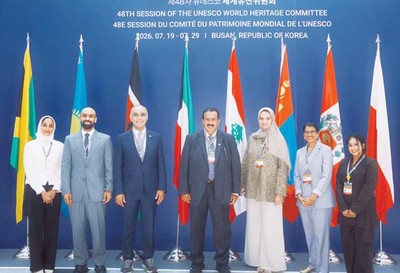
State delegations and international committees continue deliberations in Busan. Broader international participation at the summit includes the State of Kuwait, whose National Council for Culture, Arts and Letters reaffirmed its diplomatic commitment to cultural preservation during proceedings led by Permanent Delegate to UNESCO Ambassador Dr. Ali Al-Mudhaf, as detailed by Arab Times Online. The Kuwaiti delegation also includes the Secretary General of the Council, Dr. Mohammad Al-Jassar, alongside cultural and natural heritage specialists. Kuwait holds membership on the committee as one of 21 member states representing the Arab Group for a four-year term following elections at UNESCO headquarters in Paris in November 2025.
The committee also decided on Friday to place a major archaeological site in the West Bank and a group of castles in southern Lebanon on both the World Heritage List and the List of World Heritage in Danger on an emergency basis due to ongoing conflicts in the Middle East, despite objections and a call to reject the bids from Israel's Foreign Ministry.
As the international spotlight turns toward the Okefenokee, regional businesses anticipate increased tourism and sustainable economic growth. Meanwhile, broader international reporting from Arab Times Online highlights that UNESCO sessions in Busan are scheduled to review additional high-profile nominations—including France's D-Day landing beaches, Greece's Mount Olympus, and the ancient Japanese capitals of Asuka-Fujiwara—before concluding next Wednesday.
How significant is this development?
Contribute your assessment to the aggregated reader sentiment ledger.
Frequently Asked Questions
Key questions answered in this reportWhat is the key development in: Georgia’s Okefenokee Swamp joins UNESCO’s World Heritage List?
Georgia's Okefenokee Swamp has joined the UNESCO World Heritage List, marking the first National Wildlife Refuge in the United States to earn the designation.
Why is this World development significant for the UK?
This report covers critical events in our World beat. Independent reporting monitors related UK statements, regulatory shifts, and public responses as further verified details emerge.
How was this reporting corroborated and verified?
Newsarchy UK compiles and cross-references reporting from primary reporting from thecurrentga.org and cross-checked wire reports. All coverage adheres to published editorial standards.
When was this report published?
This briefing was published on July 25, 2026 and is permanently cataloged in the Newsarchy UK World archives.