Ukraine disables over 51 percent of Russian oil refining capacity
Ukrainian long-range strikes have disabled more than half of Russia's oil refining capacity, severely impacting Moscow's economy and military logistics.
- Core Development: Ukrainian long-range strikes have disabled more than half of Russia's oil refining capacity, severely impacting Moscow's economy and military logistics.
- Beat Context: Categorized under World with independent corroboration.
- Reporting Depth: 4 minute analytical read synthesized from verified newsroom sources.
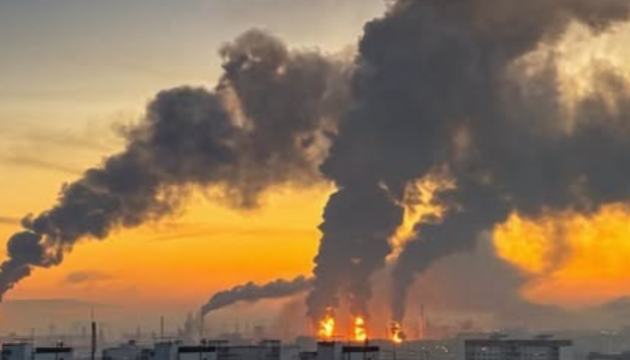
Ukrainian long-range strikes have disabled more than half of Russia's oil refining capacity, according to an assessment released by the Ukrainian Ministry of Defense. The coordinated campaign, utilizing deep-strike drones produced at triple the rate of the previous year, targets the core industrial infrastructure fueling Moscow's military operations. As the conflict grinds on across the 1,200-kilometer front line, the disabling of over 51 percent of Russian refining capacity marks a severe escalation in Kyiv's strategy to cripple the economic engine sustaining the invasion.
The assessment, compiled by analysts from Ukraine's intelligence services, General Staff, and Defense Ministry, highlights a deliberate shift toward destroying high-vulnerability components within Russian refineries. Ukrainian Defense Minister Yevhen Khmara emphasized that the deep strikes continue to shift the war onto Russian territory. According to Ukrinform, Khmara stated that the cumulative effect of these operations severely hampers Moscow's ability to carry out aggression and supply its troop groupings.
Media additions


The campaign has systematically targeted primary atmospheric distillation towers, catalytic crackers, and hydrocrackers across multiple regions. Because these large chemical towers operate under extreme heat and pressure, precision strikes easily trigger secondary detonations and cause catastrophic damage. Chinese reporting noted that the geographic spread of these attacks stretches from the Baltic coast to the Volga basin and the Ural foothills, with targets like Perm sitting more than 1,000 kilometers from launch points.
Russia has historically maintained its status as the world's third-largest producer of refined fuel products, trailing only the United States and China. However, repeated strikes on facilities such as the Kiryshinefteorgsintez plant and installations in Ust-Luga have severely disrupted that output. According to ABC News, Russian President Vladimir Putin made a rare admission regarding the economic toll during a meeting of the Valdai Club forum, conceding that the attacks had cost Russia roughly 1% of its gross domestic product. Putin remarked that while opponents set out to damage the Russian economy, the goal was only partially achieved.
Independent verification of the exact percentage remains difficult, and Russian officials have largely avoided publishing comprehensive damage statistics for domestic energy infrastructure. Yet, auxiliary fallout is readily apparent. The International Energy Agency notes that Russian diesel output has dropped by roughly 30 percent, forcing motorists to endure lengthy queues at petrol stations as domestic fuel shortages prompted earlier restrictions on gasoline sales.
| Metric | Ukrainian Ministry of Defense Claim | Observed Economic & Military Impact |
|---|---|---|
| Refining Capacity Affected | Over 51% disabled | Severe friction in supplying frontline armor and tactical aviation |
| GDP Impact | — | Approximately 1% loss, acknowledged by President Vladimir Putin |
| Diesel Output Change | — | Fallen by roughly 30%, according to the International Energy Agency |
| Repair Bottlenecks | , | Severe delays caused by Western sanctions blocking specialized machinery imports |
Repairing this damage presents an acute challenge for Moscow. Russian refineries relied heavily on engineering contractors from Europe and the United States for proprietary catalysts, special compressors, and automated control systems. With Western industrial sanctions firmly in place, acquiring replacement parts requires complex reverse-engineering and non-standard fabrication. This bottleneck stretches maintenance cycles from weeks into many months. To compound matters, Defense Mirror notes that Ukrainian forces have adopted a rolling strategy of repeated strikes, hitting facilities just as repair crews near the completion of restoration work.
The resulting fuel constraints have forced the Russian government to extend restrictive export bans on diesel to protect domestic agricultural and civilian needs, cutting off vital foreign exchange revenue. Furthermore, the defense sector faces an unresolvable force-allocation dilemma. Protecting a vast industrial hinterland requires deploying scarce surface-to-air missile systems away from active combat sectors, leaving frontline tactical networks more vulnerable.
As global attention remains fixed on the broader stalled ground campaign, the conflict has increasingly pivoted to long-range aerial exchanges. Ukraine continues to scale up its production of domestic strike drones to sustain the pressure on Russian energy assets, while Moscow relies on waves of ballistic missiles and jet-powered UAVs to target Ukrainian power grids ahead of the winter months. Diplomatic pressures continue to swirl around the conflict, with Washington pushing for potential trilateral negotiations by the end of October, even as both sides trade heavy aerial bombardments across oblasts from Kharkiv to Kyiv.
How significant is this development?
Contribute your assessment to the aggregated reader sentiment ledger.
Frequently Asked Questions
Key questions answered in this reportWhat is the key development in: Ukraine disables over 51 percent of Russian oil refining capacity?
Ukrainian long-range strikes have disabled more than half of Russia's oil refining capacity, severely impacting Moscow's economy and military logistics.
Why is this World development significant for the UK?
This report covers critical events in our World beat. Independent reporting monitors related UK statements, regulatory shifts, and public responses as further verified details emerge.
How was this reporting corroborated and verified?
Newsarchy UK compiles and cross-references reporting from primary reporting from dailykos.com and cross-checked wire reports. All coverage adheres to published editorial standards.
When was this report published?
This briefing was published on October 5, 2026 and is permanently cataloged in the Newsarchy UK World archives.