US stock futures decline as investors await Nvidia earnings and Fed signals
US stock futures declined on Monday as investors prepared for Nvidia's quarterly earnings report and upcoming Federal Reserve communications.

US stock index futures were mostly lower on Monday as investors prepared for Nvidia's quarterly earnings announcement and a series of Federal Reserve communications.
At 03:47 ET (08:47 GMT), S&P 500 futures were down 15 points, or 0.2%, while Nasdaq 100 futures declined 191 points, or 0.7%. Dow Jones futures were broadly unchanged.
Media additions
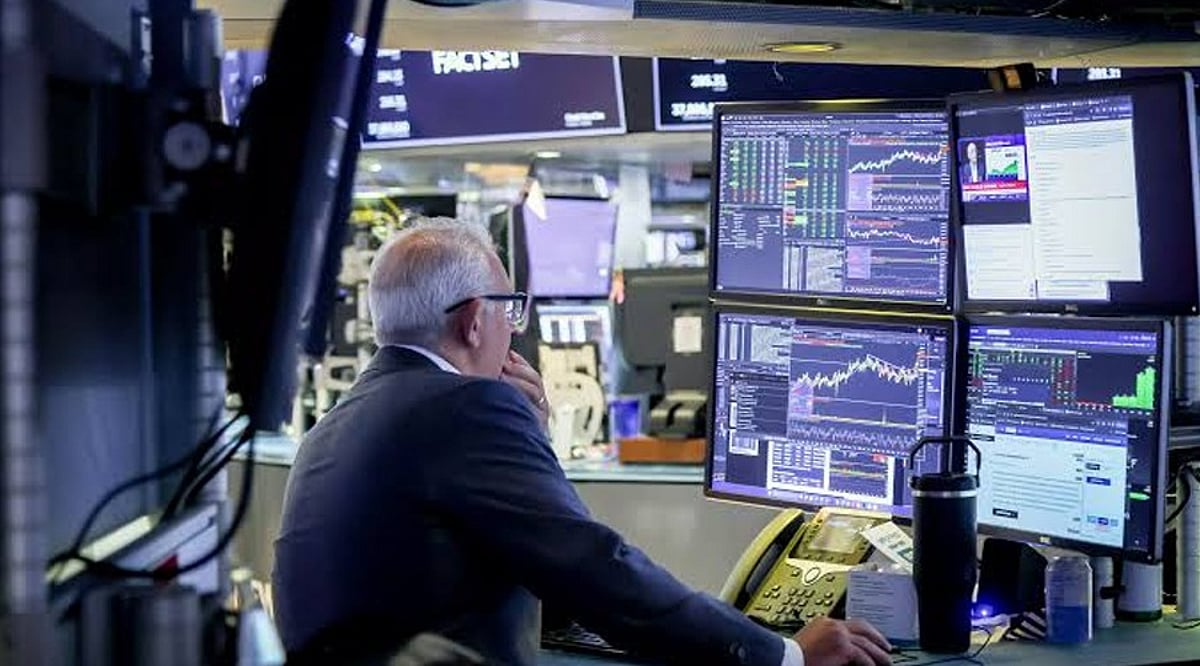


The weakness followed Nvidia's sharp decline last week after chief executive Jensen Huang resigned.
Nvidia stock is down about 30% from its early-October peak, wiping out roughly $1.7 trillion in market value, and it has ceded the world's largest market capitalization to Apple. It plunged 13% in the second week of November alone, and six straight weekly declines mark the longest streak since 2012.
In an official announcement, Nvidia confirmed that Chief Financial Officer Colette Kress had become interim CEO. Harvey C. Jones also became board chair as the company began searching for a permanent replacement.
A Financial Times report on Monday indicated that Huang had discussed the possibility of returning to the chief executive position with close associates. However, Nvidia has not announced any decision to reinstate him. Reports over the weekend indicated that Huang had discussed the possibility of returning to the company as chief executive. However, US Treasury Secretary Scott Bessent reportedly encouraged Nvidia to appoint an external candidate.
Nvidia is scheduled to publish its quarterly financial results after the US market closes on Tuesday, with investors expected to examine the company's revenue outlook and its financial relationships with customers. Nvidia expects third-quarter revenue to surge to around $108 billion. Nvidia's third-quarter revenue guidance was $108 billion (±2%), excluding China data-center sales. Gross margin guidance was 74.0% (±50bp). The LSEG consensus is $108.9 billion in revenue, up 91% year over year. The data-center segment consensus stands at about $101.8 billion.
Analysts at Vital Knowledge said Nvidia would face particular scrutiny over its projection for revenue growth of 70% in the next financial year. The analysts described near-term expectations as "somewhat sanguine", reflecting market assumptions that the company would reaffirm its guidance. However, they cautioned that any increase in Nvidia's share price following the announcement could encounter selling pressure.
"It seems like any post-earnings rally will be met with a wave of selling as sentiment has turned quite cautious on the medium and long-term post-Jensen outlook for the company amid concerns it will be forced to dial back financial support for customers while facing more stringent export rules from the White House."
Vital Knowledge analysts, via Yahoo Finance
Wall Street firms have also revised their Nvidia price targets. Mizuho lowered its target from USD 250 to USD 220, while UBS reduced its estimate from USD 300 to USD 240. Both firms maintained positive ratings.
Other technology shares also declined before Monday's opening bell. Intel and Advanced Micro Devices each fell 5.2%, while Micron Technology lost 5.3%. Broadcom declined 3.7% as selling spread across semiconductor companies. Cloud computing stocks also came under pressure. CoreWeave dropped 7.3%, Nebius fell 7.2%, and IREN lost 6.4%. Applied Digital and Core Scientific declined 5.9% and 6.3%, respectively.
Meanwhile, Anthropic is preparing for its expected public market debut. Its November 10 SEC filing proposed an offering of 825 million Class A shares at USD 70 to USD 78 each. Anthropic plans to sell about 801.35 million newly issued shares, while existing shareholders will sell another 23.65 million. The company has applied to list on Nasdaq under the ticker ANT. Its proposed valuation stands near USD 1.4 trillion, although final pricing remains subject to confirmation.
"Investors buying Anthropic may sell existing technology holdings to make room, meaning a successful debut won't necessarily lift every AI stock."
Ipek Ozkardeskaya, Swissquote analyst, via AnalyticsInsight
"A strong launch could revive confidence across the sector, supporting chipmakers, cloud providers and data centre operators as investors become more comfortable financing the next phase of expansion, despite rising costs and growing unease," said Ipek Ozkardeskaya, senior analyst at Swissquote.
Investors are also monitoring U.S. Monetary policy after stronger-than-expected inflation figures influenced expectations for the Federal Reserve's December rate decision. Federal Reserve Chair Kevin Warsh is scheduled to speak in San Francisco on Monday. Cleveland Fed President Beth Hammack will also deliver remarks, while policymakers prepare for the next interest rate decision. Additionally, the Federal Reserve will release minutes from its October policy meeting on Wednesday, November 18. The central bank held interest rates at 3.75% to 4.00% on October 28 in a 10-2 vote. Governors Lisa Cook and Beth Hammack opposed the decision, favoring a 25-basis-point increase instead.
According to analysts at Deutsche Bank, the discussion is expected to address research conducted by a Federal Reserve task force examining productivity and labour market developments. The analysts stated: "Our economists' baseline is that the task force will focus primarily on AI's potential to lift productivity and sustain strong growth without necessarily generating the same degree of inflation pressure, although possible disruption to hiring and implications for r-star could also feature." The term "r-star" refers to the theoretical neutral interest rate at which economic activity can remain close to its potential without generating sustained inflationary or deflationary pressure.
Investors will also assess any indications regarding the Federal Reserve's December interest rate decision. Comments from Federal Reserve Governor Christopher Waller last week contributed to market speculation about the possibility of a 50-basis-point rate increase. Warsh has previously expressed reluctance to provide explicit guidance on future interest rate decisions.
In Asia, tech-heavy indices struggled at the start of the week, with Taipei plunging six percent, Seoul down more than three percent and Tokyo losing over two percent. Japan's Nikkei 225 fell 2.42% after the country's economy unexpectedly contracted in the third quarter. South Korea's Kospi declined 3.59%, while China's CSI 300 lost 0.91%. Australia's S&P/ASX 200 fell 0.41%, although Hong Kong's Hang Seng Index gained 0.49%.
European stock markets were little changed on Monday as investors assessed developments in the technology sector ahead of Nvidia's quarterly earnings announcement and the planned stock market debut of artificial intelligence company Anthropic. The pan-European STOXX 600 index and Germany's DAX traded broadly unchanged, while France's CAC 40 and London's FTSE 100 each advanced approximately 0.2%.
Samsung Electronics and SK Hynix opened mixed on Nov. 16, with investors unable to commit to a clear direction ahead of quarterly earnings from AI bellwether Nvidia and the initial public offering of Anthropic. As of 9:23 a.m. On the Korea Exchange, Samsung Electronics was trading at 206,500 won (approximately $150), up 0.24% from the previous session. SK Hynix, by contrast, was down 1.07% at 1.203 million won (approximately $900).
Crude oil prices fluctuated on Monday as investors monitored developments in the Middle East and the potential implications for regional energy supplies. Brent crude futures were last trading 0.5% lower at $95.36 per barrel.
What to watch next
- Nvidia's fiscal third-quarter earnings report after the US market closes on Tuesday, including fourth-quarter guidance
- Anthropic's IPO pricing on November 18 and Nasdaq debut on November 19
- Federal Reserve October policy meeting minutes on Wednesday, November 18
- Federal Reserve Chair Kevin Warsh's San Francisco panel discussion on Monday
- US October retail sales and industrial production figures
The Trump administration is preparing to designate more than two dozen US technology companies as artificial intelligence "national champions", according to a report published by The Wall Street Journal on Sunday. The companies reportedly under consideration include Nvidia, Anthropic, Amazon and Microsoft. The initiative is intended to support US technology companies seeking to expand internationally and compete with Chinese businesses. According to the report, Commerce Secretary Howard Lutnick could announce the programme within a week, although the timing remains subject to change.
Companies receiving the designation could benefit from accelerated export licensing procedures, government assistance for international operations and access to federal financing. The proposed framework would also facilitate the sale of combined US technology offerings, including semiconductors, artificial intelligence models and related infrastructure, to foreign governments and commercial customers. The programme has been presented as part of efforts to strengthen the international position of US technology companies against competitors including Huawei Technologies.
Separately, questions have emerged about whether Chinese companies could access Nvidia's advanced semiconductors through data centres in Southeast Asia, potentially circumventing US export restrictions.
For European markets, the outcome of these diplomatic discussions could influence energy prices and investor assessments of geopolitical risk. Oil price movements remain particularly relevant to European industrial companies because of their potential effects on production costs, inflation and broader economic activity.
Geopolitical developments are also attracting attention ahead of the Asia-Pacific Economic Cooperation forum in Shenzhen. US President Donald Trump is scheduled to hold meetings with Chinese President Xi Jinping and Russian President Vladimir Putin on the sidelines of the gathering. Discussions are expected to address nuclear arms reduction and developments involving Iran, amid continuing tensions in the Middle East.
Tensions remained elevated following the arrival of a third US aircraft carrier in the region over the weekend and reports of another attack on a tanker in the Strait of Hormuz. Iran warned that it could launch a pre-emptive strike rather than wait for a US military attack. Reports also indicated that Tehran had carried out drone attacks against a US military installation in Bahrain, while Iran-backed Houthi forces had made territorial gains against Saudi-backed groups in Yemen.
Despite concerns about possible supply disruptions, indications of improving regional oil availability contributed to mixed movements in crude prices.
Investors are also preparing for several US economic releases, including October retail sales and industrial production figures, alongside the minutes of the Federal Reserve's previous monetary policy meeting.
The recent swings for AI stocks have overshadowed what's been another strong earnings reporting season for US companies. The big businesses in the S&P 500 index are on track to deliver earnings per share for the summer nearly 32% higher than a year earlier, according to FactSet. It's the third straight quarter of growth above 25% for the index, which is important because corporate profits are one of the two big levers that set stock prices over the long term, along with interest rates.
In the bond market, Treasury yields eased back following last week's jump due to a worse-than-expected report on US inflation. The yield on the 10-year Treasury fell to 5.11% from 5.15% late Friday, though it remains well above a low of 4.80% reached earlier this month. Higher yields make borrowing money more expensive for everyone, and they've already hurt the housing industry through expensive mortgage rates.
Yields fell as oil prices sank, which took away some of the upward pressure on inflation. The price for a barrel of Brent crude oil fell 2.6% to $93.32. It's been yo-yoing amid uncertainty about what will happen in the war with Iran.
Outside of Nvidia, other chip companies also fell. They had climbed in the earlier days of Nvidia's fall on hopes that they could gain a competitive advantage. But Broadcom dropped 4.7% and was on track for a second straight loss on concerns about the broader industry. So was Advanced Micro Devices, which fell 4.7%. CoreWeave, which buys Nvidia chips and then rents out access to them to customers over the cloud, sank 6.4%. GE Vernova, which is helping to power AI data centers, fell 2.8%.
The next big milestone for the AI industry may arrive Tuesday after trading in the US stock market ends for the day. That's when Nvidia will report its latest quarterly results, and interim CEO Colette Kress is set to speak to Wall Street. Investors have become accustomed to Nvidia not only reporting stronger results than analysts expected for each quarter but also giving a forecast for upcoming revenue that's well above expectations.