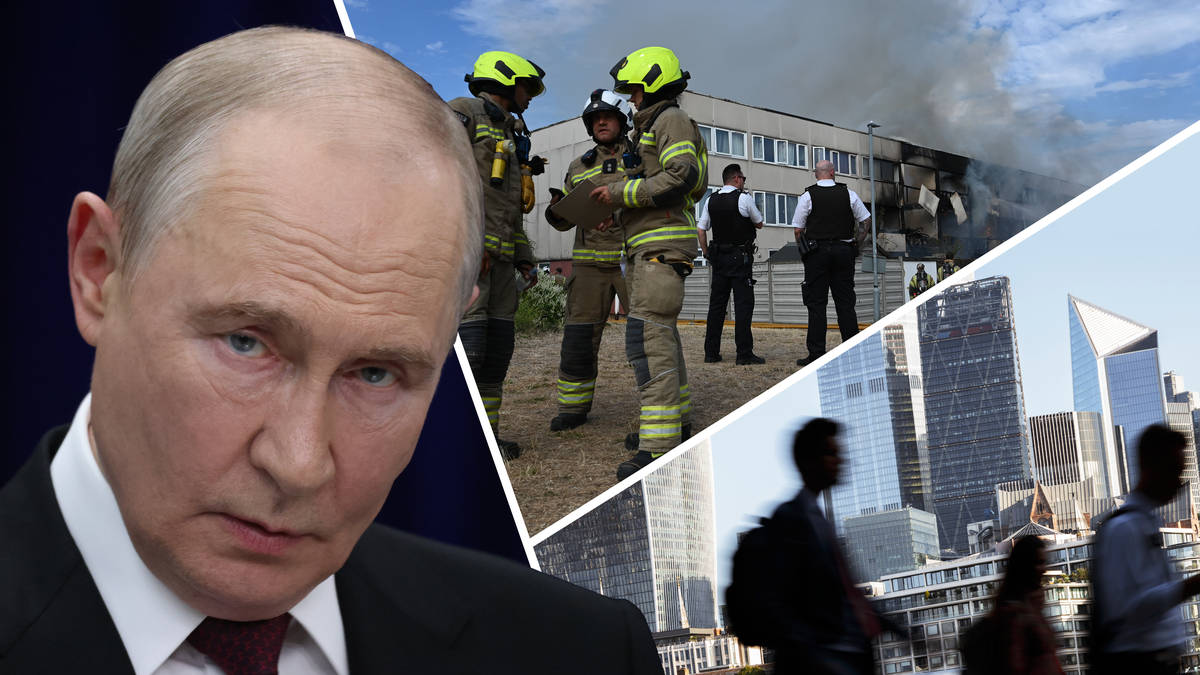
MI5 warns UK firms supporting Ukraine of Russian arson threat
Briefings and immediate guidance
Armed Forces Minister Louise Sandher-Jones convened defence industry chief executives in Whitehall on Tuesday morning. Security Minister Dan Jarvis will hold a second briefing on Wednesday for the heads of companies that run Britain’s critical national infrastructure — sectors including communications, power generation, water, transport, gas and oil, the NHS and logistics.
"Recent sabotage attempts right across Europe demonstrate the seriousness of the threats we face. It’s truly shameful that actors are seeking to disrupt our way of life and that of our allies, especially targeting organisations doing vital work in support of Ukraine."
Dan Jarvis, Security Minister, via LBC
"Russia and other hostile actors pose a growing threat to the companies that equip and support our Armed Forces. We are bringing defence industry leaders together to ensure they understand that threat and take practical action to protect their people, technology and supply chains. Government will stand alongside industry, but every company has a responsibility to strengthen its security and help protect Britain."
Media additions
Image via aol.co.ukImage via BBCImage via The Independent
Louise Sandher-Jones, Minister for the Armed Forces, via LBC
The alert urges firms to “act now to reduce opportunities for hostile actors to identify your organisation or people as targets, conduct hostile reconnaissance, and attack people, sites or operations.” Recommended steps include removing unnecessary detail from publicly available information, installing visible protective security measures such as CCTV, secure entrances and robust access controls, training staff to spot hostile reconnaissance, and rehearsing procedures for responding to suspicious activity, suspicious items and attack methodologies such as arson.
Pattern of attacks across Europe
The warning cites a recent uptick in incidents across the continent. In September, a man appeared in court accused of planning to “torch” UK drone factories on behalf of Russia’s intelligence services. Estonia has accused Moscow of an attempted arson attack at a drone factory last week, and Germany blamed Russia for a drone attack at Leipzig airport in August.
"The general assumption is that it is that such a warning would not have happened if there wasn’t some very concrete intelligence information of such Russian sabotage activities being planned. I think the other element to remember is that the suggestion is very clearly on the nature of the threat. The suggestion is not of a terribly sophisticated operations, but of a lot of proxy actors, low-level people that may be engaged in arson attacks and activities that are either designed to intimidate or designed to destroy."
Jonathan Eyal, Associate Director, Royal United Services Institute, via The i Paper
Earlier this year, incendiary devices concealed in parcels caused fires at logistics facilities in Leipzig, Birmingham and Poland; investigations linked the wider operation to Russian intelligence. In 2024, two industrial units in East London containing humanitarian supplies and Starlink equipment destined for Ukraine were deliberately set alight, causing about £1m of damage; five men were subsequently sentenced in October 2025 for their involvement in the Russian-backed operation organised through the Wagner Group.
Hybrid warfare and the proxy model
Security officials and analysts describe a shift toward “grey zone” hybrid warfare. MI5 Director General Sir Ken McCallum said last month that the agency was dedicating more resources to countering hostile states than at any point since the Cold War, with threats from foreign adversaries quadrupling over the past decade and Russia “aggressor number one.” He also warned that AI is “supercharging” cyber warfare.
The NPSA alert notes that hostile activity may sit alongside intimidation of individuals, espionage and information operations. Guidance stresses that individuals — not only senior leaders, can be targets: “anyone with access to sensitive information, assets or people may be of interest to hostile actors.” Staff are advised to remain alert to their surroundings, avoid predictable routines, and consider how personal information, movements and behaviours could be used to build a picture of them, their role and their organisation.
Industry readiness and next steps
A UK government source told The i Paper there had been “a slight frustration” across Whitehall that while companies are open to threat information, “many firms just do not have the capability or capacity” to work out how to protect their own businesses. “While you get hundreds joining NPSA briefing calls many are not security officers, but executives that have ‘security’ as just another role.”
Gen Sir Richard Barrons, co-author of last year’s Strategic Defence Review, told BBC Radio 4’s World at One the warning was “significant but not new” and that relevant companies would be “quite savvy” about cyber risks. He said there had been a recent “uptick” of attacks across Europe but “we are not expecting an epidemic.” He added: “These actions so far are significant but not strategic. They cause disruption, dismay and some damage but they have not reached the level of them being a strategic threat to the security of Europe.”
Foreign Secretary Ed Miliband, speaking to the Commons Foreign Affairs Committee earlier on Tuesday, said threats from Russia are aimed at deterring UK support for Ukraine, which “must not” happen, and that the threat from Moscow will endure beyond the Ukraine war. He reiterated that any peace settlement must not reward Russia.
What to watch next
Wednesday’s closed-door briefing for critical national infrastructure CEOs led by Security Minister Dan Jarvis.
Whether the NPSA issues further public alerts or sector-specific guidance.
Any Russian response or denial via its embassy in London; no immediate comment was reported as of Tuesday.
Potential escalation in proxy recruitment or sabotage attempts against UK defence supply chain sites.
Parliamentary scrutiny of whether companies have adequate resources and mandate to implement the recommended security measures.
The alert marks the first public warning of its kind from the NPSA and signals that the government expects the sabotage campaign to persist. As one official put it, the briefings are designed to “ram home the reality of failing to beef up security.”