US, Russia and Ukraine start second day of Abu Dhabi peace talks
Trilateral peace talks in Abu Dhabi have concluded with an agreement in principle on a massive prisoner exchange, while deep divisions over territory and European inclusion persist.

Peace talks between Russia, Ukraine, and the United States concluded in Abu Dhabi on Wednesday after a second day of closed-door discussions that yielded an agreement in principle on a major prisoner exchange but left core disputes over territory and security architecture unresolved.
The trilateral meetings in the capital of the United Arab Emirates marked the first face-to-face negotiations between Kyiv and Moscow since February. According to reporting from Yahoo News, Wednesday's session lasted just under two hours, following an initial session on Tuesday that lasted approximately 4.5 hours. While US mediators and Ukrainian delegates reported constructive momentum, stark divisions remained.
Media additions

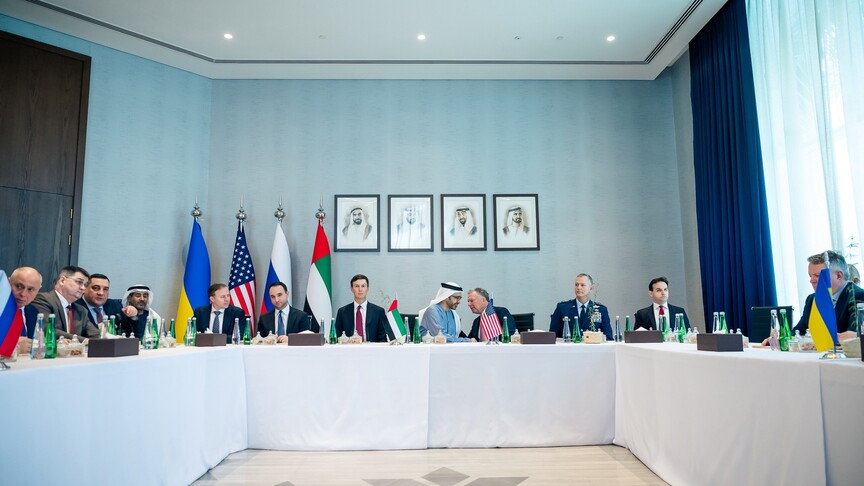

US Special Envoy Jared Kushner, speaking to reporters after the talks concluded, acknowledged the deep animosity between the combatants.
Despite the lack of trust, Kushner stated that American mediators had narrowed the gaps and that the delegations had agreed on what he described as the biggest humanitarian release of prisoners of war yet."The reality is there is no trust right now between the sides and that is to be expected after a conflict like this,"
Jared Kushner, US Special Envoy, via Yahoo News
Vladimir Medinsky, who led the Russian delegation as a presidential envoy, confirmed the prisoner swap agreement in principle, noting that concrete details would be announced later. However, Medinsky adopted a cool stance toward other aspects of the summit, telling a press conference that it remained unclear what Moscow had to discuss with the European Union.
Diplomatic Formats and European Exclusion
A major point of friction throughout the summit centered on the involvement of European partners. While European officials, the European Commission, NATO, and representatives from the E4 group—the UK, France, Germany, and Italy—held separate preparatory consultations with US and Ukrainian envoys in Abu Dhabi, Russia's delegation declined to meet directly with them, according to Kyiv Post.
Ukrainian negotiator David Arakhamia argued that future diplomacy must be multilateral rather than trilateral, insisting that European officials must be at the table. Russian Foreign Minister Sergey Lavrov dismissed the presence of European leaders, mockingly suggesting via Euronews that they could simply remain in their hotel. Nevertheless, US Secretary of State Marco Rubio maintained that European partners must eventually join the negotiations because they are vital to long-term stability.
Continuing Battlefield Strikes
The diplomatic push occurred against a backdrop of intense aerial bombardments by both sides. According to ABC News, Ukrainian and Russian forces exchanged hundreds of drone and missile strikes overnight into Wednesday. Russian forces targeted critical infrastructure, striking six large electricity substations in central Ukraine and hitting targets in Odesa, where a market attack killed three people, local authorities reported.
Conversely, Russian regional officials reported heavy drone activity over domestic territory. Aleksandr Drozdenko, governor of the Leningrad region, stated that 150 Ukrainian drones were intercepted overnight, with impacts sparking a fire and injuring workers near the Baltic Sea port of Ust-Luga. Russia's Defense Ministry claimed nationwide air defenses downed craft during the same period.
| Actor | Stance on Territory | Stance on European Inclusion | Key Deliverable |
|---|---|---|---|
| Ukraine | Rejects demands to surrender the entire Donbas region; insists leaders must resolve land disputes. | Demands full multilateral inclusion of European partners at every stage of diplomacy. | Committed to securing a large-scale prisoner exchange (1,000 to 1,500 POWs per side under discussion). |
| Russia | Demands Kyiv cede remaining Ukrainian-held land in Donbas and seeks a broad European security architecture pact first. | Opposes direct EU participation, arguing Brussels has brought no concrete peace proposals. | Agreed in principle to a major prisoner of war release; maintains military pressure on energy grids. |
| United States | Acknowledges territorial deadlocks while steering talks toward post-war security guarantees and reconstruction. | Mediators push for European integration into the broader security talks to build long-term consensus. | Facilitated trilateral talks; coordinated diplomatic travel schedules. |
What to Watch Next
Following the conclusion of the Abu Dhabi sessions, American envoys Jared Kushner and Steve Witkoff are scheduled to travel to Moscow on Thursday to hold direct talks with Russian President Vladimir Putin, as outlined by Anadolu Ajansı. Following their meetings in the Russian capital, the US mediators will fly to Ireland to brief Ukrainian leader Volodymyr Zelenskyy.
For continuing updates, consult World coverage or the background tracker on US, Russia and Ukraine resume trilateral talks in Abu Dhabi.