US appeals court halts construction on Trump White House ballroom project
A federal appeals court has temporarily halted upper-level construction on Donald Trump's controversial White House ballroom project, ruling that the executive branch lacks the authority to demolish historic portions without congressional approval.
- Core Development: A federal appeals court has temporarily halted upper-level construction on Donald Trump's controversial White House ballroom project, ruling that the executive branch lacks the authority to demolish historic portions without congressional approval.
- Beat Context: Categorized under World with independent corroboration.
- Reporting Depth: 4 minute analytical read synthesized from verified newsroom sources.
Construction on Donald Trump’s controversial White House ballroom project has hit a major legal roadblock following a federal appeals court ruling. According to AOL and The Guardian reporting, the judicial decision delivers a substantial blow to the administration’s plans, ordering an immediate halt to the upper-level structures of the development.
The Washington-based US court of appeals for the District of Columbia circuit issued a divided 2-1 order on Friday, as detailed by The Guardian. The majority opinion was penned by Judges Patricia Millet and Bradley Garcia, who firmly rejected the executive branch's unilateral approach to altering the presidential residence.
Media additions

"Each President is a temporary tenant, not the owner, of the White House and its Executive Residence."
Judges Patricia Millet and Bradley Garcia, US court of appeals for the District of Columbia circuit, via The Guardian
The judges emphasized that the executive branch lacks any constitutionally assigned authority over the property, noting that the grounds are designed and maintained for all presidents, current and future, and for the American people. The majority stated that they were aware of no prior instance in United States history where a president unilaterally and using privately collected funds demolished substantial portions of the White House that Congress authorized to be built and American taxpayers paid for.
The legal challenge originated from a lawsuit filed last year by the National Trust for Historic Preservation. The non-profit organization challenged the administration after workers tore down the historic East Wing to make way for the massive 90,000 sq ft (8,360 sq meter) undertaking without seeking authorization from Congress. The appeals court ruling successfully upholds a preliminary injunction previously secured by the preservation group.
The judicial panel clarified that the ruling does not pass judgment on the policy desirability of a new ballroom, nor does it definitively bar the structure from ever being built. Instead, the court stressed that any such massive construction requires explicit authorization from Congress rather than executive self-help during the district court's expeditious litigation. Work will be permitted to continue exclusively on structural parts deemed necessary for safety and security.
A dissenting opinion came from Judge Neomi Rao, who was appointed by Trump. Rao sided with the president's assertion that the ballroom project fell squarely within his authority as chief executive.
The latest appellate decision builds upon earlier judicial scrutiny surrounding the development. In April, a federal judge restricted the project strictly to underground construction elements deemed essential for national security, while blocking the hospitality facility intended for entertaining guests. Trump lashed out at that prior decision by Judge Richard Leon—appointed to the bench during George W Bush’s presidency—branding the judge as an opponent attempting to undermine national security and delay or prevent the construction of what the president has touted as a gift to the US people.
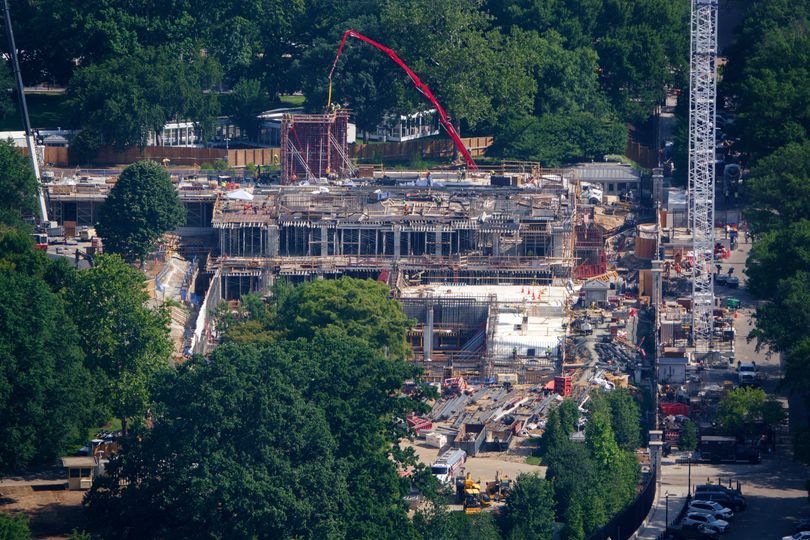
Financial and architectural details surrounding the undertaking have also drawn intense public debate and varying estimates. While initial references pointed to a $400 million project cost, reports indicate the overall expense could reach around $600 million, with $350 million potentially drawn from taxpayer funds despite initial assertions otherwise. Construction has been ongoing for about a year, but the project appears to still be in the early stages as the ongoing work has transformed the area into piles of wreckage surrounding a naked building, contrasting sharply with the administration's stated vision.
Supporters of the project have defended the construction, with figures like Lil Wayne offering public backing by stating the president is simply "being Trump." Meanwhile, the administration has framed the enterprise not merely as an entertainment space, but as a critical security upgrade. Trump has previously asserted that the massive structure will function as a protective shield against drone and sniper threats, safeguarding sensitive subterranean areas located several stories below ground level. According to Trump, the ballroom acts as a shield for everything below, noting that workers could not build the lower floors without that shield over the top, which protects what goes down six stories, three of which are already built.
What to Watch Next
- The appeals court has placed its ruling on hold for a brief two-week window, granting the Trump administration time to appeal the decision directly to the US Supreme Court.
- Litigation will continue in the district court unless higher judicial intervention alters the current course of the injunction.
How significant is this development?
Contribute your assessment to the aggregated reader sentiment ledger.
Frequently Asked Questions
Key questions answered in this reportWhat is the key development in: US appeals court halts construction on Trump White House ballroom project?
A federal appeals court has temporarily halted upper-level construction on Donald Trump's controversial White House ballroom project, ruling that the executive branch lacks the authority to demolish historic portions without congressional approval.
Why is this World development significant for the UK?
This report covers critical events in our World beat. Independent reporting monitors related UK statements, regulatory shifts, and public responses as further verified details emerge.
How was this reporting corroborated and verified?
Newsarchy UK compiles and cross-references reporting from primary reporting from aol.com and cross-checked wire reports. All coverage adheres to published editorial standards.
When was this report published?
This briefing was published on August 7, 2026 and is permanently cataloged in the Newsarchy UK World archives.