China October retail sales and industrial output growth slow as domestic demand sags
China's retail sales and industrial output growth slowed in October as persistent domestic consumer weakness threatened economic momentum.

China's retail sales and industrial output growth slow as domestic demand sags, threatening growth momentum as the world's second-largest economy struggles to shake off persistent consumer weakness.
According to figures published by the National Bureau of Statistics (NBS) on Monday, retail sales expanded by just 0.4% year-on-year in October. This marked a sharp slowdown from September's 1.1% increase and missed analyst forecasts. ING analysts and market consensus had expected retail growth of 0.7% and 0.8% respectively, while Investinglive noted the weak print arrived despite a seven-day national holiday and the kickoff of the Singles Day shopping festival. Industrial production similarly lost steam, expanding 4.8% year-on-year in October compared to 5.5% in September, falling short of Bloomberg and market expectations of 5.3%.
Media additions


Beijing continues grappling with sluggish domestic spending that has weighed down national growth since the end of the Covid-19 pandemic, even as robust exports provide an offset. The NBS stated that while the economy remained stable in October, the international environment remains characterised by significant instability and uncertainty. Officials acknowledged that the imbalance between strong supply and weak demand persists, while authorities pursue an official full-year growth target of 4.5% to 5.0%—the lowest goal in decades.
Economic strain appeared across multiple sectors in October, with domestic demand-linked industries bearing the brunt of the slowdown.
| Economic Indicator | October 2026 Actual | Previous Period | Market Forecast / Consensus |
|---|---|---|---|
| Retail Sales (YoY) | 0.4% | 1.1% (September) | 0.8% |
| Industrial Production (YoY) | 4.8% | 5.5% (September) | 5.3% |
| Fixed-Asset Investment (YoY YTD) | -8.1% | -7.2% (Jan-Sep) | -7.0% |
| New Yuan Bank Loans | -100 billion yuan | Positive territory | Contraction |
Consumer spending faced sharp double-digit year-on-year contractions in specific categories, including gold and jewellery sales dropping 28.7% amid falling precious metal prices, auto sales sliding 21.4% as demand cooled following years of policy support, and building and decoration materials falling 11.2% due to ongoing property market pressures. Even high-flying categories like communication appliances slowed to 6.5% growth.
The property sector remained a primary drag on the wider economy. New home prices fell for the forty-first consecutive month in October, declining 0.15% month-on-month, while used home prices dropped 0.24%. Property investment slumped 21.6% in the first ten months of the year. However, ING pointed to cautious optimism in city-level breakdowns, noting that 21 of 70 cities saw new home prices stabilise or rise, with Shanghai recording its ninth straight month of secondary market price gains.
Credit data revealed unprecedented weakness in borrowing demand. According to Reuters calculations based on People's Bank of China statistics, new yuan-denominated bank loans turned negative 100 billion yuan in October, marking the third time this year that monthly lending contracted as loan repayments outpaced new borrowing. Outstanding yuan loan growth slowed to a record low of 4.7% year-on-year. Despite this contraction in bank credit, Total Social Financing expanded 7.2% year-on-year, reflecting broader funding injections through government and corporate bond issuances.
Manufacturing performance displayed stark divergences. High-tech manufacturing surged 17.6% year-on-year, led by computer, communication, and electronic equipment manufacturing jumping 19.4%, alongside robust semiconductor output up 21.9% and industrial robots climbing 26.0%. Conversely, traditional manufacturing, vehicle production, and construction-linked materials suffered steep declines.
International observers Note that China's economy is effectively running on a single engine powered by exports and high-tech manufacturing, while domestic consumption and property languish. Investors are closely monitoring how these domestic trends impact global markets, including business sentiment, Japanese equities, and broader trade dynamics.
As the year progresses toward its final weeks, analysts observe that the current slowdown leaves little room for error if Beijing wishes to meet its growth objectives without deploying aggressive new stimulus. Observers note that while the third-quarter gross domestic product managed to expand at 4.5%, the October indicators demonstrate that the foundational momentum of the domestic market remains fragile.
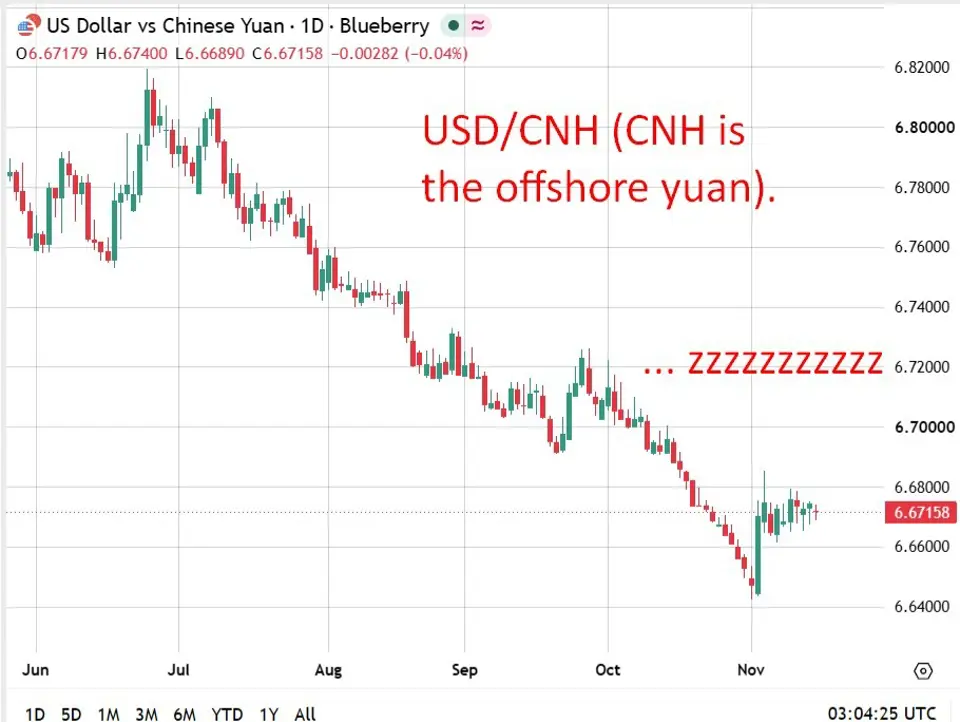
The stark divergence between the booming external export sector and the anaemic domestic consumer base has forced market participants to re-evaluate potential trajectories for the broader Asian economy. Currency markets and commodities, including oil and industrial metals, are adjusting to the prospect of tempered Chinese internal consumption. Meanwhile, financial institutions continue to parse whether upcoming policy meetings will introduce targeted measures to reinvigorate household confidence or if authorities will remain content to let the export-driven engine carry the macroeconomic weight.
What to watch next
- Further monthly releases tracking whether household and corporate bank borrowing demand shows signs of recovery.
- Property price indices to verify if tier-one and tier-two housing stabilisation spreads to broader inventory clearance.
- Potential policy signals from Beijing regarding targeted fiscal support for consumption heading into next year.