Xiaomi tipped as top beneficiary of China AI home appliance market growth
As China’s traditional home appliance market contracts, manufacturers are pivoting toward AI-driven systems to target the silver economy and smart home integration.

- Core Development: As China’s traditional home appliance market contracts, manufacturers are pivoting toward AI-driven systems to target the silver economy and smart home integration.
- Beat Context: Categorized under Business with independent corroboration.
- Reporting Depth: 3 minute analytical read synthesized from verified newsroom sources.
China’s domestic home appliance sector is undergoing a profound transformation as manufacturers pivot toward software-driven capabilities to counter a shrinking traditional market. In response, major firms are leveraging artificial intelligence to transition from simple hardware sales to offering “appliance-as-agent” systems that promise task automation, health monitoring, and energy efficiency.
Xiaomi is currently positioned as a primary beneficiary of this trend. According to Morgan Stanley, the company maintains an Overweight rating and is well-placed to capture long-term growth through its expansive ecosystem. Unlike legacy appliance manufacturers, Xiaomi utilizes its HyperOS platform to link smartphones, wearables, televisions, and electric vehicles into a unified experience. This “Human + Car + Home” strategy allows the company to cross-sell products across a massive installed base of over one billion connected devices. Analysts project Xiaomi’s domestic AI home appliance revenue could exceed RMB200 billion by 2035, with international markets representing a significant secondary revenue stream.
Media additions
Market Contraction and the AI Pivot
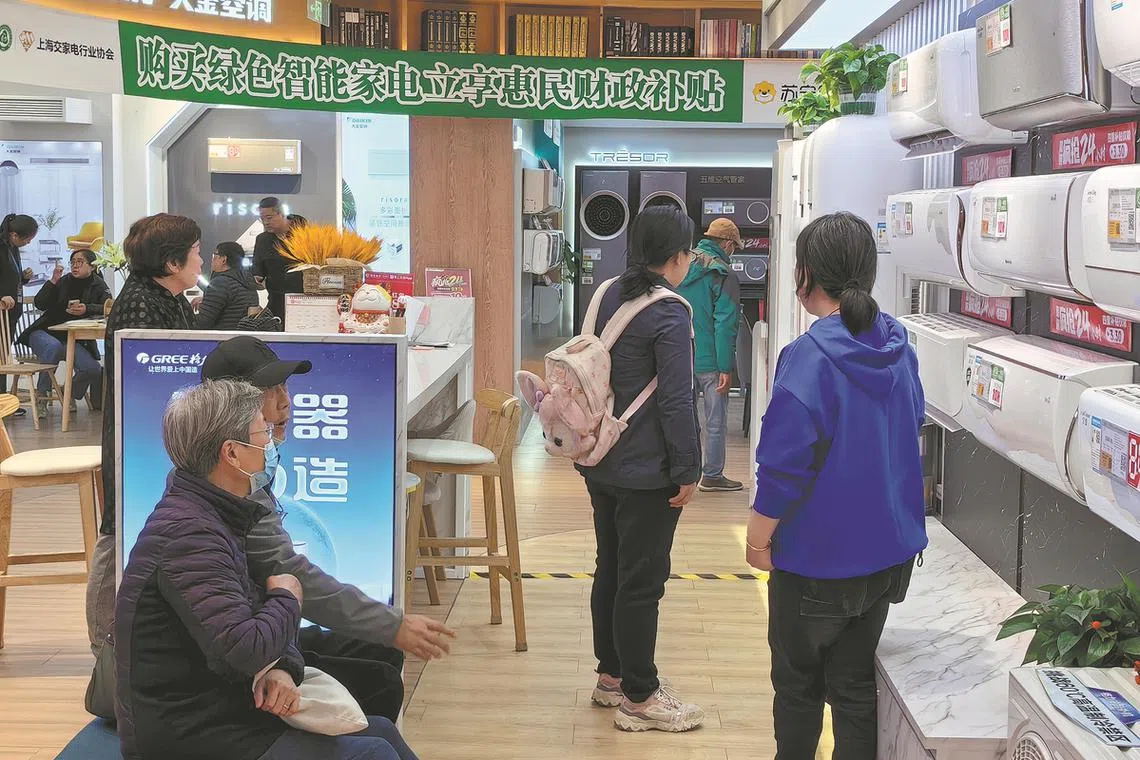
The push toward high-tech differentiation follows a period of retail stagnation. According to AVC data, full-channel retail sales of home appliances in China, excluding 3C products, fell 4.3% in 2025 to RMB 893.1 billion. The air-conditioner market, a cornerstone of the domestic industry, faces further pressure; retail sales are projected to decline by 6.9% to RMB 230.5 billion in 2026, down from RMB 235.7 billion the previous year. TV shipments also saw a decline, reaching 27.63 million units in 2025.
To combat eroding margins, brands including Haier, Gree, Hisense, and TCL are moving beyond basic specifications. At the AWE 2026 industry event, manufacturers showcased floor cleaners equipped with bionic arms, refrigerators with food-recognition models, and televisions powered by AI chips designed for multi-user recognition and content recommendation. Companies are also investing heavily in fulfillment and logistics to ensure these complex systems are properly installed, with Gree Electric Appliances partnering with digital platforms to improve delivery speeds and integration services.
Targeting the Silver Economy
A major focus for manufacturers is the rapid growth of the silver economy. With the elderly population in China projected to grow by more than 10 million annually over the next decade, companies are tailoring appliances to meet specific health and mobility needs. Haier has introduced rehabilitation robots and bathroom systems with voice-activated temperature controls, while Hisense and Sichuan Changhong have developed smart televisions that provide medication reminders, health information, and medical-level vision protection.
Industry experts emphasize that this demographic shift turns household appliances into “emotional companions.” According to the China Research Centre on Ageing, the silver economy is expected to grow from 7 trillion yuan in 2024 to 30 trillion yuan by 2035. Regulatory support, including guidelines released by the Ministry of Civil Affairs, encourages the development of these senior-friendly products to improve quality of life and create new revenue drivers.
Global Outlook and Operational Hurdles
While domestic firms focus on local replacement demand, the 2026 market marks an inflection point for international strategy. Panasonic has restructured its regional operations, establishing a unit in China with cross-business coordination authority to evaluate locally developed AI appliances for global rollout. The company aims to double the revenue share from Asian markets, excluding Japan and China, to 20% within three years.
Despite the optimism surrounding AI, broader IT spending in China remains cautious. A survey of 60 chief information officers conducted in March and April 2026 by Morgan Stanley revealed that while AI remains a top investment priority, IT budget growth is at a record low. Furthermore, 47% of those surveyed noted that the actual deployment of initial AI projects has been delayed until 2027 due to budget constraints and economic pressures.
What to Watch Next
- Regulatory Implementation: The rollout of general technical requirements for smart home appliances, which commenced in May 2026, is expected to reduce interoperability friction between different brands.
- Cost Management: Manufacturers, including Xiaomi, are managing rising memory chip costs through product mix improvements and price adjustments. Industry observers expect these cost pressures to ease during the second half of 2026.
- Monetization Metrics: As the market moves into the latter half of the year, investors will be monitoring whether companies can prove measurable outcomes—such as energy savings and effective health management—to justify premium pricing in a competitive environment.
How significant is this development?
Contribute your assessment to the aggregated reader sentiment ledger.
Frequently Asked Questions
Key questions answered in this reportWhat is the key development in: Xiaomi tipped as top beneficiary of China AI home appliance market growth?
As China’s traditional home appliance market contracts, manufacturers are pivoting toward AI-driven systems to target the silver economy and smart home integration.
Why is this Business development significant for the UK?
This report covers critical events in our Business beat. Independent reporting monitors related UK statements, regulatory shifts, and public responses as further verified details emerge.
How was this reporting corroborated and verified?
Newsarchy UK compiles and cross-references reporting from primary reporting from chinabizinsider.com and cross-checked wire reports. All coverage adheres to published editorial standards.
When was this report published?
This briefing was published on July 12, 2026 and is permanently cataloged in the Newsarchy UK Business archives.