Donald Trump approval rating crashes among Republicans ahead of US midterms
President Donald Trump faces a sharp decline in voter approval and Republican support just weeks before the congressional midterms, driven by severe economic anxiety.

- Core Development: President Donald Trump faces a sharp decline in voter approval and Republican support just weeks before the congressional midterms, driven by severe economic anxiety.
- Beat Context: Categorized under Cost of Living with independent corroboration.
- Reporting Depth: 3 minute analytical read synthesized from verified newsroom sources.
President Donald Trump’s job approval rating has plummeted to historic lows among registered voters and within his own party just weeks before the upcoming congressional midterm elections on November 3, The Economic Times reports. As the cost of living continues to squeeze households facing higher prices for fuel, groceries, housing, and healthcare, voter sentiment has turned sharply against the administration, placing the Republican congressional majorities in serious jeopardy.
The legislative branch is at stake on November 3, when Americans head to the ballot box to choose all 435 members of the House of Representatives and 35 out of 100 seats in the Senate, according to the BBC. The outcome will determine whether Republicans retain control of Capitol Hill or if opposition Democrats reclaim a chamber, a shift that would grant them subpoena power and the ability to block the president's domestic policy agenda. Historically, the party holding the White House loses ground in these midterms, but current data points suggest a potentially severe defeat for the governing party, notes CBC.
Media additions


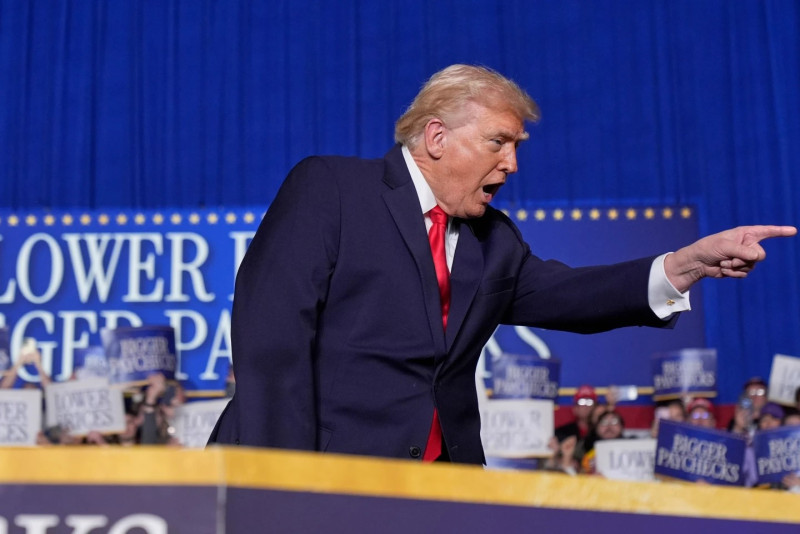
Polling compiled across major outlets paints a grim picture for the administration's standing. Meanwhile, The Vibes cites a Reuters/Ipsos poll placing his approval at 32 per cent, with registered voters favoring Democrats over Republicans by 44 per cent to 37 per cent.
| Polling Organization / Metric | Approval RatingDisapproval / Advantage||
|---|---|---|
| Reuters / Ipsos Poll | 32% | Democrats favored 44% to 37% |
| AP-NORC Center Poll | 26% (Economy) | Widespread economic dissatisfaction |
The primary driver behind the plunge in support is the ongoing affordability crisis. Voters are struggling with the cost of daily necessities, a situation aggravated by persistent inflation that remains above the target set by the US Federal Reserve. CBC reports that inflation is running hotter than it was when the second term began, while WHEC notes that only 26 per cent of US adults approve of Trump's handling of the economy. Economists attribute part of the price pressure to administration trade tariffs and the impact of the war on Iran, which commenced in February and disrupted global oil supplies, spiking diesel and fuel costs.
Discontent has even seeped into the Republican base. A Reuters/Ipsos poll highlighted by WTVB revealed that party support for the president dropped nine points over the course of a single week, landing at 73 per cent. In response, several Republican candidates in competitive senate and house races have begun distancing themselves from the White House. In Michigan, Senate candidate Mike Rogers released an ad denouncing the trade war with Canada, while Maine incumbent Senator Susan Collins stated in a debate that she is not the president's favorite senator, according to CBC.
To combat the polling deficit, congressional Republicans returned to Washington to advance measures aimed at proving their affordability credentials. As WTVB reports, lawmakers took up the Ratepayer Protection Act to shield consumers from rising electricity bills driven by power-hungry data centers required for artificial intelligence infrastructure. Meanwhile, President Trump has continued a heavy travel schedule, rallying supporters in states like Alabama, Ohio, and Texas while frequently promoting a proposal to distribute $5,000 checks to every American adult if the party retains Congress—a pledge that has received little backing from congressional Republicans wary of its impact on the national debt and inflation, as noted by WHEC.
What happens next will depend on the final weeks of campaigning. With the Group of Seven industrial nations planning to release 100 million barrels of oil and fuel products to ease energy costs, and both parties pouring vast financial resources into tight races, the November 3 election will serve as a definitive referendum on the administration's economic trajectory and dictate the balance of power in Washington for the remainder of the presidential term.
How significant is this development?
Contribute your assessment to the aggregated reader sentiment ledger.
Frequently Asked Questions
Key questions answered in this reportWhat is the key development in: Donald Trump approval rating crashes among Republicans ahead of US midterms?
President Donald Trump faces a sharp decline in voter approval and Republican support just weeks before the congressional midterms, driven by severe economic anxiety.
Why is this Cost of Living development significant for the UK?
This report covers critical events in our Cost of Living beat. Independent reporting monitors related UK statements, regulatory shifts, and public responses as further verified details emerge.
How was this reporting corroborated and verified?
Newsarchy UK compiles and cross-references reporting from primary reporting from BBC and cross-checked wire reports. All coverage adheres to published editorial standards.
When was this report published?
This briefing was published on October 10, 2026 and is permanently cataloged in the Newsarchy UK Cost of Living archives.