EU households spend average of 19.7 percent of disposable income on housing
Housing has become the primary financial burden for EU households, with average expenditure reaching 19.7% of disposable income in 2023. This report examines regional disparities and the disproportionate impact of housing costs on lower-income families.

- Core Development: Housing has become the primary financial burden for EU households, with average expenditure reaching 19.7% of disposable income in 2023. This report examines regional disparities and the disproportionate impact of housing costs on lower-income families.
- Beat Context: Categorized under Cost of Living with independent corroboration.
- Reporting Depth: 3 minute analytical read synthesized from verified newsroom sources.
Housing has solidified its status as the primary financial burden for households across the European Union. According to Euronews and IndexBox, the average share of disposable income dedicated to housing reached 19.7 percent in 2023. This expenditure — encompassing mortgage interest, rent, utilities, maintenance, and mandatory property taxes — now stands as the single largest category of household spending, consistently eclipsing food and transport costs.
The financial pressure is not uniform. The Realting analysis highlights that while the EU-wide average sits near 20 percent, national experiences vary significantly. Greece serves as a stark outlier, with households allocating 35.2 percent of their disposable income to housing. This reflects a prolonged period of economic instability; Ilias Nikolaidis of the Athens-based think tank diaNEOsis explained that Greek households experienced a 40 percent loss in income between 2009 and 2014, while a lack of new construction and increased international demand, driven by tourism and golden visa programmes, kept upward pressure on housing costs.
Media additions
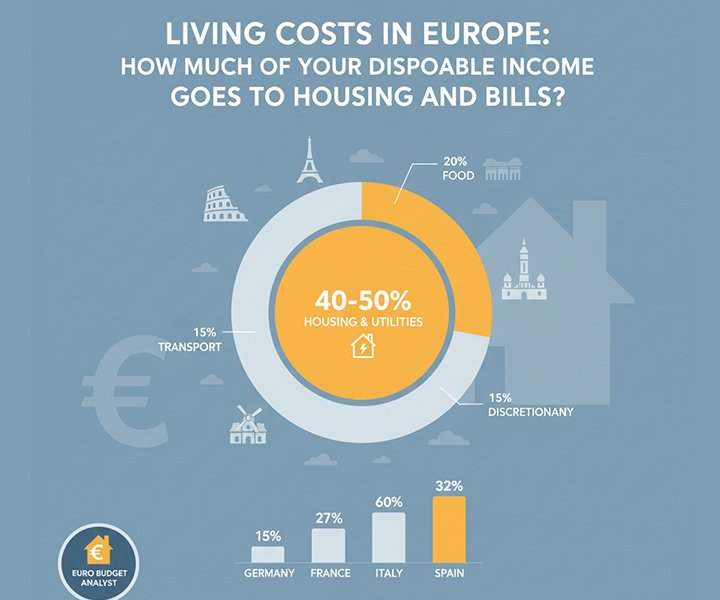


The divergence between higher-income and lower-income households remains a defining feature of the current Cost of Living crisis. Data from Finorum and Yahoo Finance indicate that for those at risk of poverty, defined as individuals earning less than 60 percent of the national median, housing costs consume an average of 38.2 percent of their income across the EU. In Greece, this burden reaches 62.4 percent. Conversely, households above the median income threshold allocate roughly 16.2 percent to the same expenses.
Northern and Western European nations also report high cost ratios despite higher average incomes. Germany, for instance, leads the EU’s "Big Four" economies with 25.2 percent of income spent on housing, while Denmark (25.9 percent) and Norway (25 percent) also rank among the most expensive nations for residents. Experts from Trustvistaconsulting note that these figures are influenced by a complex interplay of local rental markets, mortgage conditions, and energy costs.
Comparative Housing Cost Burdens
| Country | Share of Disposable Income Spent on Housing |
|---|---|
| Greece | 35.2% |
| Denmark | 25.9% |
| Germany | 25.2% |
| EU Average | 19.7% |
| Italy | 14.5% |
| Cyprus | 11.6% |
The upward trend in housing costs is widespread. Between 2020 and 2023, the EU average increased by 1.2 percentage points. While Bulgaria recorded a decrease of 2 percentage points, countries such as Hungary reported an increase of 5.7 percentage points. Dara Turnbull, a research coordinator at Housing Europe, cautions that these percentage-based measures may not capture the full gravity of the situation, as they fail to reflect the remaining disposable income available for other essentials after housing is paid.
This perspective is echoed in studies of the UK market. The Resolution Foundation notes that aggregate measures often mask the intensity of housing costs for lower-income groups. In Britain, housing costs are 44 percent above the OECD average. While food costs in the UK remain comparatively low due to retail competition, this relief is insufficient to offset the high housing expenditure, rendering Britain a more expensive environment for poorer families than headline figures imply.
What to watch next
- Policy interventions: Whether national governments will implement stricter rent controls or increase housing supply to address the gap between income growth and rent inflation.
- Energy price volatility: As utilities constitute a major component of housing costs, ongoing fluctuations in electricity and heating prices are expected to continue impacting the share of income households dedicate to their homes.
- Market adjustments: With preliminary 2024 data from five EU nations suggesting that cost increases may be accelerating, observers will monitor if housing pressure begins to impact broader consumer spending and economic growth in the coming quarters.
As affordability becomes a central issue for policymakers, the divergence between housing markets and wage growth remains the core driver of economic strain. Those seeking to understand their own financial standing should consider that national averages rarely reflect the specific pressures faced by residents in major capital cities, where urban density and labor market constraints frequently push costs well above the national median.
How significant is this development?
Contribute your assessment to the aggregated reader sentiment ledger.
Frequently Asked Questions
Key questions answered in this reportWhat is the key development in: EU households spend average of 19.7 percent of disposable income on housing?
Housing has become the primary financial burden for EU households, with average expenditure reaching 19.7% of disposable income in 2023. This report examines regional disparities and the disproportionate impact of housing costs on lower-income families.
Why is this Cost of Living development significant for the UK?
This report covers critical events in our Cost of Living beat. Independent reporting monitors related UK statements, regulatory shifts, and public responses as further verified details emerge.
How was this reporting corroborated and verified?
Newsarchy UK compiles and cross-references reporting from primary reporting from euronews.com and cross-checked wire reports. All coverage adheres to published editorial standards.
When was this report published?
This briefing was published on July 9, 2026 and is permanently cataloged in the Newsarchy UK Cost of Living archives.