AfD reelects leaders in Erfurt amid mass protests against party convention
The AfD reelected Alice Weidel and Tino Chrupalla as party leaders during a national convention in Erfurt, which was met with mass protests and civil unrest.

- Core Development: The AfD reelected Alice Weidel and Tino Chrupalla as party leaders during a national convention in Erfurt, which was met with mass protests and civil unrest.
- Beat Context: Categorized under World with independent corroboration.
- Reporting Depth: 3 minute analytical read synthesized from verified newsroom sources.
The Alternative for Germany (AfD) party moved to solidify its national leadership on Saturday, 4 July 2026, reelecting Alice Weidel and Tino Chrupalla to head the organization during a two-day national convention in Erfurt. The assembly, held amid significant public unrest, serves as a strategic launchpad for the party as it seeks to secure its first-ever state-level government control in upcoming regional elections.
The convention proceeded on schedule despite mass demonstrations aimed at preventing delegates from reaching the Erfurt Exhibition Center. While police estimates of the protest turnout varied—with reports ranging between 15,000 and 31,000 participants—the Widersetzen (Resist) alliance and other groups engaged in widespread civil disobedience. Activities included street blockades, sit-ins, and activists chaining themselves to tram tracks. Authorities recorded isolated clashes between demonstrators and riot police, with law enforcement deploying pepper spray and reporting nearly 60 arrests during the day’s activities.
Media additions

Leadership and Strategy
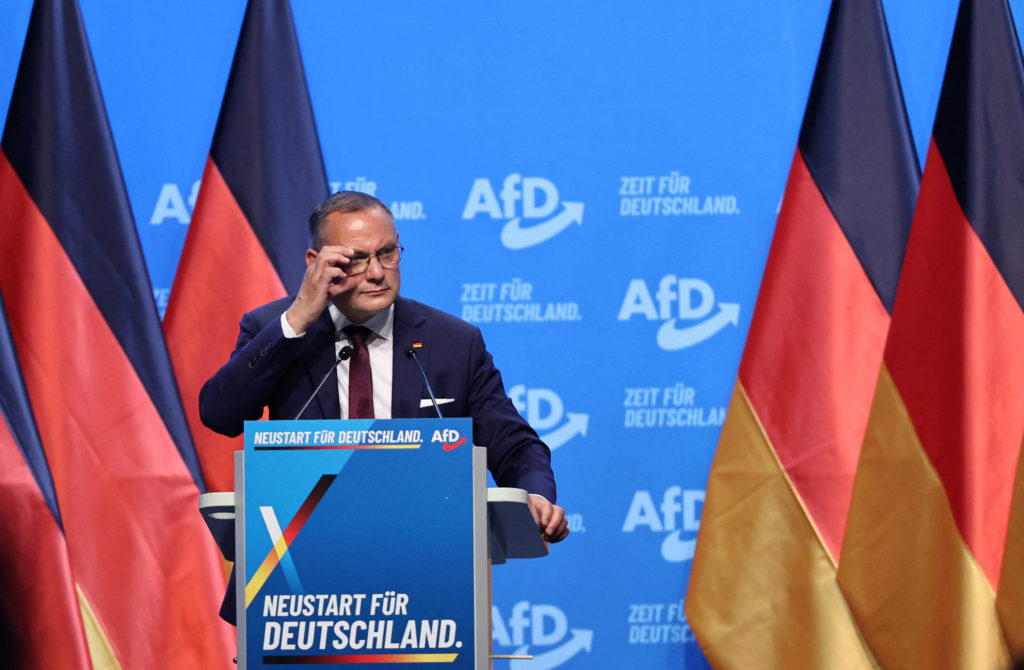
The party’s internal elections reinforced the current leadership structure, though with varying levels of consensus. Weidel, a former finance sector analyst, secured 81% of the delegate vote. Chrupalla, a former tradesman, received 70% support, a decrease from his standing in previous years. In speeches to the party faithful, both leaders framed their organization as a mainstream people’s party
and directly challenged the firewall
strategy adopted by Germany’s established political parties, which seek to prevent any coalition cooperation with the AfD.
The rhetoric inside the hall focused heavily on the party’s ambition to govern. We will govern. First at a regional level, then at national level,
Chrupalla declared to delegates. The party’s platform continues to emphasize a remigration
policy, with Weidel promising rigorous deportations for illegal migrants and criminals. The event also featured regional leader Björn Höcke, who defended the party’s choice of venue against critics who noted that the date coincided with the 100-year anniversary of a 1926 Nazi Party meeting in nearby Weimar. Höcke characterized the controversy as nonsense
and an attempt by political opponents to weaponize history.
Protester Perspectives
For the thousands gathered outside, the convention represented a threat to the nation's democratic foundations. Many participants explicitly referenced Germany’s history between 1933 and 1945 as a reason for their presence. The democratic parties need to understand that they must impose a ban,
said one protester named Ella, reflecting a sentiment shared by those who argue the AfD promotes racist and extremist policies. Other figures, including Thuringia’s Interior Minister Georg Maier, attended separate, authorized demonstrations to signal support for diversity and opposition to the shift toward far-right politics.
Upcoming Political Milestones
The convention serves as a focal point for a party currently riding high in national opinion polls. After achieving 20.8% of the vote in the February 2025 national election, the AfD has seen its support climb further amidst ongoing economic stagnation. The party is now targeting key state elections scheduled for September 2026.
As the convention concludes, the political divide continues to widen. While the AfD attempts to project unity and readiness for governance, mainstream political leaders, including Chancellor Friedrich Merz, face increasing pressure to provide viable economic reforms to counter the party’s growing influence. The ongoing legal challenges regarding the classification of the party as an extremist group remain unresolved, with the next court evaluations set to play a pivotal role in the party's future activities.
How significant is this development?
Contribute your assessment to the aggregated reader sentiment ledger.
Frequently Asked Questions
Key questions answered in this reportWhat is the key development in: AfD reelects leaders in Erfurt amid mass protests against party convention?
The AfD reelected Alice Weidel and Tino Chrupalla as party leaders during a national convention in Erfurt, which was met with mass protests and civil unrest.
Why is this World development significant for the UK?
This report covers critical events in our World beat. Independent reporting monitors related UK statements, regulatory shifts, and public responses as further verified details emerge.
How was this reporting corroborated and verified?
Newsarchy UK compiles and cross-references reporting from primary reporting from pbs.org and cross-checked wire reports. All coverage adheres to published editorial standards.
When was this report published?
This briefing was published on July 5, 2026 and is permanently cataloged in the Newsarchy UK World archives.