Board of Peace says Israel's aid response after Gaza floods insufficient
Severe seasonal storms flooded displacement camps across Gaza, prompting Donald Trump's Board of Peace to declare an emergency and criticize Israel's aid response.

Severe seasonal storms have transformed displacement camps across Gaza into flooded squalor, prompting Donald Trump's Board of Peace to declare an immediate humanitarian emergency on Monday while rebuking Israel for an inadequate aid response.
Torrents of rain and powerful winds battered the territory, submerging tens of thousands of makeshift tents and triggering a deadly sand embankment collapse in Deir al-Balah that killed a mother and her three young children. The weekend storm affected hundreds of thousands of individuals, many of whom are already enduring displacement following years of conflict.
Media additions


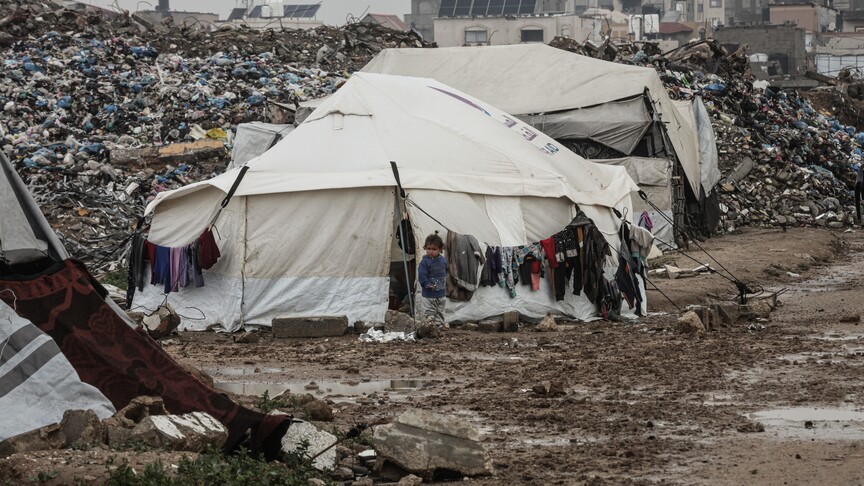
In a rare public rebuke, the US-led body overseeing the region's peace plan stated that the Israeli government's actions fell short of what was required. According to reporting by the BBC, the board noted that it had spent months urging authorities in Tel Aviv to authorize essential goods for temporary shelter, drainage, waste management, and sanitation infrastructure. The United Nations swiftly backed this assessment, with deputy UN spokesperson Farhan Haq confirming to reporters that the organisation agreed with the evaluation of insufficient support.
Humanitarian agencies warned that the infrastructure failure extends far beyond surface water. In Gaza City, the Sheikh Radwan stormwater basin filled past capacity and mixed with raw sewage, raising urgent public health alarms regarding potential outbreaks of hepatitis A, parasitic infections like giardiasis, and waterborne illnesses. Aid officials noted that more than 150,000 tents and critical heavy machinery—including mobile dewatering pumps, vacuum trucks, and hoses—remain stranded just outside the enclave's borders.
Disagreements persist over accountability for the stalled humanitarian response and the broader peace framework. COGAT, the Israeli military agency overseeing aid flows, countered that it was actively coordinating a winter preparedness plan alongside international organizations. The agency maintained that over 91,000 tents and thousands of truckloads carrying winter supplies had entered the territory. However, COGAT asserted that half of additional logistics requests stalled due to administrative and budgetary hurdles within the United Nations, while insisting that reconstruction and specialized equipment entries must wait until Hamas fully disarms. Israeli Foreign Ministry spokeswoman Michal Maayan argued that winter hardships stem directly from Hamas policies and delays in transferring governance.
| Indicator / Metric | Reported Figure | Reporting Source |
|---|---|---|
| Population living in tents or makeshift shelters | ~65% (about 1.4 million people) | United Nations / BBC |
| Tents and temporary shelters flooded or damaged | Over 70,000 to 150,000+ | Save the Children / OCHA / Yahoo News |
| Tents reported brought in under COGAT winter plan | 91,000+ | COGAT / The Siasat Daily |
| Tents and heavy equipment awaiting entry outside Gaza | 150,000+ tents | OCHA / Anadolu Ajansı |
Hamas rejected the Board of Peace's statements as a distorted account of the disaster, pointing instead to Israeli restrictions and citing previous warnings from regional mediators regarding ceasefire violations. Under the terms of the October 2025 accord designed to end the two-year war, Hamas agreed to relinquish its governance and weapons in exchange for a phased troop withdrawal by Israel from the remaining areas it occupies. Disagreements over the sequence of disarmament and withdrawal have left subsequent phases frozen.
International figures have amplified calls for immediate intervention. British Foreign Secretary Ed Miliband stated that the humanitarian situation is deteriorating rapidly and reminded occupying authorities of their legal obligations to protect civilians and facilitate basic welfare.
What to watch next
- Decisions by Israeli authorities regarding the clearance of heavy dewatering machinery and shelter equipment held at border checkpoints.
- Potential negotiations concerning the disarmament schedule and the transfer of administrative authority to transitional committees.
- Updates from international health agencies monitoring disease vectors and stormwater basin rehabilitation efforts as winter weather continues.
For related developments across the region, visit our broader World coverage.


