Kennedy family sues to block Trump arch over Arlington gravesite shadows
Nine members of the Kennedy family have joined a lawsuit to block a 250-foot Trump administration arch, arguing the structure would cast shadows over Arlington gravesites without congressional approval.
Kennedy family sues to block Trump arch over Arlington gravesite shadows
"This action is about protecting sacred spaces that belong to the American people. Our parents, Robert and Ethel Kennedy, and our uncles, President John F. Kennedy and Senator Edward M. Kennedy, are laid to rest at Arlington National Cemetery. Our uncle Joseph P. Kennedy Jr., who lost his life serving our country in World War II, is also memorialized there. They are among the more than 400,000 veterans and family members buried or honored on this hallowed ground. We believe Donald Trump has violated the laws and procedures established by Congress to protect this most sacred national memorial. In bringing this lawsuit, we stand for those who can not stand for themselves."
Rory Kennedy and Maxwell Kennedy, on behalf of the family, via Democracy Defenders Fund
The plaintiffs are Rory Kennedy, Maxwell Kennedy, Christopher G. Kennedy, Kerry Kennedy, Courtney Kennedy, Kathleen Kennedy Townsend, Joseph P. Kennedy II, Joseph P. Kennedy III and Edward M. Kennedy Jr. — seven children of Robert and Ethel Kennedy, one grandchild, and the son of Senator Edward M. Kennedy. Notably absent is Robert F. Kennedy Jr., the current Secretary of Health and Human Services, who leads the Department of Health and Human Services.
The arch and its location
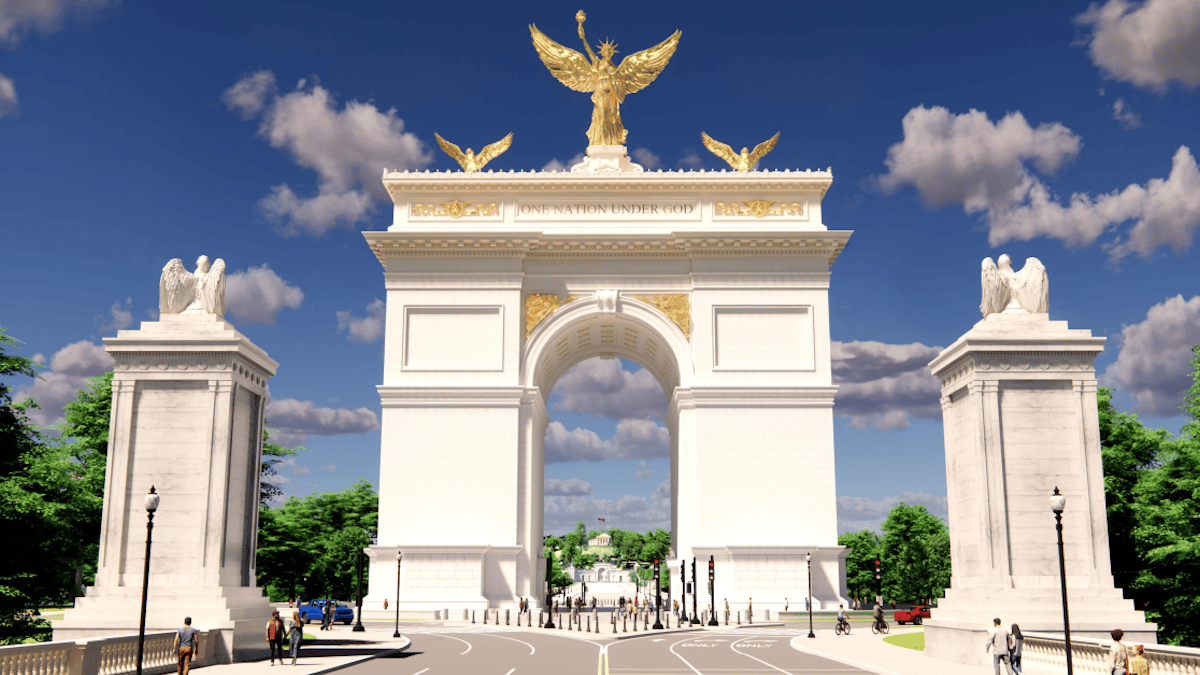
The proposed structure — dubbed the "Independence Arch" by the administration and the "Arc de Trump" by critics, would rise 250 feet (76 metres) at Memorial Circle on Columbia Island, at the western end of Arlington Memorial Bridge. According to the White House, it would feature a mezzanine at 166 feet, a 24-foot observation deck and a 60-foot Lady Liberty-style winged statue atop the crown. The administration says it is intended to commemorate the nation’s 250th anniversary.
"The gigantic proposed arch is an illegal interference with Arlington National Cemetery and the heroes remembered there, including at the gravesites and memorials of the Kennedy brothers and Ethel Kennedy. Only Congress has the constitutional power to authorize an intrusion of this magnitude. Today, members of the Kennedy family are joining with the other litigants in this case to protect this historic site–and to defend the rule of law and separation of powers."
Image via bostonglobe.comImage via nbcnewyork.comImage via Democracy Defenders Fund
Norman Eisen and Steve Jonas, Democracy Defenders Fund
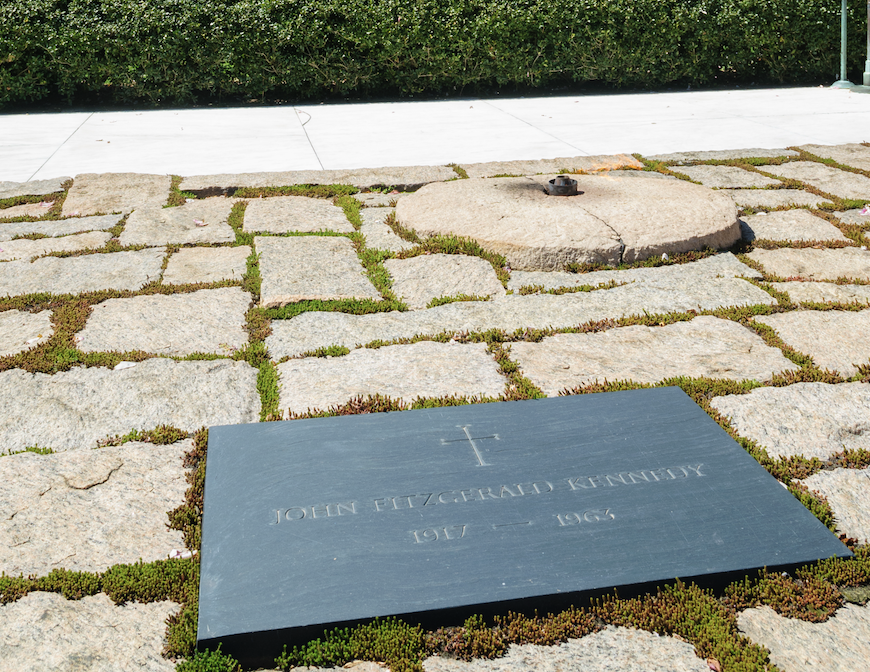
The Kennedy complaint argues the arch would sit directly between the Lincoln Memorial and Arlington House, two landmarks designed to face each other as a symbol of national reunification after the Civil War, and would “obstruct reciprocal views” of both. It would also block the sightline from Arlington Memorial Bridge to the Kennedy gravesites and the Eternal Flame, a vista the Kennedy family specifically chose decades ago. The structure would cast shadows across the graves, particularly in the early morning hours when the family traditionally visits.
Procedural history and the 14-day pause
On November 5, 2026, the National Park Service and Interior Department authorized construction. The same day, the National Capital Planning Commission, described in multiple filings as “stacked with Trump allies”, voted to approve final site and building plans. Within days, U.S. District Judge Tanya Chutkan issued a temporary restraining order halting any construction-related activity for 14 days, until November 19, while she considers a preliminary injunction. The Justice Department has argued the arch does not violate the law and that the plaintiffs lack standing to sue.
Date
Event
Source
November 5, 2026
National Park Service and Interior Department authorize construction; National Capital Planning Commission approves plans
Democracy Defenders Fund complaint; BBC; Boston Globe
November 6, 2026
U.S. District Judge Tanya Chutkan issues 14-day temporary restraining order blocking construction
BBC; Boston Globe; NBC New York; The Guardian; CBS News; ABC News
November 10, 2026
Nine Kennedy family members file motion to intervene in existing lawsuits
All eight sources
November 19, 2026
Expiration of temporary restraining order; hearing on preliminary injunction expected
ABC News; Reuters via ABC
Legal arguments: congressional approval and separation of powers
The core of the Kennedy complaint, echoed by the Democracy Defenders Fund, the state of Virginia and the District of Columbia, is that only Congress can authorize a commemorative structure of this scale on federal land adjacent to a national cemetery. The plaintiffs cite the Commemorative Works Act and other statutes requiring congressional approval for monuments in the capital’s monumental core. They argue the administration bypassed that process, relying instead on executive authority and a planning commission vote.
The complaint also points to the National Park Service’s own findings of adverse effects, a large volume of opposing public comments, and the planning commission’s own acknowledgment that the arch would “fully obstruct reciprocal views of the Lincoln Memorial and Arlington.” The filing asks the court to set aside the November 5 authorization and permanently enjoin construction.
White House response
White House spokesman Davis Ingle (identified as Davis R. Ingle in the BBC report) issued a statement criticizing the Kennedy family’s involvement: “It is unfortunate to see that some members of the Kennedy family have joined the litigation against the Arch as the project is intended to honor our heroes who rest in Arlington Cemetery. The judiciary should not be abused to politicize a structure designed to unite our nation. We will continue making the case for this beautiful and fitting monument and are confident we will be fully vindicated as this litigation proceeds.”
The administration has also advanced a secondary justification: that the arch would serve as a “top-grade military complex” incorporating drone and ammunition storage, sniper facilities on the roof and plaza, and other homeland defense functions. Secretary of Defense Pete Hegseth described it in a court filing last month as a “generational national defense opportunity to mitigate these evolving threats … utilized as a dual-purpose structure.”
Broader context: remaking the capital
The arch is one of several Trump-driven projects reshaping Washington. The president has renovated the White House East Wing, pursued changes to the Lincoln Memorial Reflecting Pool, and taken control of the John F. Kennedy Center for the Performing Arts, adding his name to the marble facade for six months until a court ruled the move illegal and ordered its removal. Trump has threatened to shutter the center if he does not receive “recognition” on the building.
Democrats gained control of Congress in the November 2026 midterm elections, and numerous incoming members have vowed to block the arch legislatively when they take office in January. The Kennedy family’s lawsuit adds a powerful political and symbolic dimension to a legal fight that already pits the executive branch against two sovereign jurisdictions, veterans’ groups and preservationists.
What to watch next
November 19, 2026: Expiration of Judge Chutkan’s temporary restraining order; decision on preliminary injunction expected.
January 2027: New Democratic-controlled Congress sworn in; potential legislative action to defund or prohibit the arch.
Ongoing: Parallel lawsuits by Virginia, D.C., conservationists and Vietnam veterans proceed on similar grounds, lack of congressional authorization, violation of the Commemorative Works Act, and adverse impact on historic sightlines.
Family dynamics: Whether Robert F. Kennedy Jr. Publicly comments on his relatives’ lawsuit, given his cabinet role and past statements distancing himself from family disputes over the Kennedy Center.
The case now sits at the intersection of executive power, historic preservation and a family legacy that has shaped American public memory for six decades. As Rory and Maxwell Kennedy put it in their statement: “A towering arch casting shadows across the graves of our father, mother, and uncles, as well as the graves of so many who have served our country, would also cast a shadow over our democratic principles, undermining the safeguards established by our elected representatives to protect this hallowed ground for generations to come.”