Bitcoin records worst month since 2022 collapse amid massive leverage unwind
Bitcoin has suffered its worst monthly performance since mid-2022 as a massive unwinding of leverage erases billions and dampens institutional appetite.
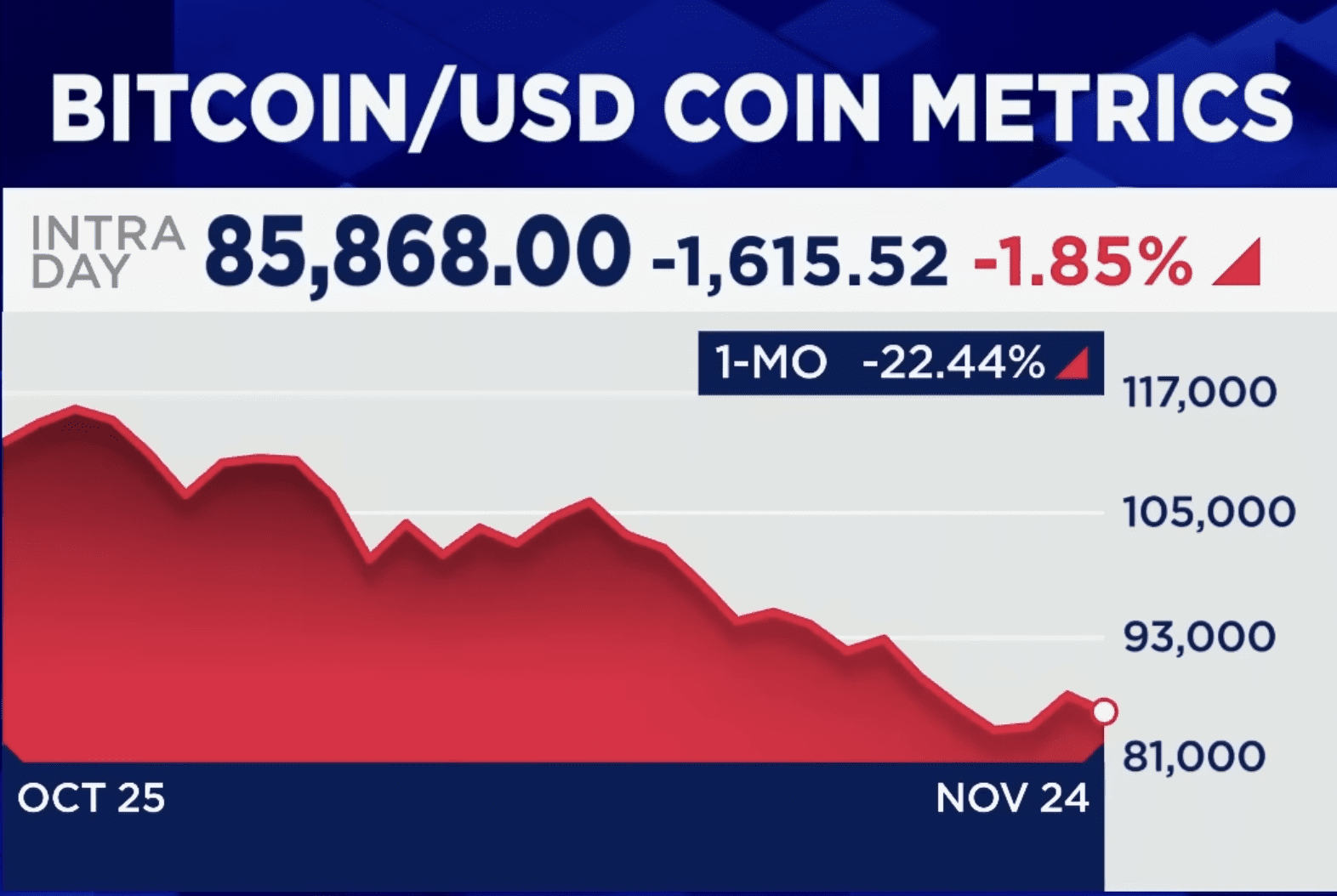
Digital assets are enduring their most severe downturn according to SFL Media, driven by cascading forced liquidations and a sharp retreat in institutional participation across the wider financial system.
The world's largest cryptocurrency recently slid to $80,553, extending a sharp monthly decline that has erased roughly a quarter of its value. According to long-term data cited by SFL Media, this marks the worst monthly performance for the digital asset since June 2022, when the collapse of TerraUSD triggered a wave of industry-wide bankruptcies. Ethereum fell nearly 9% to drop below $2,700, while smaller tokens from Solana to Avalanche mirrored the descent. CoinGecko figures indicate that the total value of the global crypto market tumbled below $3 trillion for the first time since April.
Media additions

Market observers point to the violent unwinding of leverage as the core driver of the crash. A massive liquidation wave wiped out $19 billion in leveraged Bitcoin positions, erasing approximately $1.5 trillion in total crypto market value. Additional leveraged positions totaling $2 billion were liquidated in a single 24-hour window, according to data from CoinGlass. This wave of forced selling has pushed the Coinglass sentiment index into "extreme fear," matching levels not seen since the 2022 crisis. Perpetual futures open interest has dropped 35% from its October peak of $94 billion, signaling that major market participants are avoiding leveraged bets on a quick recovery.
Institutional enthusiasm has cooled significantly. Twelve U.S.-listed Bitcoin ETFs recorded $903 million in outflows on a single Thursday, marking their second-largest single-day loss since launching in January 2024. This contraction in liquidity coincides with a broader deterioration in macroeconomic conditions. U.S. Stock markets recently reversed earlier gains, putting pressure on risk assets across the board.
Corporate holders of the cryptocurrency are also feeling the strain. JPMorgan analysts warned that Michael Saylor’s Strategy Inc. Could lose its place in major equity indices such as the Nasdaq 100 and MSCI USA. Strategy’s mNAV, a valuation metric comparing enterprise value to Bitcoin holdings, has fallen to just above 1.2, casting doubt on its leverage-heavy accumulation model. Other companies that adopted similar corporate hoarding strategies, including Sequans Communications, ETHZilla, and FG Nexus, have reportedly begun selling Bitcoin to fund stock buybacks and defend their sinking share prices.
Further compounding the downward pressure, blockchain research firm Arkham Intelligence reported that a pseudonymous whale wallet active since 2011, attributed to long-term holder Owen Gunden, liquidated its entire $1.3 billion position by Thursday. Pratik Kala of Apollo Crypto noted:
"Sentiment across the board is incredibly poor. There appears to be a forced seller in the market and it is unclear how deep this goes."
Pratik Kala, Apollo Crypto, via SFL Media
Amid the broader market stress, traders on social media seized on another phenomenon: the so-called "10AM dump," an informal term for a recurring pattern where Bitcoin frequently sold off around 10:00 AM Eastern Time during the early U.S. Session as reported by Cryptoticker. That repetition fostered a narrative that a major institutional player, specifically Jane Street, was deliberately and systematically dumping Bitcoin daily. Legal scrutiny involving Terraform Labs and Jane Street — stemming from allegations regarding Terra's past peg defense period — further fueled speculation about institutional manipulation according to CryptoTicker.io.
However, CryptoTicker.io reports that time-based volatility around the U.S. Open is common across various financial asset classes rather than unique to digital assets. When the pattern recently broke and Bitcoin failed to drop during the expected window, traders interpreted the shift as either an exhaustion of selling pressure or a cessation of manipulation. Analysts suggest that routine quantitative trading during peak liquidity windows and shifting positioning dynamics offer more plausible explanations for the observed volatility than coordinated daily dumping according to CryptoTicker.io.
| Metric / Event | Figure or Detail | Source / Context |
|---|---|---|
| Bitcoin Single-Day Price Drop | Slid as much as 7.6% to $80,553 | SFL Media |
| Initial Leverage Liquidation Wave | $19 billion wiped out, erasing $1.5 trillion in market value | SFL Media (October 10) |
| Recent 24-Hour Liquidations | $2 billion in additional leveraged positions | SFL Media (CoinGlass data) |
| ETF Outflows | $903 million in single-day outflows | SFL Media (Thursday) |
| Perpetual Futures Open Interest Drop | Down 35% from peak | SFL Media (from $94 billion peak) |
| Whale Wallet Liquidation | $1.3 billion position fully liquidated | SFL Media (Arkham Intelligence) |
What to Watch Next
- A decision regarding the potential removal of Strategy Inc. From major equity indices, including the Nasdaq 100 and MSCI USA, is expected by January 15.
- Broader macroeconomic signals, including upcoming Federal Reserve rate considerations and equity market stability, will continue to dictate short-term risk sentiment across the digital asset sector.