British Airways Flight BA295 returns to Heathrow after emergency descent
British Airways Flight BA295 experienced an emergency descent over Ireland following a technical issue, eventually returning safely to London Heathrow.

- Core Development: British Airways Flight BA295 experienced an emergency descent over Ireland following a technical issue, eventually returning safely to London Heathrow.
- Beat Context: Categorized under NHS with independent corroboration.
- Reporting Depth: 3 minute analytical read synthesized from verified newsroom sources.
A transatlantic British Airways flight bound for the United States was forced to execute a dramatic mid-air emergency descent on Monday, shaking passengers and triggering international aviation tracking alerts.
Flight BA295 departed from London Heathrow Airport's Terminal 5, according to Mirror reporting, with a scheduled destination of Chicago O'Hare International Airport. Roughly thirty minutes to an hour into the journey, while cruising at an altitude between 36,000 and 37,000 feet over Ireland, the aircraft encountered trouble. Flight tracking data recorded by Flightradar24 showed the widebody jet plunging precipitously — dropping between 27,000 and 28,000 feet in a matter of minutes to stabilize at a barometric altitude of 9,000 feet.
Media additions
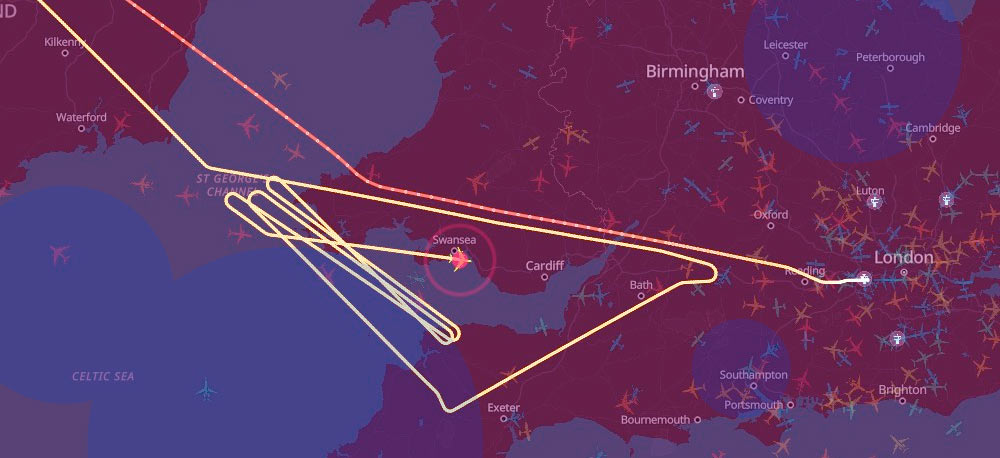


Amid the rapid descent, oxygen masks dropped from the cabin ceiling, prompting passengers to scramble to put them on, as reported by Paddle Your Own Kanoo. Aviation analysts noted that controlled rapid descents to altitudes below 10,000 feet typically signal a cabin depressurisation event or a failure within the aircraft's pressurisation system, where outside air fails to compress adequately for human physiological needs. The flight crew broadcast squawk code 7700 over Ireland — the universal transponder signal for a general emergency, alerting air traffic controllers that the crew required priority handling and a clear flight path, though the code itself does not diagnose the exact mechanical failure.
The aircraft involved in the incident is a Boeing 777-200ER registered as G-VIIA, powered by General Electric GE90 engines. According to Paddle Your Own Kanoo, this particular frame is British Airways' oldest widebody aircraft, having entered service in July 1997. Following the emergency drop over Ireland, the pilots turned the aircraft back toward the United Kingdom rather than continuing the transatlantic voyage.
| Metric / Detail | Flight BA295 Incident Data |
|---|---|
| Aircraft Type | Boeing 777-200ER (Registration G-VIIA) |
| Route | London Heathrow (LHR) to Chicago O'Hare (ORD) |
| Cruising Altitude | 36,000 to 37,000 feet |
| Emergency Altitude | 9,000 feet over Ireland |
| Descent Rate | 27,000 to 28,000 feet in minutes |
| Squawk Code | 7700 (General Emergency) |
| Landing Location | London Heathrow Airport (Runway 27L) |
Rather than landing immediately, the heavy aircraft spent time zig-zagging and holding in a pattern over the Bristol Channel and southwestern England. According to Beinsure and Paddle Your Own Kanoo, the flight crew lowered the landing gear while circling to create aerodynamic drag, burning off excess fuel from the full transatlantic load to reduce the aircraft's weight to safe parameters for landing. The flight ultimately touched down safely at Heathrow.
British Airways issued a formal statement regarding the incident, emphasizing crew training and passenger safety:
"The safety of our customers and crew is always our top priority, and the aircraft landed safely after our highly trained pilots returned to Heathrow following a technical issue."
British Airways spokesperson, via Paddle Your Own Kanoo
The airline added that customers disembarked normally and ground teams were deployed to manage onward travel arrangements. While British Airways did not disclose an official passenger headcounts, the Boeing 777-200 configuration accommodates hundreds of travelers across multiple classes, and aviation experts note that affected passengers could be eligible for statutory compensation under passenger rights regulations given the technical defect under airline control.
Meanwhile, passengers from BA295 await reaccommodation, and aviation authorities are expected to examine the flight data recorders and maintenance logs of registration G-VIIA to determine the exact mechanical trigger behind the sudden depressurisation event.
How significant is this development?
Contribute your assessment to the aggregated reader sentiment ledger.
Frequently Asked Questions
Key questions answered in this reportWhat is the key development in: British Airways Flight BA295 returns to Heathrow after emergency descent?
British Airways Flight BA295 experienced an emergency descent over Ireland following a technical issue, eventually returning safely to London Heathrow.
Why is this NHS development significant for the UK?
This report covers critical events in our NHS beat. Independent reporting monitors related UK statements, regulatory shifts, and public responses as further verified details emerge.
How was this reporting corroborated and verified?
Newsarchy UK compiles and cross-references reporting from primary reporting from NBC News and cross-checked wire reports. All coverage adheres to published editorial standards.
When was this report published?
This briefing was published on October 5, 2026 and is permanently cataloged in the Newsarchy UK NHS archives.