EU launches Luxembourg summit to advance Middle Corridor trade route
The European Union convened a high-level summit to focus on the Middle Corridor trade route, pledging billions in investments for regional infrastructure projects.
The European Union kicked off a high-level summit with top officials from Central Asia, the Caucasus, and other neighboring countries on October 20 as the bloc aims to make new inroads in a region where China and Russia wield longstanding influence.
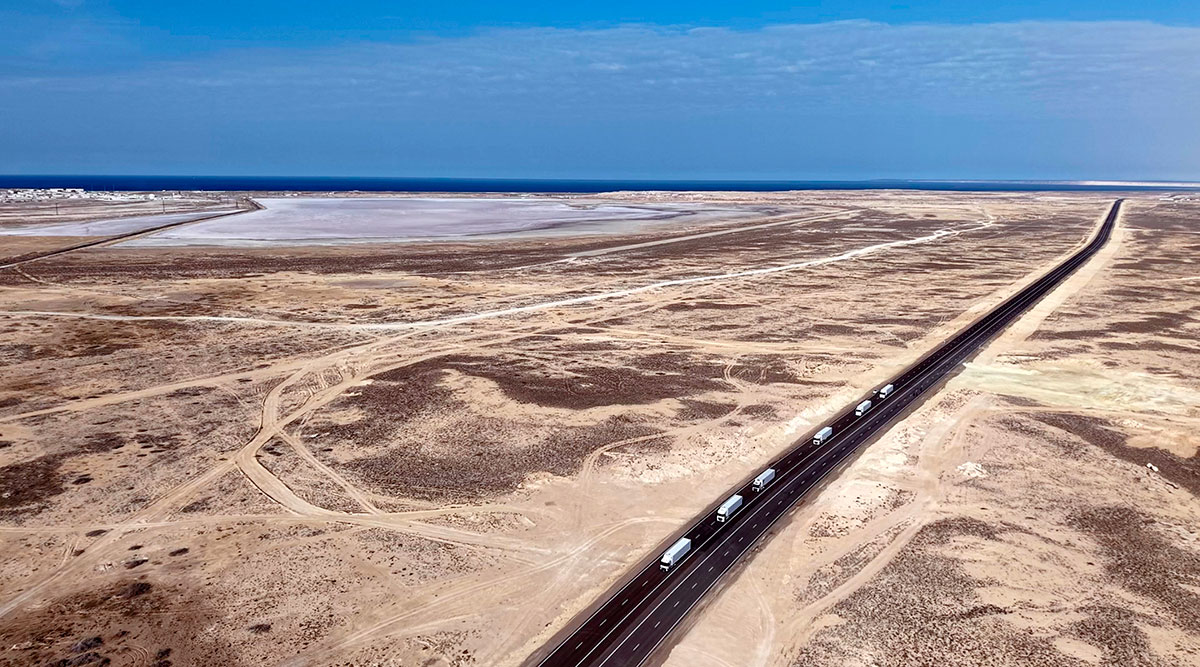
According to Radio Free Europe/Radio Liberty reporting, the gathering centers on the Trans Caspian Transport Corridor -- also known as the Middle Corridor – an emerging 6,500-kilometer-long trade route that connects China to Europe through Central Asia and the Caucasus by bypassing Russia. Eduards Stiprais, the EU’s special representative for Central Asia, told RFE/RL in an interview that the meeting is “specifically focused on the issue of establishing a well-functioning so-called Middle Corridor stretching across the Black Sea and the Caspian Sea towards Central Asia.”
Media additions
The summit is something of a watershed for the 27-member EU as it looks to grow its regional standing at a time when Russia's full-scale invasion of Ukraine has shifted the geopolitical balance and China's economic expansion has left the region more integrated with Beijing. According to a draft program for the summit seen by RFE/RL, the EU is hosting ministers from Armenia, Azerbaijan, Kazakhstan, Kyrgyzstan, Moldova, Tajikistan, Turkey, Turkmenistan, Ukraine, and Uzbekistan. Georgia was also invited but declined to attend.
Discussions in Luxembourg build directly upon previous funding pledges through the Global Gateway, the EU's infrastructure partnership plan launched in 2021 that's seen as an alternative to China's worldwide Belt and Road Initiative (BRI). European Commission President Ursula von der Leyen and European Council President Antonio Costa met with the region’s five presidents and announced an additional 12-billion-euro ($14 billion) investment in the Global Gateway to kick-start a new digital and infrastructural development project. Out of that total, 3 billion euros ($3.5 billion) are earmarked for the Middle Corridor, which adds to a previous 10 billion euros ($11.6 billion) pledged in 2024. Stiprais says that the money is there, and that the issues are where we need some political decisions and agreements on how to proceed.
Central Asian governments -- and Kazakhstan in particular -- are some of the biggest supporters of the Middle Corridor and see the trade route and deeper ties with Brussels as necessary steps to diversify their economies and lessen their political dependence on China and Russia. Roman Vassilenko, Kazakhstan’s ambassador to the EU and NATO, told RFE/RL that investments around the Middle Corridor are still “in the early stages” as they prepare feasibility studies. He pointed to new rail projects built in the country and a 35-million-euro loan ($41 million) Astana received from the European Bank for Reconstruction and Development (EBRD) to upgrade infrastructure at the port of Aqtau, a Kazakh city on the Caspian Sea that is one of the most critical links in the corridor.
Despite enthusiasm, regional experts remain cautious. Temur Umarov, a fellow at the Carnegie Eurasia Center in Berlin, told RFE/RL that “Central Asia wants more EU involvement, but regional leaders are not overly optimistic,” adding that “The EU hasn’t yet provided the kind of funding that would make it a true ‘third player’ helping the region rely less on Russia and China.” In Central Asia, bilateral trade with China, the region’s largest individual trade partner, has been rising steadily in recent years, hitting a record high of $94.8 billion in 2024. Meanwhile, Georgia’s ruling Georgian Dream party has pivoted closer to Russia and seen its relations with the EU deteriorate in recent years, increasingly relying on China for infrastructure investment by turning to state-backed Chinese firms over European bids to build its $1 billion cross-country highway and winning the contract to build a deep-sea port in Anaklia on the Black Sea.
The diplomatic push for the corridor gained additional momentum following separate ministerial engagements. On 16 November 2026, a second Ministerial Meeting on Cross-Regional Security and Connectivity was held in Brussels, bringing together EU member states with partners from the Black Sea region, the South Caucasus and Central Asia, including Turkmenistan. According to Trend News Agency, the Turkmen delegation led by Deputy Foreign Minister Myahri Byashimova expressed support for the Global Gateway initiative and the further development of the Coordination Platform for the Trans-Caspian Transport Corridor, which co-hosted the high-level launch in Ashgabat on 3 October 2024.
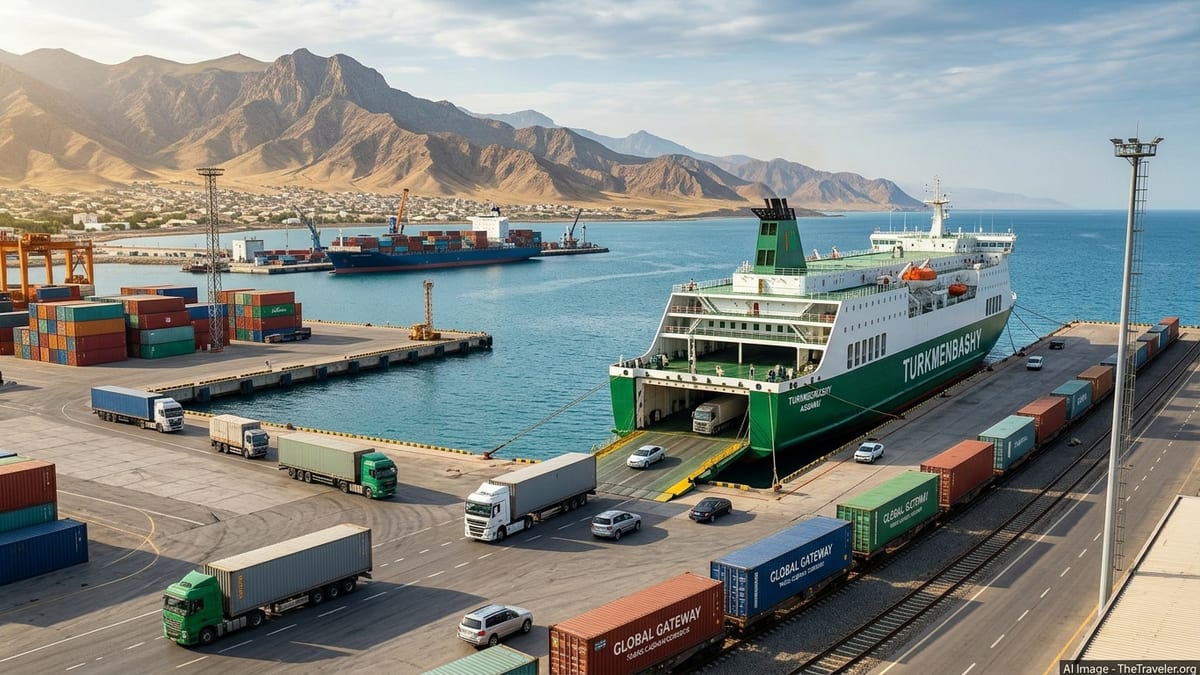
Turkmenistan highlighted ongoing domestic transport modernization efforts to expand its transit capacity. These initiatives include the railway connecting Ashgabat with the Turkmenbashi International Seaport, alongside expanding its highway network, including the Ashgabat-Turkmenabat high-speed road, while continuing to develop maritime infrastructure. The Organization for Economic Co-operation and Development (OECD) identifies Turkmenistan as a critical node of the Trans-Caspian Transport Corridor, noting the country's role in developing links between Central Asia and Europe.
| Event / Milestone | Date | Key Focus |
|---|---|---|
| Trans-Caspian Coordination Platform Launch | 3 October 2024 | Establishing hard and soft infrastructure coordination across Central Asia and the Caucasus. |
| Inaugural EU-Central Asia Summit | April | Announcement of an additional 12-billion-euro ($14 billion) investment in the Global Gateway, with 3 billion euros ($3.5 billion) earmarked for the Middle Corridor. |
| Brussels Ministerial Meeting | 16 November 2026 | Reaffirming regional support for the Trans-Caspian transport corridor and cross-regional security. |
| EU-Turkmenistan Business Forum | March 2026 | Strengthening economic ties and private-sector cooperation. |
| Luxembourg Summit | October 20 | Launching a new regular diplomatic format for connectivity, trade, digital development, and energy around the Black Sea and the broader region. |
The diplomatic trajectory points toward further institutional integration. Bilateral reviews between the EU Delegation to Turkmenistan and Turkmen officials highlighted a busy agenda for 2026, including the first EU–Turkmenistan Business Forum, to be held in March 2026, upcoming inter-parliamentary meetings, and preparations for regional programmes on border management, drug action, gender equality, and women’s empowerment.
Travelers and freight operators should note that recent diplomatic meetings serve primarily as policy signals rather than immediate timetable changes, as no new commercial passenger flights, rail services or ferry timetables between Turkmenistan and EU countries were announced in Brussels. Co-chairs’ conclusions issued after the Brussels ministerial trail a Regional Connectivity Summit in Sofia in 2027, presented as the next major milestone for moving from political statements toward concrete projects and investment decisions across the interconnected regions.
What to watch next
- Project-level announcements, tender launches, and infrastructure funding commitments ahead of the Sofia summit in 2027.
- Progress on feasibility studies and port upgrades funded by international financial institutions along the Caspian Sea.
- An EU-Central Asia Economic Forum scheduled for November in Uzbekistan which will be an important litmus test.