High-speed train crash in Spain leaves at least 68 dead, dozens injured, officials say
A high-speed rail collision in central Spain left at least 68 people dead and dozens injured, prompting a rigorous government inquiry.

- Core Development: A high-speed rail collision in central Spain left at least 68 people dead and dozens injured, prompting a rigorous government inquiry.
- Beat Context: Categorized under World with independent corroboration.
- Reporting Depth: 4 minute analytical read synthesized from verified newsroom sources.
A catastrophic high-speed rail disaster in central Spain has left at least 68 people dead and dozens injured, marking the nation's second major fatal railway crash this year and compounding mounting scrutiny over the safety of Europe's second-largest high-speed network. According to reports compiled across Yahoo News and CBS News, the collision occurred when a state-operated passenger service slammed into the rear of a stationary private train near the town of Urda in the province of Toledo.
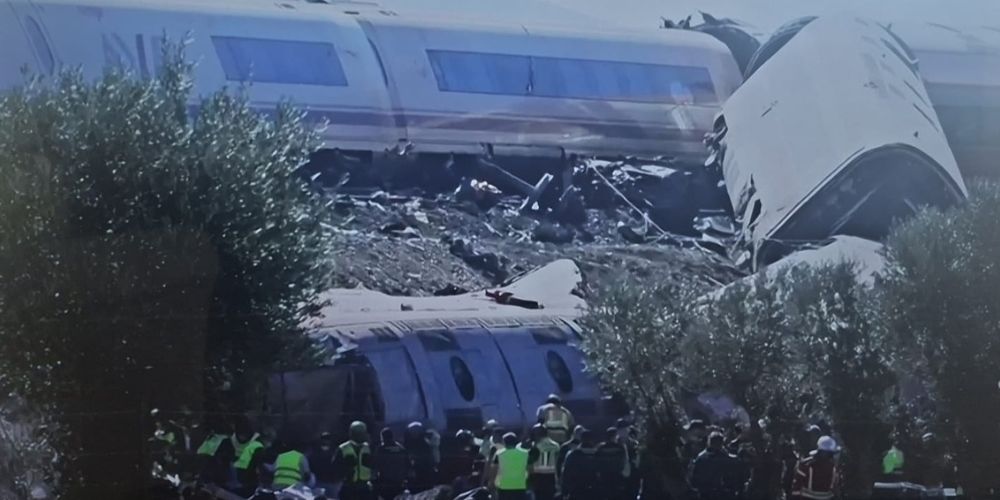
The tragedy unfolded along the high-speed rail corridor connecting Madrid to the southern city of Seville. A train operated by Spain's national provider, Renfe, carrying 397 passengers, struck a stationary service operated by private rail company Iryo, which had 147 people on board. The force of the impact sheared through carriages, derailing two tail cars of the Iryo train and the front of the Renfe service, and scattering twisted metal down an embankment into surrounding olive and almond fields.
Media additions


Emergency responders, military units, and rescue helicopters flooded the rural site. As Ksmu reported, local farmhands and construction workers rushed to assist, cutting fences and treating the wounded with makeshift first-aid supplies and improvised stretchers before professional rescue units could arrive. Regional health officials confirmed that dozens of survivors were hospitalized with varying degrees of injury, prompting a massive public response that filled blood donation centers across Madrid, Toledo, and Ciudad Real.
Government officials have pointed to a sequence of technical failures and human errors as the catalyst for the disaster. Speaking at a press conference, Spain's Transport Minister Óscar Puente explained that an automatic train control system dating back to the 1960s — known as the Linienzugbeeinflussung, or LZB — suffered a computer failure affecting a 63-kilometer stretch of track. The malfunction triggered an automatic stop for all rail traffic in the sector, transferring management to the central command center in Madrid.
According to Puente's account, traffic control operators instructed the Renfe train to resume its journey at normal speed despite an active red signal and the stationary train ahead. Describing the instruction as "inexplicable," Puente noted that another train driver had attempted to warn control center operators of the danger, urging that traffic proceed at reduced speeds. The operator acknowledged the error just minutes before the collision occurred at approximately 8:53 a.m.
| Metric / Detail | January 2026 Crash | October 2026 Crash |
|---|---|---|
| Location | Southern Spain (near Adamuz) | Central Spain (near Urda/Toledo) |
| Death Toll | 46 fatalities | At least 68 fatalities |
| Collision Type | Derailment into oncoming train | Rear-end collision into stationary train |
| Involved Operators | Renfe and Iryo | Renfe and Iryo |
Prime Minister Pedro Sánchez traveled to the disaster zone and announced three days of national mourning. Sánchez asserted that it was unacceptable for a nation like Spain to endure two high-speed rail disasters within a single year. If there has been negligence, it will come to light,
Sánchez stated, vowing strict accountability. European Commission President Ursula von der Leyen expressed solidarity, stating that Europe mourns with Spain.
The accident has intensified political friction ahead of national elections scheduled for November. The conservative opposition Popular Party canceled all campaign events, with party leaders demanding an independent, nationwide review of railway infrastructure, track conditions, and safety protocols.
Labor representatives and transit analysts have also raised questions regarding the systemic pressures facing the rail network. Union spokespersons noted that the liberalization of Spain's high-speed rail market, which saw Italian-owned Iryo enter as a competitor to Renfe, has significantly increased traffic density. Critics argue that infrastructure upkeep and maintenance investments have not kept pace with expansion and increased usage, pointing to European Commission data showing that a smaller percentage of high-speed spending is earmarked for maintenance compared to other major European nations.
Rail service remains suspended between Madrid, Ciudad Real, and Andalusia, with Renfe halting ticket sales on the Madrid-Andalusia corridor through mid-December. Investigators from the Civil Guard continue to gather forensic evidence at the site. As recovery operations conclude, authorities face mounting pressure to deliver definitive answers on how a critical safety signal was bypassed on a network that had operated without a fatal high-speed crash for over three decades prior to this year.
How significant is this development?
Contribute your assessment to the aggregated reader sentiment ledger.
Frequently Asked Questions
Key questions answered in this reportWhat is the key development in: High-speed train crash in Spain leaves at least 68 dead, dozens injured, officials say?
A high-speed rail collision in central Spain left at least 68 people dead and dozens injured, prompting a rigorous government inquiry.
Why is this World development significant for the UK?
This report covers critical events in our World beat. Independent reporting monitors related UK statements, regulatory shifts, and public responses as further verified details emerge.
How was this reporting corroborated and verified?
Newsarchy UK compiles and cross-references reporting from primary reporting from DW.com and cross-checked wire reports. All coverage adheres to published editorial standards.
When was this report published?
This briefing was published on October 29, 2026 and is permanently cataloged in the Newsarchy UK World archives.