Spain installs floating barrier in Ceuta as migrant rush subsides
Spanish forces have begun installing a floating barrier off the coast of Ceuta following a massive border rush, as EU nations clash over migration policy.

- Core Development: Spanish forces have begun installing a floating barrier off the coast of Ceuta following a massive border rush, as EU nations clash over migration policy.
- Beat Context: Categorized under World with independent corroboration.
- Reporting Depth: 3 minute analytical read synthesized from verified newsroom sources.
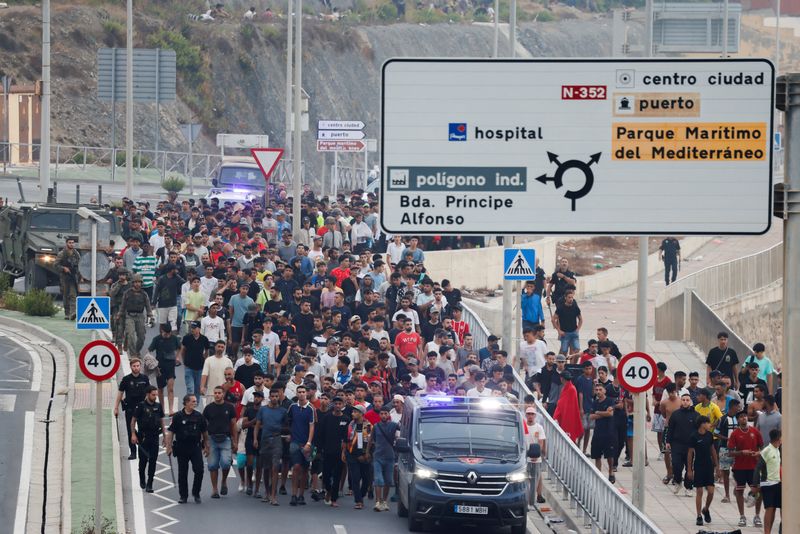
Spanish authorities reported that roughly 50,000 people entered the North African enclave of Ceuta by land and sea during a surge starting from Thursday, before the flow began to recede.
Within a 48-hour window, more than 48,000 of those arrivals were escorted back across the frontier to Morocco without major incident, according to a statement from the Spanish government. The remaining migrants who stayed behind faced a chaotic scene on the Tarajal breakwater, where at least 67 bodies have been recovered on the Spanish side of the fence. Officials stated that many of the dead drowned while others were crushed as crowds tried to climb the barrier.
Media additions
Spanish soldiers and Civil Guard officers moved onto the fog-shrouded Tarajal beach and began installing a 500-metre (1,640-foot) floating barrier. The operation started at 7:50 a.m. (0550 GMT) on Saturday and involved laying a pneumatic curtain supported by a line of anchored naval buoys. The barrier is engineered to stand between 30 centimetres and 70 centimetres (12 to 28 inches) above the waterline while extending up to one metre below the surface, creating a channel that allows patrol vessels to maneuver between the curtains.
Interior Minister Fernando Grande-Marlaska, speaking from Ceuta, described the installation as a step toward re-establishing order. He added that overnight crossings had dropped to about zero and that the crisis was not yet formally over, stressing that reinforced police and military deployments would remain in place as long as needed.
Grande-Marlaska also blamed organised people-smuggling networks for exploiting vulnerable migrants and for circulating misleading interpretations of a recent Spanish Supreme Court ruling that bars the summary return of migrants intercepted at sea unless a physical barrier is in place.
Prime Minister Pedro Sánchez, who visited Ceuta on Friday, framed the episode as a breach of Spain’s territorial sovereignty. In a message to EU leaders, he urged an urgent convening of interior ministers and criticised several European governments that had suggested Spain should be temporarily excluded from the Schengen passport-free area.
"In the current international context, the EU cannot afford this kind of selfish, polarising and unlawful reaction,"
Pedro Sánchez, prime minister, via TimesNow
Italy’s right-wing government announced on Friday it was suspending Schengen arrangements with Spain for one month. Officials in Rome did not immediately respond to a request for comment on Saturday.
Twenty-two EU governments called on Saturday for an emergency meeting of interior ministers over the Ceuta crisis, urging the bloc to help Madrid regain control of its border with Morocco. They called for a coordinated response, including possible extra support from EU border agency Frontex and a review of cooperation with Morocco. France, Luxembourg and Portugal did not sign the letter, alongside Spain and Ireland.
Madrid stated that the people who entered Ceuta irregularly could not travel onwards to mainland Spain or elsewhere in the Schengen zone. In a statement, the Foreign Ministry added that travellers leaving Ceuta by sea or air undergo police identity checks, representing a second layer of control after the land border with Morocco.
In contrast to most of Europe, Spain has adopted a more open stance on migrants, introducing a programme to grant residency to more than half a million undocumented people. But it has rejected suggestions that the regularisation scheme had encouraged the rush into Ceuta, saying applicants must prove residence in Spain before January 1, 2026, and five continuous months of residence when applying.
As the fog lifted on the Tarajal beach, Reuters footage on Saturday showed Spanish soldiers and police patrolling a mostly empty beach.
How significant is this development?
Contribute your assessment to the aggregated reader sentiment ledger.
Frequently Asked Questions
Key questions answered in this reportWhat is the key development in: Spain installs floating barrier in Ceuta as migrant rush subsides?
Spanish forces have begun installing a floating barrier off the coast of Ceuta following a massive border rush, as EU nations clash over migration policy.
Why is this World development significant for the UK?
This report covers critical events in our World beat. Independent reporting monitors related UK statements, regulatory shifts, and public responses as further verified details emerge.
How was this reporting corroborated and verified?
Newsarchy UK compiles and cross-references reporting from primary reporting from timesnownews.com and cross-checked wire reports. All coverage adheres to published editorial standards.
When was this report published?
This briefing was published on August 1, 2026 and is permanently cataloged in the Newsarchy UK World archives.