US floats Ukraine NATO membership in exchange for Donbas territory
Washington mediators asked whether Kyiv would withdraw forces from the eastern Donbas region in return for formal Western defense integration.
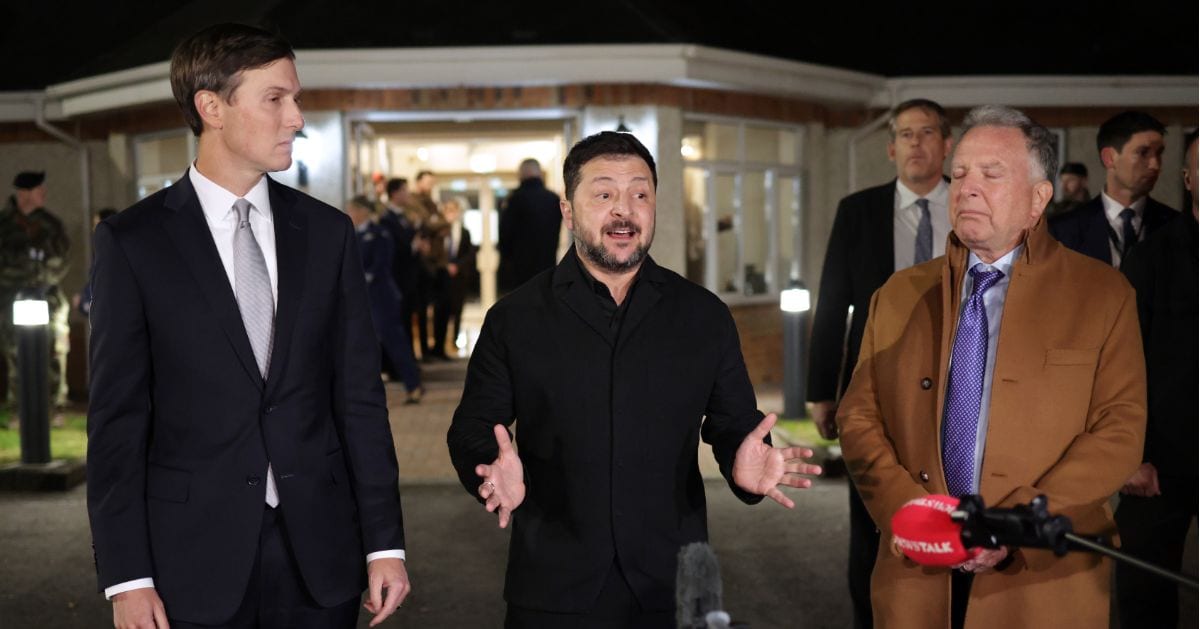
Washington has raised the possibility of Ukraine joining the military alliance in exchange for surrendering the eastern Donbas region, opening a controversial new front in diplomatic efforts to end the conflict according to reports by MEAWW.
The diplomatic maneuver emerged after intensive trilateral negotiations involving American, Russian, and Ukrainian representatives concluded in the United Arab Emirates. Ukrainian President Volodymyr Zelenskyy revealed to reporters that US mediators explicitly asked whether Kyiv would withdraw its forces from the remaining unoccupied parts of Donetsk and Luhansk provinces in return for formal Western defense integration. It marks the first time such an explicit link between territorial withdrawal and alliance membership has been put on the table by Washington negotiators.
Media additions

According to estimates by the US-based Institute for the Study of War, Russian forces control significant portions of the industrial heartland. The Donbas represents not only a vital land corridor and mineral-rich territory but also houses the heavily fortified "fortress belt" that has historically blocked Russian advances toward central Ukraine.
While Zelenskyy reiterated that his administration remains fundamentally opposed to ceding sovereign land, he did not entirely dismiss the concept. Instead, he indicated that any such profound national choice would require concrete security guarantees modeled on mutual defense principles, alongside robust reconstruction funding. If the American side confirms precisely this to us, together with other NATO partners, then I will ask our Ukrainian society what it thinks: do we accept it or not? I have no right to make that decision on my own,
Zelenskyy told CBS News, adding that Kyiv would never officially recognize occupied territories as belonging to Moscow.
Reactions to the broader diplomatic push exposed deep fractures among international stakeholders. Following the Abu Dhabi discussions, US diplomatic envoys Jared Kushner and Steve Witkoff traveled to Moscow to meet with Russian President Vladimir Putin before flying to Ireland to brief European leaders. While the diplomatic shuttle failed to secure a comprehensive ceasefire, participants agreed to initiate preparations for a large-scale prisoner exchange involving more than one thousand individuals, as noted by ABC News.
At a summit in Ireland, European Union leaders moved swiftly to secure formal representation in any upcoming formal peace architecture. A unified European negotiating team was established, comprising officials from the European Union alongside five major military powers: Britain, France, Germany, Italy, and Poland.
The diplomatic maneuvering runs parallel to vastly divergent maximalist demands from the Kremlin. European media outlets disclosed that a Russian policy document drafted ahead of the talks laid out sweeping security prerequisites across the continent. Moscow demanded that NATO forces withdraw entirely behind 1997 enlargement boundaries, that Finland exit the alliance, and that Britain strip its nuclear umbrella away from European allies. European officials swiftly rejected those terms as untenable.
| Actor | Reported Stated Position | Key Demand / Condition |
|---|---|---|
| United States | Mediating talks via envoys Steve Witkoff and Jared Kushner | Floated Donbas withdrawal in exchange for NATO path |
| Ukraine | Maintains territorial integrity; conditions future choices on public referendum | Demands robust security guarantees and reconstruction funding |
| Russia | Maintains hardline stance on neutrality and territorial control | Demands demilitarization, Donbas cession, and rollback of NATO infrastructure |
| European Powers (E5 + EU) | Organized unified delegation comprising Britain, France, Germany, Italy, and Poland | Rejects pre-conditions dismantling European security architecture |
Tensions also flared over local humanitarian proposals. Zelenskyy dismissed a suggested localized ceasefire in Kostiantynivka, arguing that the Kremlin was merely seeking to capture the strategic city without fighting, while noting that Kyiv had submitted an alternative list of front-line settlements requiring truces to protect trapped civilians. Meanwhile, Russian airstrikes continued to batter civilian infrastructure, including a heavy bombardment in Zaporizhzhya that injured dozens of residents.
What to Watch Next
- Finalization of logistics and numbers for the upcoming mass prisoner exchange between Kyiv and Moscow.
- Formal consolidation of the newly formed European negotiating delegation representing Britain, France, Germany, Italy, Poland, and EU institutions.
- Further clarification from Washington regarding the exact parameters of the security package tied to potential territorial arrangements.
For ongoing updates on regional diplomacy, consult our broader World coverage.