France GDP shrinks more than first reported as politics and prices weigh
France's economy shrank more than initially reported in the third quarter, weighed down by falling investment, sliding consumer spending, and political turmoil.

France’s economy contracted 0.2% in the third quarter, marking a deeper decline than initially estimated after economic stagnation in the second quarter, according to statistics office Insee. Underlying data revealed further drops in investment and a sharp fall in exports.
Household demand remains constrained. A separate release showed that October consumer spending failed to recover compared with September. Insee revised its figures to show that September outlays tumbled 0.9%, worse than the previously reported 0.5% decrease. Business and consumer confidence have both slid, while activity gauges point to ongoing softness.
Media additions
Political and fiscal anxieties have prompted investors to sell French bonds, driving up the country's borrowing costs. Paris now faces another parliamentary showdown over austerity measures designed to rein in a swollen deficit. According to Finance Minister Roland Lescure, these weak figures require the government to push through a budget that narrows the deficit to 5% of GDP by 2027, down from 5.4% this year, despite strong opposition in parliament.
"The situation calls on us to redouble our vigilance and our efforts,"
Roland Lescure, Finance Minister, via Briefs.co
Lescure added, It is vital to give economic agents visibility again.
He subsequently noted that the growth path remains uncertain amid a volatile global environment and mentioned that officials are monitoring ongoing risks to activity.
Ratings pressure persists. France has experienced multiple sovereign downgrades over the past two years, with Fitch assigning a negative outlook last month and S&P Global Ratings due to update its view later Friday. These economic strains coincide with recent cost-of-living protests that escalated into rioting and looting, leaving a cloudy outlook roughly five months before the presidential election to succeed Emmanuel Macron.
According to ING senior economist Charlotte de Montpellier, expectations point to average GDP growth of only 0.4% in 2027, with risks skewed to the downside even if quarterly prints manage slight positive growth. Insee noted that if the fourth quarter records no expansion, full-year growth for 2026 will land at just 0.1%.
International Divergence in Growth and Inflation
Across the Channel, the Bank of England prepares to navigate a slowing domestic economy alongside a Middle East energy shock. Despite pressures on UK inflation stemming from the conflict involving Iran, economists widely anticipate that policymakers will leave interest rates on hold. The Bank's Monetary Policy Committee is expected to maintain rates at 3.75% during its next announcement on Thursday.
Suren Thiru, chief economist for ICAEW, stated: An interest rate hold on Thursday looks highly certain with rate-setters likely to maintain a watchful approach to tightening policy given the recent deluge of downbeat economic data and growing global uncertainty.
Meanwhile, Sanjay Raja, chief UK economist for Deutsche Bank, remarked that the central bank continues to walk a narrow path in balancing weaker labour market outcomes with emerging price pressures,
and warned that the committee's patience may be running thin.
UK inflation climbed from 1.7% in September 2024 to 3.8% in July 2025, driven by regulated energy caps and sticky wage growth, contrasted against euro area inflation remaining stable near 2%. A measure of relief arrived as annual UK inflation eased to 3.2% in November from 3.7% in October, marking the lowest reading since August and falling short of the median Bloomberg survey forecast of 3.6%.
| Region / Indicator | Recent Growth / GDP Print | Inflation Metric | Policy Rate Stance |
|---|---|---|---|
| France | Contracted 0.2% in Q3 | 3.2% in November | Fiscal austerity and deficit targeting |
| United Kingdom | Declined 0.1% in April | 3.8% in July 2025 | Expected hold at 3.75% |
| Euro Area | Stable relative performance | Near 2% ECB target | ECB rate increase noted |
Global Economic Outlook and Trade Pressures
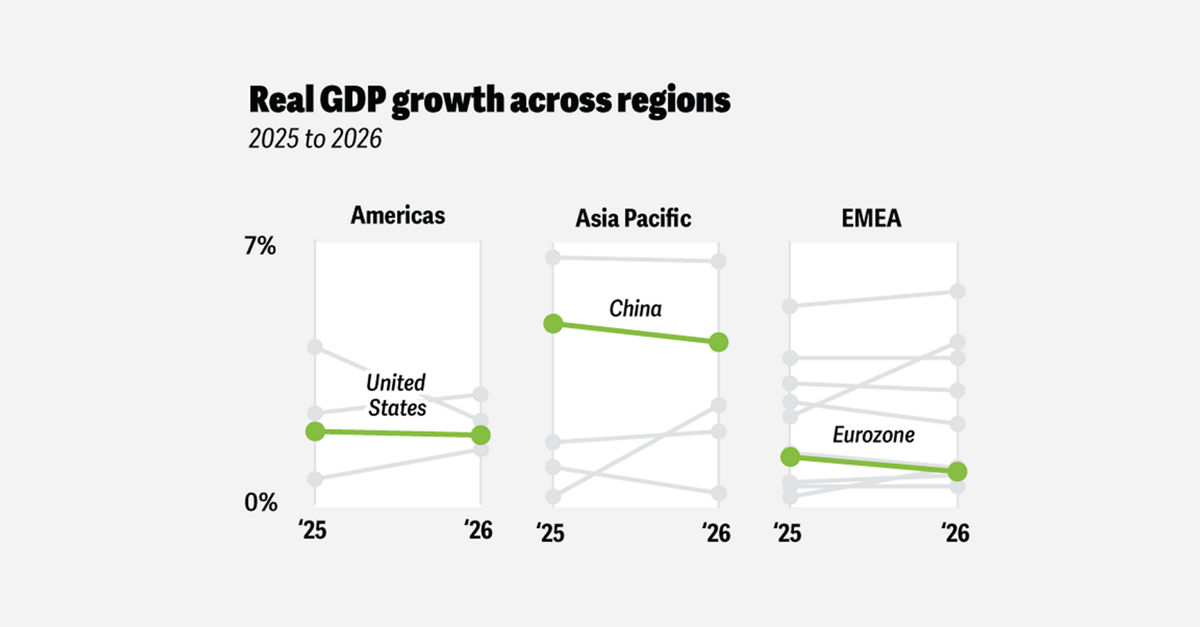
Broader international economies display varied trajectories. The United States economy maintains resilience, supported by business investment in artificial intelligence and information processing equipment alongside strong consumer spending. Canada faces ongoing headwinds in 2026, though supportive fiscal and monetary policies are expected to cushion the impact, with the Bank of Canada anticipated to hold its policy rate steady.
In Latin America, Mexico anticipates 1.6% GDP growth for 2026 as tariff uncertainty eases and nearshoring investments recover, following a slower 2025 where growth settled at 0.4%. Colombia navigates moderate growth supported by retail and services, though fiscal deficits exceeding 7% of GDP prompt structural reform debates. Argentina continues a profound macroeconomic adjustment, projecting 3.5% growth for 2026 as disinflation progresses and energy production from Vaca Muerta drives trade surpluses.
What Happens Next
- S&P Global Ratings evaluation on French sovereign debt, scheduled to update its view later Friday.
- The Bank of England interest rate decision on Thursday.
- Upcoming parliamentary debates and votes concerning the French government's austerity budget.
- Fourth-quarter Insee economic data releases to determine whether full-year 2026 French growth reaches the 0.1% threshold.