H-One faces market skepticism despite strong recovery and low P/E ratio
H-One achieves a sharp operational turnaround and low valuation multiples, yet investors remain cautious amid high customer dependence on Honda and global economic headwinds.
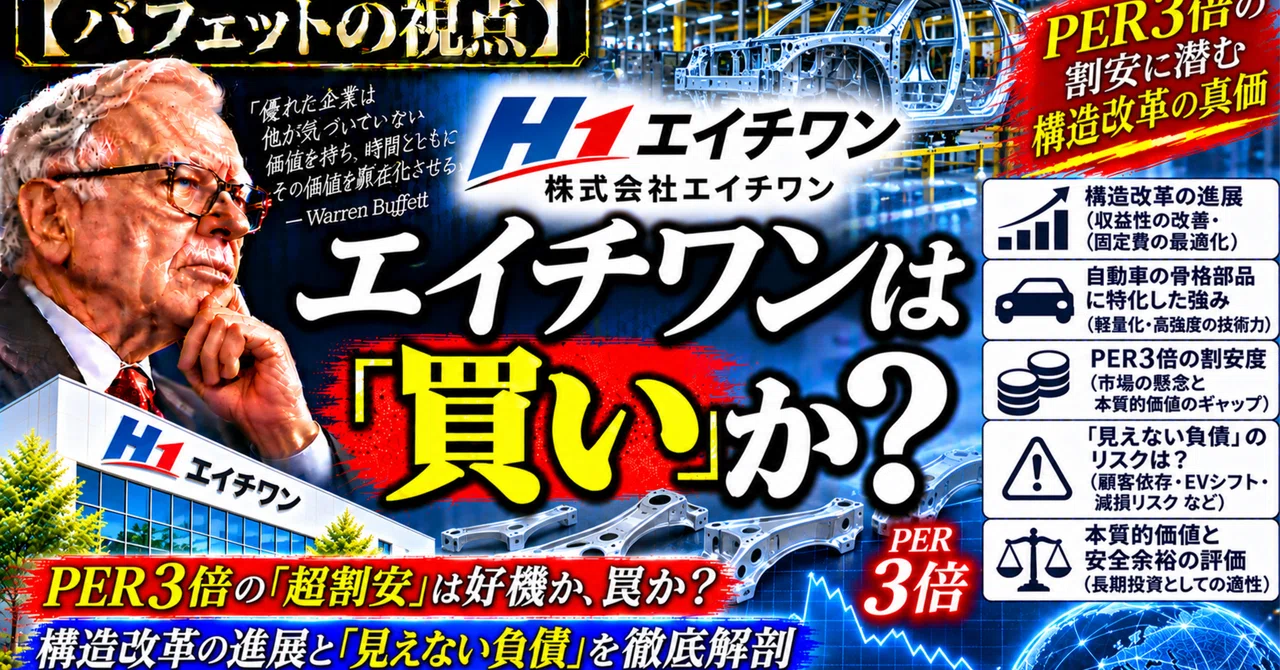
H-One faces market skepticism despite strong recovery and low P/E ratio, as investors weigh the automotive parts manufacturer's impressive turnaround against structural risks and broader economic headwinds.
Automotive frame component manufacturer H-One Co., Ltd., trading on the Tokyo Stock Exchange Prime under the code 5989, exhibits valuation metrics that immediately attract the attention of value-focused investors. According to analysis published by the AI Buffett Lab via Note, the company's trailing price-to-earnings ratio stood at 2.93x based on its closing price of 1,275 yen on November 25, 2026. This valuation is accompanied by a forward price-to-earnings ratio of 3.26x based on company guidance, a price-to-book ratio of 0.43x, and a forward dividend yield reaches 5.49%. Yet financial analysts warn that such low multiples can frequently mask underlying vulnerabilities rather than represent a genuine oversight by the market.
Media additions



The company's journey has been marked by extreme operational volatility. H-One previously suffered consecutive operating and net losses from the fiscal year ended March 2022 to the fiscal year ended March 2024. In the fiscal year ended March 2024 alone, the firm booked a massive net loss of 21.656 billion yen after recording heavy impairment losses at its bases in China and Japan. Following a leadership transition that saw Seiki Mayumi take office as President in April 2024, management executed a rigorous restructuring under the medium-term management plan titled "Change 2027." This strategy engineered a sharp V-shaped recovery, lifting operating profit to 11.860 billion yen in the fiscal year ended March 2025. In the subsequent fiscal year ended March 2026, despite headwinds causing lower revenue, the firm posted an operating profit of 14.648 billion yen with an operating margin of 7.0%, recording its highest profit margin level since voluntarily adopting International Financial Reporting Standards in the fiscal year ended March 2016.
However, external macroeconomic pressures cast a long shadow over both the automotive sector and the wider economy. The broader cost-of-living crisis intersects with currency fluctuations and interest rate shifts in Japan, where the yield on newly issued 10-year government bonds hovered around 2.62% as of November 25, 2026, remaining elevated after breaking above 3% in September of that year for the first time in roughly 30 years. Meanwhile, the dollar-yen exchange rate traded at weak-yen levels in the 159-yen range. Domestically, British households face mounting financial strain. According to reports from Yahoo Finance UK, the energy regulator Ofgem announced a 26% increase in its domestic price cap, raising bills to £2,166 ($2,835) a year for average households from January. Regulators and analysts attribute this surge to surging wholesale gas prices driven by shipping disruption and conflict in the Middle East.
The upcoming energy price surge threatens to exacerbate inflationary pressures across the economy. Independent economic forecasters at NIESR warn that renewed full-scale hostilities and the closure of key shipping lanes including the Strait of Hormuz and the Bab-el-Mandeb will feed a fresh wave of inflation with cumulative effects extending well into 2027, leaving central bankers little room to ease monetary policy. Industry experts at The Money Pages advise households to review tariffs, check eligibility for support schemes such as the Warm Home Discount, and adjust heating controls to mitigate the impact of winter bills. Simultaneously, data from Energy UK indicates that domestic energy debt has reached £6 billion, which expects arrears to rise to £7 billion by the end of the year.
For H-One, operational realities mirror these global uncertainties. While the firm demonstrates robust integrated capabilities—spanning design, die fabrication, and mass production of vehicle skeletal structures known as body-in-white assemblies—its fortunes remain tightly bound to a single major client group. Honda Motor Co., Ltd. Serves as H-One's largest shareholder with a 21.33% stake, and annual securities reports confirm that sales dependence on the Honda Group reaches approximately 87% to 90%. Regional divergence compounds this concentration risk. Operations in North America, where external sales accounted for 61.7% during the interim period of the fiscal year ending March 2027, and Japan show solid resilience. By contrast, the Chinese business has faced severe contraction, with sales down 38.4% year-on-year and plunging into an operating deficit amid intense competition from local electric vehicle manufacturers.
| Metric / Indicator | Reported Figure / Detail | Source / Context |
|---|---|---|
| H-One Trailing P/E Ratio | 2.93x | Note (AI Buffett Lab analysis as of November 25, 2026) |
| H-One Forward P/E Ratio | 3.26x | Note (Company guidance) |
| H-One Price-to-Book Ratio | 0.43x | Note (Based on closing prices on November 25, 2026) |
| H-One Forward Dividend Yield | 5.49% | Note (Financial disclosures) |
| UK Energy Price Cap Hike | 26% increase to £2,166 annually | Yahoo Finance UK / Ofgem (Effective January) |
| UK Domestic Energy Debt | £6 billion to £7 billion expected | Energy UK via Yahoo Finance UK |
Market observers note that H-One's economic moat remains narrow due to intense customer concentration, despite high switching costs during active vehicle model cycles and proprietary ultra-high-strength steel processing techniques. As automakers navigate the transition toward hybrid and electric vehicles, suppliers must continually adapt to changing structural demands and evolving manufacturing methods. What happens next depends heavily on upcoming corporate earnings reports, ongoing trade developments in key international markets, and central bank policy decisions regarding interest rates and inflation containment.