Belgium airports shut down as national anti-austerity strike grounds flights
Flights across Belgium ground to a halt as air traffic controllers and major unions staged a sweeping anti-austerity strike, disrupting travel for tens of thousands of passengers.

Flights across Belgium ground to a halt as air traffic controllers and major unions staged a sweeping anti-austerity strike on Monday, 23 November 2026, disrupting travel for tens of thousands of passengers.
The nationwide action was triggered by proposed government spending cuts and pension reforms pursued by the coalition government led by Prime Minister Bart De Wever. Belgium air navigation service provider skeyes stated that controller participation meant normal services could not be guaranteed across the country's airspace.
Media additions


Operational Impact Across Major Hubs
The air traffic control suspension forced sweeping closures at the nation's primary aviation facilities. Brussels Airport required the cancellation of all arrivals and departures scheduled between 07:00 and 21:00 local time. Before the stoppage, the airport had anticipated 429 flights and 59,500 passengers across a wider window, according to operational notices cited by Airways Magazine. Meanwhile, Brussels South Charleroi Airport faced a full-day stoppage, shutting down both arrivals and departures.
Essential minimum services for emergencies and safety-critical flights remained operational, but commercial carriers withdrew flights in large blocks. Flag carrier Brussels Airlines and long-haul operators such as United Airlines issued travel alerts, waiving change fees and offering rebooking or refund options under EU air passenger rights regulations.
| Facility / Operator | Operational Status | Affected Window |
|---|---|---|
| Brussels Airport (BRU) | All arrivals and departures cancelled | 07:00 to 21:00 local time |
| Brussels South Charleroi (CRL) | Full-day stoppage of commercial flights | Entire day |
| skeyes Air Traffic Control | Regular airspace services suspended | 07:00 to 21:00 local time |
| Port of Antwerp Shipping | Suspended due to understaffing | Until Wednesday |
Broader Economic Unrest and Public Transport Disruption
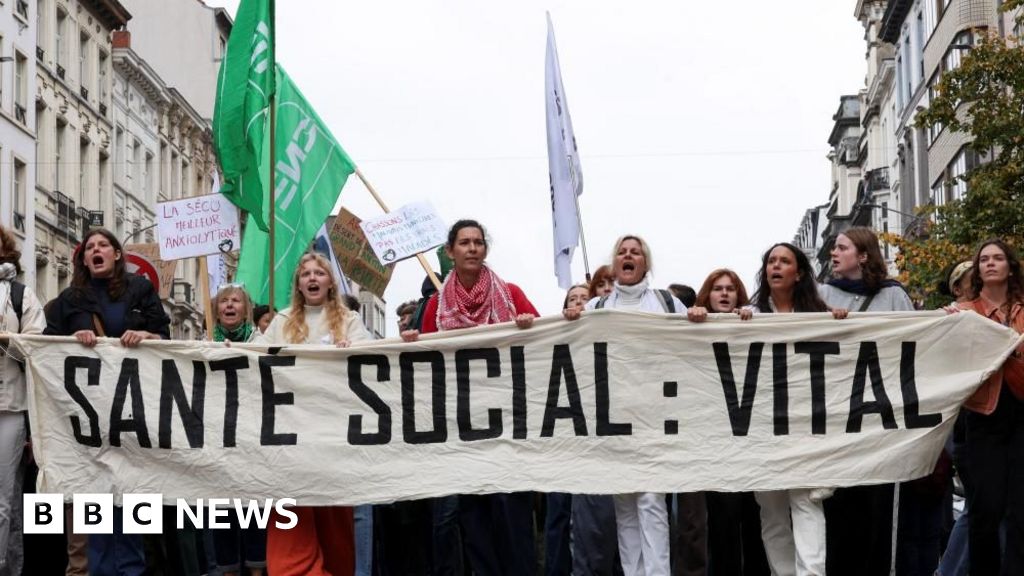
The aviation shutdown formed part of a broader national mobilization organized by Belgium's major trade unions, including the ABVV and ACV, protesting the federal government's budget deficit reduction targets. Prime Minister Bart De Wever has been locked in protracted talks to secure 10 billion euros in savings, facing fierce opposition over plans to alter pension eligibility and limit unemployment benefits.
Demonstrators flooded the streets of the capital, with police estimating that 80,000 protesters joined the central march, as reported by the BBC. The friction between labor groups and the center-right administration reflects deep political divisions following months of coalition negotiations.
Ground transport networks also suffered severe disruptions. In Brussels, local operator STIB reported that underground trains, trams, and buses ground to a halt or ran with severely limited frequencies. Regional bus services operated by De Lijn faced widespread timetable cuts, while maritime shipping at the port of Antwerp was suspended under similar understaffing pressures, leaving dozens of vessels waiting in the North Sea.
"The fight against the De Wever government is not just the fight of a day or a year - it's for a whole generation"
Thierry Bodson, ABVV union, via Belga news agency and BBC
Additional reactions captured by media outlets highlighted the widespread anxiety among citizens facing the economic squeeze. One protester, Anaïs, voiced frustration over retirement age changes, stating via the BBC: 65 is enough. 67 is too late. We are asked to work more, to work longer hours. It's not fair.
Another participant, Vanessa, expressed concern for her family's future, telling the BBC: I'm worried about the measures that will be taken. What sort of future will my children have?
The unrest extends beyond federal institutions. Regional authorities are also implementing austerity measures, adding to the pressure on public sector workers. Sandrine, an educator interviewed by the BBC, noted regarding proposed changes in Wallonia: Nothing is clear, and it's really worrying, but if higher-level teachers have to work more, many jobs will be cut.
Airlines and airport operators expressed frustration over the timing and coordination of the action. Brussels South Charleroi Airport criticized the walkout as a last-minute decision
that carried disastrous consequences
for thousands of travelers. Meanwhile, industry associations noted that the industrial action marked a continuation of frequent airspace disruptions over the preceding months, prompting renewed calls for minimum service standards during national strikes.
What to Watch Next
As recovery efforts begin, passengers and transit authorities are preparing for subsequent disruptions:
- Flight Resumption: Brussels Airport warned that the day following the strike would experience extreme congestion, advising travelers to check recommended arrival times closely.
- Further Protests: Trade unions have signaled that industrial opposition will continue if coalition budget talks proceed without concessions on pension reforms and purchasing power protections.


