Ukraine sinks Russian corvette Merkury off Libyan coast
Ukrainian forces used naval drones to sink a Russian warship near Benghazi, Libya, extending the maritime conflict far beyond the Black Sea.
Ukraine has claimed responsibility for sinking a Russian warship off Libya, extending the war with Russia into the Mediterranean and drawing a sharp warning from the Kremlin.
President Volodymyr Zelenskyy said Ukrainian forces deployed seven domestically made naval drones against two Russian vessels near the Libyan port of Benghazi on Sunday, sinking the corvette Merkury and striking the dry cargo vessel MV Angara, which Kyiv said was being used to transport weapons. A Ka-27 military helicopter aboard the corvette also went down, according to Ukraine's Security Service.
Media additions


The operation, carried out roughly 2,400 kilometres from the front line in Ukraine, marks the latest in a series of long-range strikes that have taken the maritime war far beyond the Black Sea. Zelenskyy described it as "an exemplary Ukrainian operation in response to Russia's war," adding that the targets set were achieved.
| Vessel | Flag / affiliation | Outcome | Source |
|---|---|---|---|
| Russian corvette Merkury | Russian Navy | Sunk; Ka-27 helicopter also destroyed | Zelenskyy via X; SBU |
| MV Angara | Russian dry cargo vessel | Struck; Kyiv says it transported weapons | Zelenskyy via X; SBU |
| Unnamed commercial vessel | Maltese flag | Targeted by sea drones off Benghazi | Libyan coast guard; Bangkok Post |
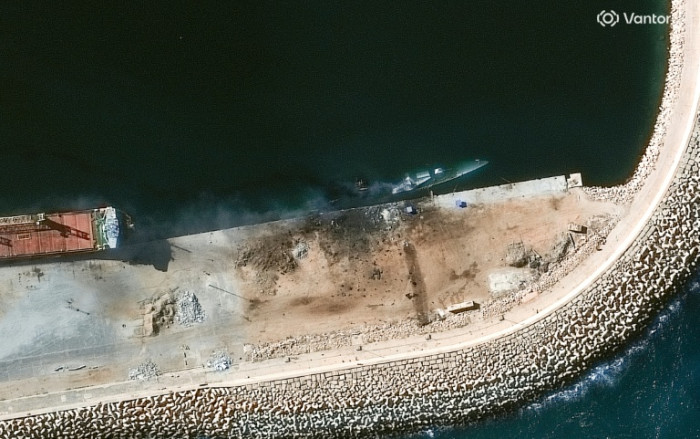
Satellite imagery reviewed by multiple outlets showed most of the corvette had capsized and sunk, with only its bow visible above water. Libyan authorities in the east said the vessel had docked at Benghazi for refuelling and resupply while returning to Russia under a cooperation agreement with the eastern-based administration.
The Kremlin responded on Monday with a warning of "highly painful consequences" for the Kyiv regime, according to Kremlin spokesman Dmitry Peskov. He declined to comment directly on the Libya strikes, saying the Defence Ministry was dealing with the matter and would provide information if deemed appropriate. Russia has not publicly confirmed the loss of the Merkury.
Libya's eastern administration condemned the attack as a violation of sovereignty and said it had requested an international investigation through the United Nations. Prime minister Osama Hamad called for an investigation into suspicions that the drones had been launched from western Libya, and for verification of the presence of Ukrainian experts in the country. The rival UN-recognised government in Tripoli said it was alarmed by "risks posed by involving civilian ports and facilities in activities linked to external conflicts."
The UN Support Mission in Libya expressed "serious concern" over the attacks, calling for "an immediate, independent and transparent investigation." UNSMIL wrote on X that "Libya cannot afford, and must not become a battleground for foreign conflicts."
Albania on Monday denied any involvement in the attack, rejecting reports that the operation originated from its territory. The Albanian foreign ministry said the reports were "inaccurate" and did not reflect the facts, adding that Albania's territory was neither used nor made available for the launch or facilitation of such an attack.
Ukraine's SBU said the Merkury "regularly escorted enemy maritime convoys" and was part of Russia's Black Sea Fleet. The service described the operation as unique, saying the drones were delivered to a designated location and launched from a so-called mothership near the target. Russian defences tried from air, sea and land to hit the attacking drones, the SBU added.
Libyan officials briefed on the attack told The Associated Press that at least four drones were intercepted while two hit the corvette, which is designed to patrol coastal waters and escort other ships. At least 10 people, including Libyan and Russian nationals, were wounded in the attack, one official said. The local health ministry said it had received injured people from a commercial ship targeted off the coast, though it was not clear whether this was the same vessel Ukraine claimed to have struck.
The strikes come amid an intensifying Ukrainian campaign targeting Russian naval assets, energy infrastructure and vessels linked to Moscow's so-called shadow fleet, which helps Russia circumvent Western sanctions. In March, a Russian liquefied natural gas carrier sank off the Libyan coast following an attack that Russian President Vladimir Putin blamed on Ukraine. In December 2025, Ukraine claimed responsibility for striking a Russian-linked oil tanker in the Mediterranean.
A day before the Libya strikes, a Russian cargo ship, the Sparta II, was struck by drones in the Gulf of Finland. The vessel caught fire and drifted into Finnish waters, with all 16 crew members evacuated and one slightly injured. Finland said Ukraine was likely behind the attack; Kyiv has not publicly claimed responsibility.
Academic Alexey D Muraviev, senior research fellow in defence and strategic studies at Edith Cowan University, told Al Jazeera that the Mediterranean has firmly become an external theatre of operations, particularly maritime operations. He said the vessels targeted in Libyan and Finnish territories were likely involved in transporting military equipment or other supplies to Africa, potentially supporting Russia's Africa Corps, which operates alongside Moscow-aligned governments.
Muraviev warned that the Gulf of Finland was particularly sensitive because of its geography and the proximity of Russian and NATO forces, saying that in his personal view it was an area where a possible clash between Russia and NATO was quite possible. He added that the attacks could have wider implications for global shipping, which is already facing heightened security threats around the Strait of Hormuz and Bab al-Mandeb.
The sinking of the Merkury, commissioned in 2023, would also weaken Russia's naval capabilities, Muraviev said. Ukraine has previously claimed to have destroyed the Russian landing ship Caesar Kunikov with naval drones off the coast of Crimea in 2024.
Ukraine's defence forces have once again shown that the Russian navy and its logistics have no safe routes, even far beyond the Black Sea, which borders both Russia and Ukraine, the SBU said.
What to watch next
- The UN investigation into the Benghazi attacks, requested by Libya's eastern administration and called for by UNSMIL.
- Russia's promised response, with the Defence Ministry expected to provide information on the strikes.
- Further Ukrainian operations in designated maritime areas, as signalled by Zelenskyy.
- NATO consultations on recent Russian violations of Polish airspace, taking place during regular meetings in Brussels.
Libya has been divided between the government in Tripoli and a rival administration in the east since the overthrow of longtime ruler Muammar Gaddafi in 2011. In September, Libya denied reports by CNN that it allowed Ukraine to use a military base in the northwest of the country to launch drones against vessels from Russia's shadow fleet in the Mediterranean.
The war in Ukraine, which began with Moscow's full-scale invasion in 2022, has killed hundreds of thousands of people and displaced millions. Sunday's strikes demonstrate that the conflict is increasingly being fought across the world, not only on Ukrainian soil.