US military launches seventh night of strikes on Iranian infrastructure
US forces have expanded aerial operations targeting Iranian military assets near the Strait of Hormuz amid a widening regional conflict. Neighboring nations report retaliatory strikes, prompting regional infrastructure damage and a rise in global oil prices.
- Core Development: US forces have expanded aerial operations targeting Iranian military assets near the Strait of Hormuz amid a widening regional conflict. Neighboring nations report retaliatory strikes, prompting regional infrastructure damage and a rise in global oil prices.
- Beat Context: Categorized under Transport with independent corroboration.
- Reporting Depth: 3 minute analytical read synthesized from verified newsroom sources.
The United States military completed its seventh consecutive night of strikes against Iran on Saturday, 18 July 2026, according to US Central Command. Operations utilized fighter aircraft, aerial drones, warships, and other assets to target military logistics infrastructure, surveillance sites, underground weapons storage, and maritime capabilities. The campaign, directed by the US Commander in Chief, concluded its latest round of strikes at 9:30 pm ET on 17 July 2026. CENTCOM maintains that more than 50,000 American service members remain deployed across the region, describing its forces as vigilant, lethal, and ready.
Strikes targeted bridges, railway links, and port facilities, resulting in disruptions to transport routes between Bandar Abbas and other areas. US forces also destroyed a maritime surveillance tower at Shahid Kalantari Port in Chabahar on 16 July 2026. The US military identified the tower as a component of a network used by the Islamic Revolutionary Guard Corps (IRGC) to track and target commercial vessels. Iranian officials asserted the structure was utilized for civilian navigation and local fishermen.
Media additions

Regional Retaliation
The conflict has expanded across the Middle East as Iran and its regional affiliates launched retaliatory missile and drone attacks. On 18 July 2026, Kuwait reported that Iranian strikes damaged power and water desalination facilities, leading to the deactivation of several power generation units. The Kuwait Fire Force confirmed that several firefighters and a worker were injured while responding to these incidents. Separately, the Kuwaiti military reported that explosions were caused by its air defence systems intercepting hostile targets. In Bahrain, the military confirmed its air defences intercepted a wave of Iranian attacks on 18 July 2026.
Jordan reported the interception of 10 missiles, while the IRGC claimed attacks against fuel tanks at the Al-Azraq Air Base. Meanwhile, in Iraq, coalition forces intercepted explosive-laden drones over Erbil. The IRGC issued a warning to countries hosting US forces, stating that such nations should expect corresponding responses
if their territory is utilized for operations against Iran. Iranian state media also reported additional explosions across central and southern regions, including near Ahvaz, Lar, Yazd, and Sirik.
Maritime and Energy Impacts
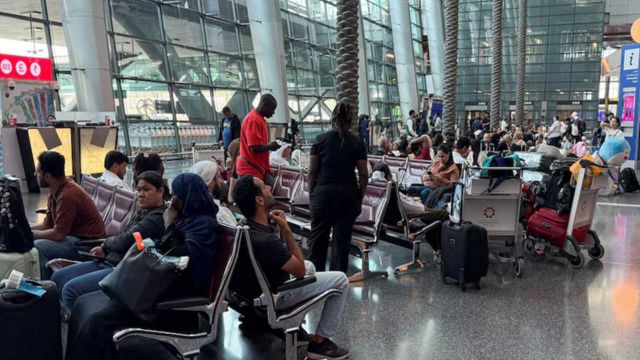
Control of the Strait of Hormuz remains a central driver of the conflict. As tensions persist, the US Department of State issued a fresh Travel advisory urging American citizens to reconsider travel across the Middle East, citing a volatile security environment. The advisory suggests that citizens monitor news for breaking developments and confirm flight schedules, as regional hostilities may disrupt commercial transportation.
Amid the disruption to shipping, Pakistan announced that petroleum prices will be revised on a daily basis to mitigate market fluctuations.
Internal Tensions and Future Outlook
Internal friction within Iran has intensified following a move toward a US-brokered ceasefire. Hardline factions have accused the country’s civilian leadership of orchestrating a soft coup,
arguing that the agreement betrays revolutionary ideals. Seyed Majid Mousavi, commander of the IRGC Aerospace Force, stated that attacks will continue until calm returns to the southern coastline and the Strait of Hormuz.
Conversely, international leaders from Germany and France have urged Tehran to return to negotiations and avoid further escalation. CENTCOM denies claims regarding the death or capture of US troops in the region. As the seventh night of strikes concludes, the security situation remains fluid, with ongoing military operations and regional countermeasures expected to influence the trajectory of the confrontation.
How significant is this development?
Contribute your assessment to the aggregated reader sentiment ledger.
Frequently Asked Questions
Key questions answered in this reportWhat is the key development in: US military launches seventh night of strikes on Iranian infrastructure?
US forces have expanded aerial operations targeting Iranian military assets near the Strait of Hormuz amid a widening regional conflict. Neighboring nations report retaliatory strikes, prompting regional infrastructure damage and a rise in global oil prices.
Why is this Transport development significant for the UK?
This report covers critical events in our Transport beat. Independent reporting monitors related UK statements, regulatory shifts, and public responses as further verified details emerge.
How was this reporting corroborated and verified?
Newsarchy UK compiles and cross-references reporting from primary reporting from moneycontrol.com and cross-checked wire reports. All coverage adheres to published editorial standards.
When was this report published?
This briefing was published on July 18, 2026 and is permanently cataloged in the Newsarchy UK Transport archives.